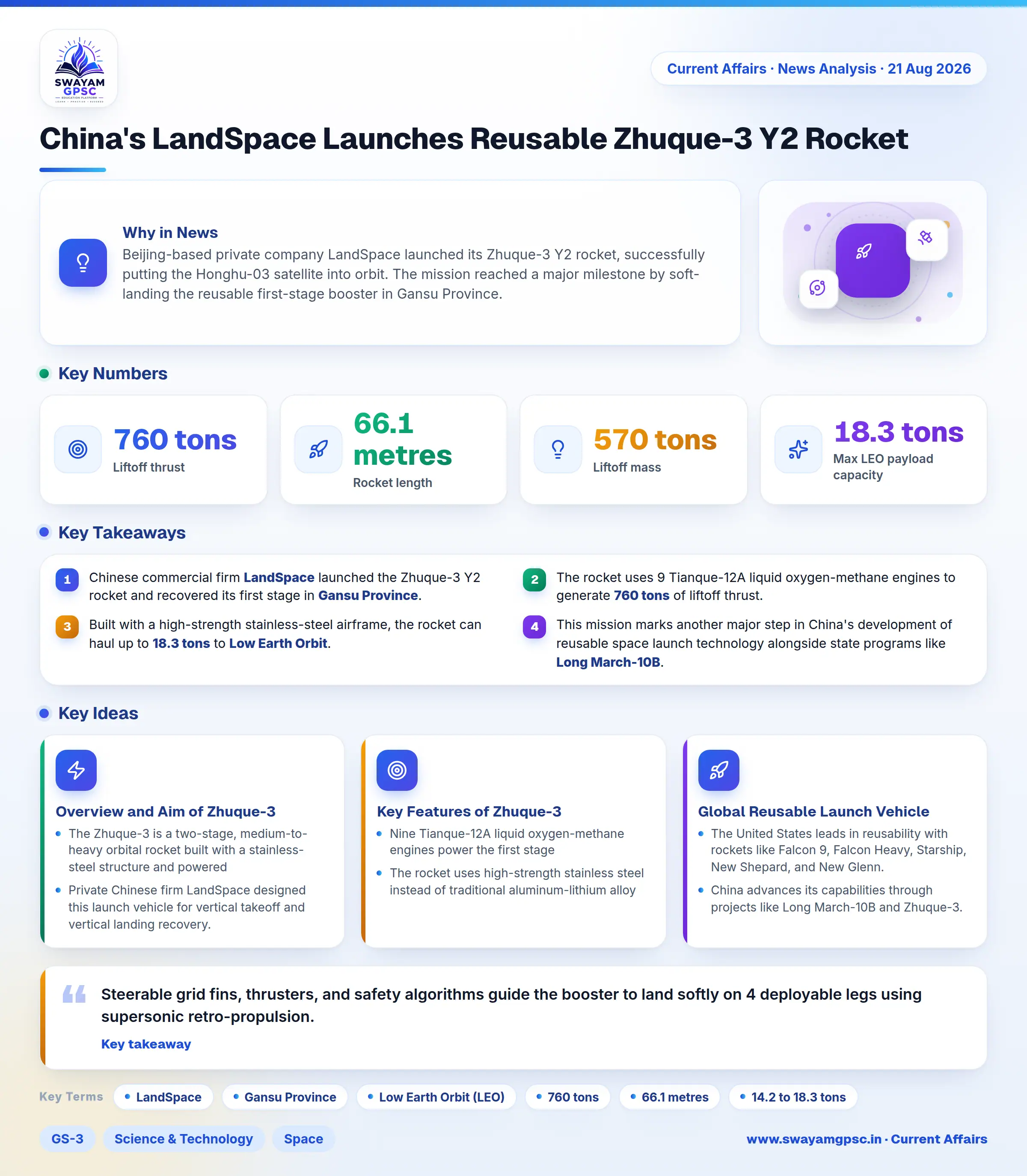
China's LandSpace Launches Reusable Zhuque-3 Y2 Rocket
#GS-3 #Science & Technology #Space #GS-2 #Current Events #International #Reusable Launch Vehicle #LandSpace #China
Key takeaways
- Chinese commercial firm LandSpace launched the Zhuque-3 Y2 rocket and recovered its first stage in Gansu Province.
- The rocket uses 9 Tianque-12A liquid oxygen-methane engines to generate 760 tons of liftoff thrust.
- Built with a high-strength stainless-steel airframe, the rocket can haul up to 18.3 tons to Low Earth Orbit.
- This mission marks another major step in China's development of reusable space launch technology alongside state programs like Long March-10B.
Why in News
- Beijing-based private company LandSpace launched its Zhuque-3 Y2 rocket, successfully putting the Honghu-03 satellite into orbit.
- The mission reached a major milestone by soft-landing the reusable first-stage booster in Gansu Province.
Overview and Aim of Zhuque-3
- The Zhuque-3 is a two-stage, medium-to-heavy orbital rocket built with a stainless-steel structure and powered by liquid oxygen-methane fuel.
- Private Chinese firm LandSpace designed this launch vehicle for vertical takeoff and vertical landing recovery.
- The project aims to lower space transportation costs by reusing the expensive first stage multiple times.
- This cost-effective model supports the rapid deployment of large satellite internet constellations in Low Earth Orbit (LEO).
Key Features of Zhuque-3
- Nine Tianque-12A liquid oxygen-methane engines power the first stage, generating more than 760 tons of liftoff thrust while burning clean without heavy soot.
- The rocket uses high-strength stainless steel instead of traditional aluminum-lithium alloy, offering superior heat resistance and lower manufacturing costs.
- It measures 66.1 metres in length and 4.5 metres in diameter, with a total liftoff mass of 570 tons.
- The vehicle can carry up to 14.2 to 18.3 tons of payload to Low Earth Orbit in expendable mode.
- Steerable grid fins, thrusters, and safety algorithms guide the booster to land softly on 4 deployable legs using supersonic retro-propulsion.
- This flight is China's second major booster recovery success, following the state-owned Long March-10B sea recovery effort.
Global Reusable Launch Vehicle Programmes
- The United States leads in reusability with rockets like Falcon 9, Falcon Heavy, Starship, New Shepard, and New Glenn.
- China advances its capabilities through projects like Long March-10B and Zhuque-3.
- India builds its reusable technology through ISRO flight tests such as RLV-TD and RLV-LEX.
- Europe develops reusable rocket components through the European Space Agency Themis programme.
- Japan tests reusable launch concepts under the JAXA CALLISTO project.