China's Export Controls: Strategic Impact on India
#GS-2 #Current Events #International #GS-3 #Economy #Infrastructure #Science & Technology #Defence #India and its Neighbourhood #Supply Chain Security
Key takeaways
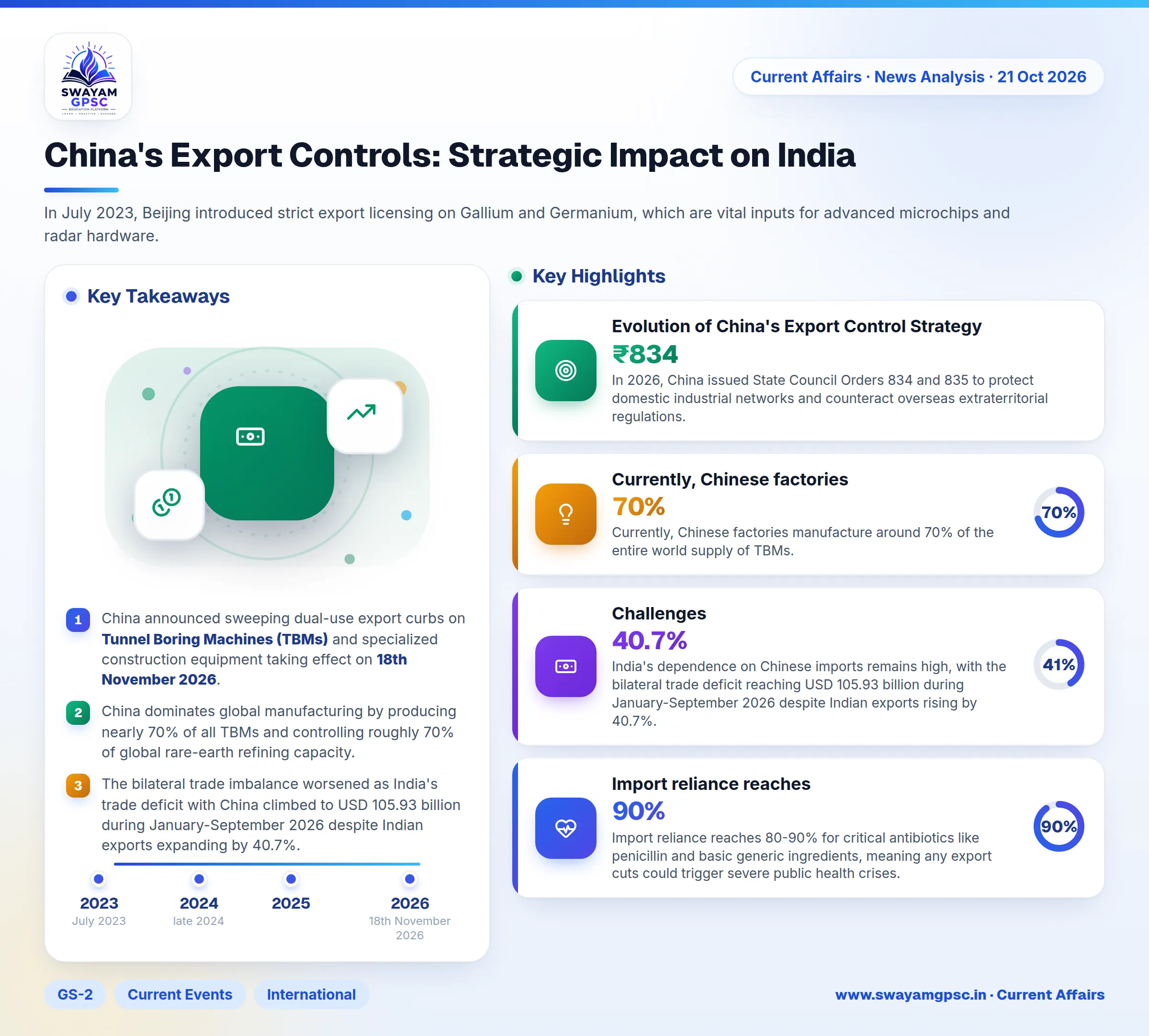
- China announced sweeping dual-use export curbs on Tunnel Boring Machines (TBMs) and specialized construction equipment taking effect on 18th November 2026.
- China dominates global manufacturing by producing nearly 70% of all TBMs and controlling roughly 70% of global rare-earth refining capacity.
- The bilateral trade imbalance worsened as India's trade deficit with China climbed to USD 105.93 billion during January-September 2026 despite Indian exports expanding by 40.7%.
- India remains heavily dependent on China for healthcare, importing about 70% of its Active Pharmaceutical Ingredients (APIs) and up to 80-90% of key antibiotic raw materials.
- To counter supply risks, India is deploying the National Critical Mineral Mission (NCMM) and the Battery Waste Management Rules, 2022 to expand local processing and circular recycling.
Why in News
- China announced new export restrictions on heavy industrial equipment, such as Tunnel Boring Machines (TBMs), walking excavators, and specialized shotcrete machines.
- These curbs take effect on 18th November 2026 under a dual-use licensing regime driven by national security considerations.
- This decision demonstrates how Beijing is expanding supply-chain curbs beyond raw critical minerals into complex industrial machinery, directly threatening India's infrastructure development and supply stability.
Summary of the Situation
- China's export restrictions show that global trade networks are being turned into weapons, threatening Indian infrastructure projects, military readiness, generic medicines, and clean energy goals.
- India can build supply-chain resilience by boosting domestic manufacturing, developing critical mineral refining units, capturing investments via the China Plus One approach, and expanding international recycling partnerships.
Evolution of China's Export Control Strategy
- China passed the Export Control Law in late 2020 to replace informal trade bans with a statutory framework under a unified national security mandate.
- In July 2023, Beijing introduced strict export licensing on Gallium and Germanium, which are vital inputs for advanced microchips and radar hardware.
- In October 2023, authorities placed export controls on Graphite, an essential component for Electric Vehicle (EV) battery anodes.
- By late 2023, China updated its technology export catalogue to ban the transfer of processing know-how for rare-earth extraction, separation, and magnet production.
- By late 2024, export curbs expanded to Antimony, which is critical for military munitions and solar hardware, followed by a total ban on deliveries to American defense buyers.
- Throughout 2025, Beijing expanded licensing rules to include medium and heavy rare earths, deliberately targeting international clean energy and military supply chains.
- In 2026, China issued State Council Orders 834 and 835 to protect domestic industrial networks and counteract overseas extraterritorial regulations.
- These new state orders can trap multinational companies between conflicting regulatory systems across Western and Chinese jurisdictions.
- China proposed new export curbs on 40 cutting-edge technologies in 2026, covering 23 artificial intelligence platforms, 12 photovoltaic systems, and five biotechnology applications.
- These proposed limits focus on semiconductor design, advanced AI software, polysilicon processing, and advanced solar cells, raising serious technology access worries worldwide.
- In October 2026, Beijing moved beyond minerals to restrict heavy machinery like TBMs, dredging parts, and alpine excavators to hurt rivals' infrastructure capabilities.
- Currently, Chinese factories manufacture around 70% of the entire world supply of TBMs.
Strategic Objectives Behind the Curbs
- These export curbs act as asymmetric retaliation against Western embargoes on cutting-edge microchips and Extreme Ultraviolet (EUV) lithography systems.
- While Western powers restrict access to proprietary software and microchips, China weaponizes its control over physical raw materials and heavy equipment.
- China processes nearly 70% of all refined rare-earth elements globally, giving it immense leverage over global manufacturing.
- By blocking technology exports alongside raw minerals, Beijing ensures other countries cannot easily build competing domestic processing facilities.
- Through these actions, China strengthens its manufacturing dominance and stops rival nations from building independent supply networks.
- By restricting materials abroad, Beijing forces downstream electronics and battery manufacturers to move their factories into China to secure inputs.
- These restrictions prove that owning foreign intellectual property offers little protection if the production plant sits inside Chinese territory.
- Since 2024, Chinese customs authorities have repeatedly stopped exports of TBMs manufactured by German firm Herrenknecht at its Chinese plant for Indian projects.
Challenges
- India's dependence on Chinese imports remains high, with the bilateral trade deficit reaching USD 105.93 billion during January-September 2026 despite Indian exports rising by 40.7%.
- Flagship Indian infrastructure ventures like the Mumbai-Ahmedabad High-Speed Rail Corridor rely on 3,000-tonne TBMs, and licensing delays threaten major cost and schedule overruns.
- Restricting wet shotcrete machines and alpine excavators directly slows down India's strategic road and rail tunnels across sensitive Himalayan border zones.
- India imports around 70% of its Active Pharmaceutical Ingredients (APIs) from China, exposing its pharmaceutical industry to major supply disruptions.
- Import reliance reaches 80-90% for critical antibiotics like penicillin and basic generic ingredients, meaning any export cuts could trigger severe public health crises.
- Disruptions in electronic components and solar supplies threaten India's green targets, as it imports over 75% of electronic parts and 80% of solar panels from China.
- Tight curbs on NdFeB permanent magnets, antimony, and graphite directly endanger India's domestic electric vehicle manufacturing and decarbonization plans.
- Military modernization faces severe risks because modern radars require gallium, while night-vision systems and specialized armor-piercing munitions rely heavily on antimony.
- Trade tensions between the two nations escalated when India launched 18 anti-dumping probes in the July-September 2026 quarter alone, focusing primarily on Chinese goods.
- India faces an artificial intelligence squeeze between Western hardware restrictions and Chinese software controls, raising data security and system privacy concerns.
Way Forward
- The government must urgently execute the National Critical Mineral Mission (NCMM) to speed up local exploration, extraction, and mineral refining across the country.
- India needs to expand Production Linked Incentive (PLI) schemes into heavy engineering to manufacture indigenous tunnel boring machines and border construction machinery.
- Policymakers must fund domestic solvent extraction and hydrometallurgical refining plants through public-private partnerships to overcome midstream dependence on Chinese processing.
- India should use its updated Press Note 3 framework, which allows 10% non-controlling foreign investments via the automatic route, to attract overseas manufacturing joint ventures.
- Multinational equipment makers like Herrenknecht are expanding production sites in India, creating prime opportunities to acquire critical machinery technology.
- India must deepen friend-shoring partnerships by engaging actively in the Minerals Security Partnership (MSP) and leveraging the Quad grouping for critical technology sharing.
- Enforcing the Battery Waste Management Rules, 2022 and Extended Producer Responsibility will help recover high-value minerals from e-waste through domestic recycling.
Conclusion
- China's export restrictions confirm that global supply chains have become instruments of geopolitical rivalry and economic leverage.
- These restrictions create immediate challenges for Indian projects, but they offer India a strong incentive to build self-reliant domestic manufacturing and secure trade partnerships.
Key Conceptual Questions
- China's new machinery controls announced in October 2026 place dual-use export permits on TBMs, wet shotcrete systems, and specialized excavators starting 18th November 2026.
- Tunnel Boring Machines are essential for building high-speed rail lines, city metro networks, and high-altitude Himalayan military supply tunnels.
- The National Critical Mineral Mission (NCMM) works to build an end-to-end mineral supply chain through exploration, refining, overseas mining acquisitions, and recycling.
- The China Plus One strategy allows India to attract global supply chain investments, provided it maintains reliable domestic policies and modern infrastructure.
- Under the Battery Waste Management Rules, 2022, mandated producer recycling helps extract valuable metals from discarded batteries, decreasing mineral import dependence.