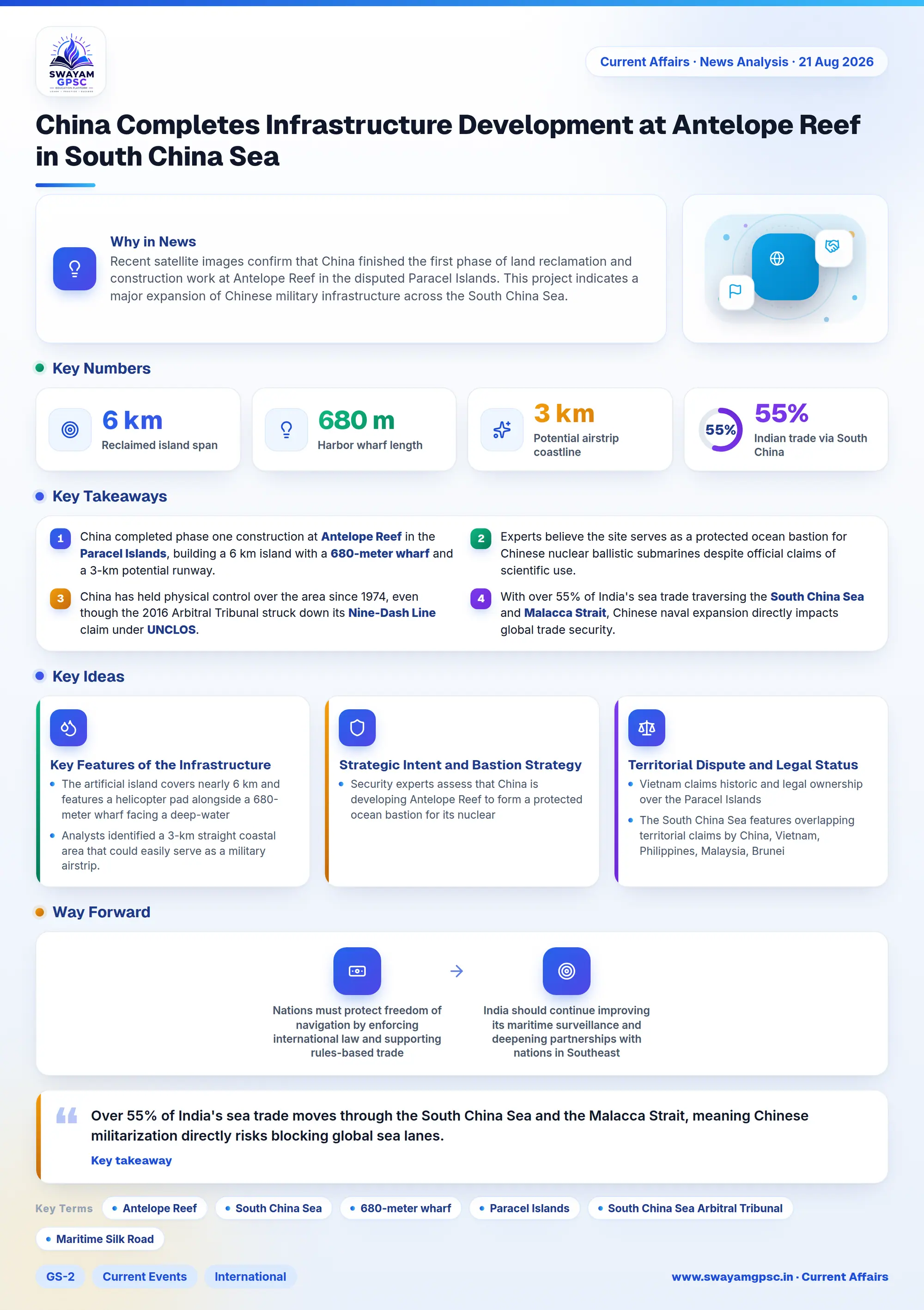
China Completes Infrastructure Development at Antelope Reef in South China Sea
#GS-2 #Current Events #International #GS-3 #Economy #Infrastructure #Maritime Security #South China Sea #Geopolitics
Key takeaways
- China completed phase one construction at Antelope Reef in the Paracel Islands, building a 6 km island with a 680-meter wharf and a 3-km potential runway.
- Experts believe the site serves as a protected ocean bastion for Chinese nuclear ballistic submarines despite official claims of scientific use.
- China has held physical control over the area since 1974, even though the 2016 Arbitral Tribunal struck down its Nine-Dash Line claim under UNCLOS.
- With over 55% of India's sea trade traversing the South China Sea and Malacca Strait, Chinese naval expansion directly impacts global trade security.
Why in News
- Recent satellite images confirm that China finished the first phase of land reclamation and construction work at Antelope Reef in the disputed Paracel Islands.
- This project indicates a major expansion of Chinese military infrastructure across the South China Sea.
Key Features of the Infrastructure
- The artificial island covers nearly 6 km and features a helicopter pad alongside a 680-meter wharf facing a deep-water harbor.
- Analysts identified a 3-km straight coastal area that could easily serve as a military airstrip.
- China has not publicly acknowledged building a military base, claiming the site serves civilian purposes like weather tracking and scientific research.
Strategic Intent and Bastion Strategy
- Security experts assess that China is developing Antelope Reef to form a protected ocean bastion for its nuclear ballistic missile submarines against American and Vietnamese forces.
Territorial Dispute and Legal Status
- Vietnam claims historic and legal ownership over the Paracel Islands, but China has maintained control since 1974 after taking them by force during the Battle of Paracel Islands.
- The South China Sea features overlapping territorial claims by China, Vietnam, Philippines, Malaysia, Brunei, and Taiwan.
- In 2016, the South China Sea Arbitral Tribunal rejected China's Nine-Dash Line, ruling that historic claims outside UNCLOS rules are illegal.
Strategic Impact on India
- Over 55% of India's sea trade moves through the South China Sea and the Malacca Strait, meaning Chinese militarization directly risks blocking global sea lanes.
- A stronger Chinese navy supports its Maritime Silk Road initiative, allowing China to project force into the Indian Ocean Region and challenge India's security role.
Way Forward
- Nations must protect freedom of navigation by enforcing international law and supporting rules-based trade corridors in the South China Sea.
- India should continue improving its maritime surveillance and deepening partnerships with nations in Southeast Asia to secure vital sea routes.