China's Announcement No. 48: Tech Export Restrictions and Impacts on India
#GS-2 #Current Events #International #GS-3 #Economy #Infrastructure #Science & Technology #Artificial Intelligence #Environment #Climate Change #China Tech Restrictions #Solar Energy #Biomedicine
Key takeaways
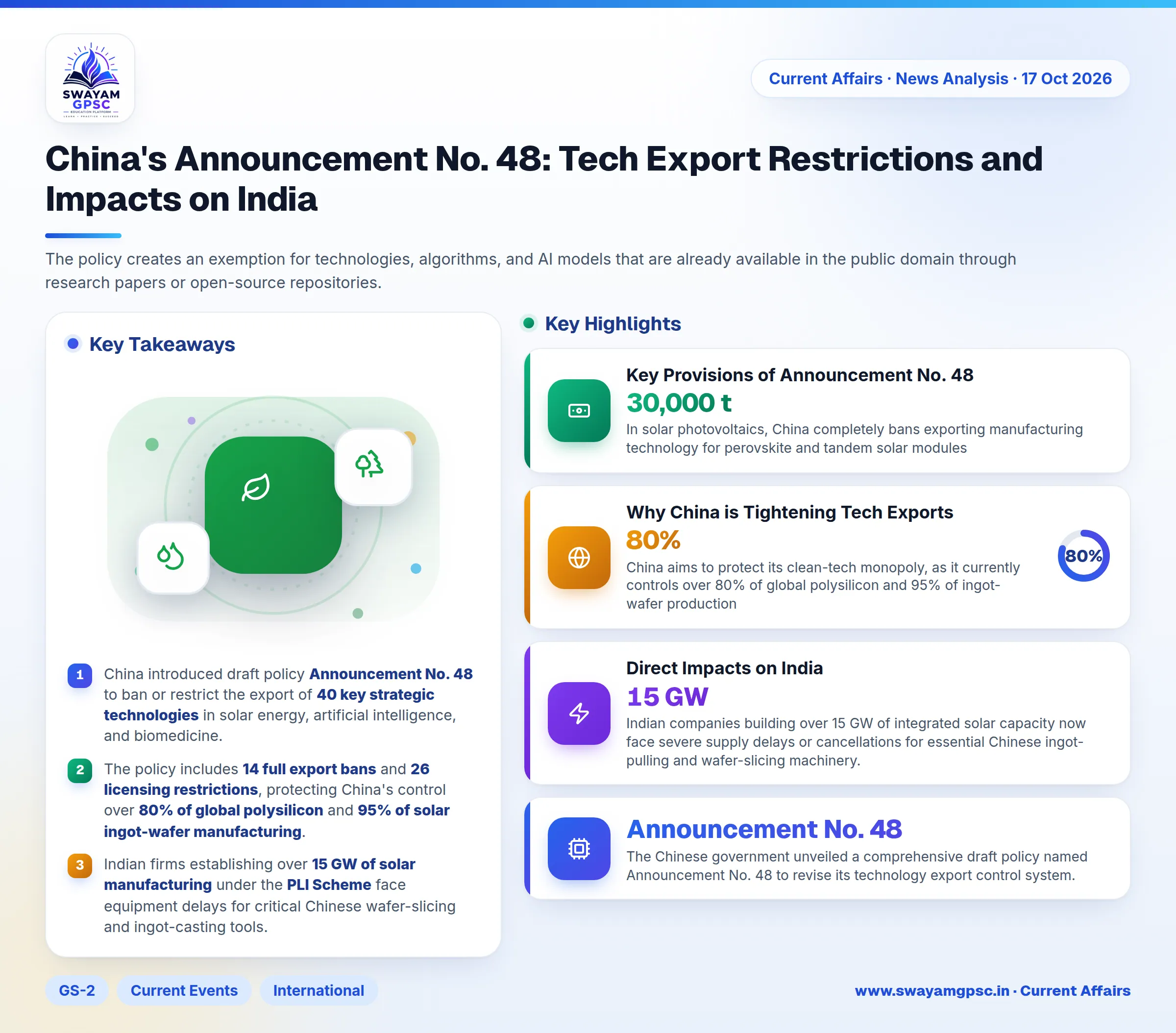
- China introduced draft policy Announcement No. 48 to ban or restrict the export of 40 key strategic technologies in solar energy, artificial intelligence, and biomedicine.
- The policy includes 14 full export bans and 26 licensing restrictions, protecting China's control over 80% of global polysilicon and 95% of solar ingot-wafer manufacturing.
- Indian firms establishing over 15 GW of solar manufacturing under the PLI Scheme face equipment delays for critical Chinese wafer-slicing and ingot-casting tools.
- To counter these controls, India must expand its PLI Scheme to build heavy manufacturing machinery and partner with Quad nations for alternative clean energy tech.
Why in News
- The Chinese government unveiled a comprehensive draft policy named Announcement No. 48 to revise its technology export control system.
- This proposed regulation aims to either completely ban or strictly control the export of 40 cutting-edge strategic technologies across artificial intelligence, solar photovoltaics, and biomedicine.
What is China's Announcement No. 48?
- Announcement No. 48 is China's draft reform to overhaul its outbound technology control framework, covering 40 strategic technological domains.
- The policy divides these fields into 14 outright export bans and 26 conditional restrictions that require state licensing to protect national security and industrial advantage.
Key Provisions of Announcement No. 48
- The policy regulates 40 high-tech fields, splitting them into 14 full export bans and 26 restricted categories requiring special government licenses.
- In solar photovoltaics, China completely bans exporting manufacturing technology for perovskite and tandem solar modules, while restricting large-scale polysilicon production lines with capacities above 30,000 tonnes per year alongside advanced wafer-slicing tech.
- In artificial intelligence, it prohibits exports of autonomous malicious cyber code while restricting large foundation model parameters, multi-modal agents, specialized compute cluster controls, and chip design frameworks.
- In biomedicine, it forbids transferring specific gene editing systems and autologous cell therapy pipelines, while setting strict license hurdles for small nucleic-acid treatments.
- The policy creates an exemption for technologies, algorithms, and AI models that are already available in the public domain through research papers or open-source repositories.
Why China is Tightening Tech Exports
- China aims to protect its clean-tech monopoly, as it currently controls over 80% of global polysilicon and 95% of ingot-wafer production, preventing global competitors from building complete factories.
- The country seeks to address dual-use security concerns, because advanced ultra-light solar panels are critical for satellite power, high-altitude pseudo-satellites, and military drones.
- It serves as a retaliatory defense against strict Western sanctions that restrict China's access to advanced semiconductor lithography and memory chips.
- It aims to prevent automated cyber threats by stopping the export of self-modifying AI code that could attack critical national infrastructure or bypass state firewalls.
Direct Impacts on India
- The restrictions disrupt India's upstream solar manufacturing goals under the Production Linked Incentive (PLI) Scheme, which seeks to shift local firms from basic assembly to full polysilicon manufacturing.
- Indian companies building over 15 GW of integrated solar capacity now face severe supply delays or cancellations for essential Chinese ingot-pulling and wafer-slicing machinery.
- India's policy shift in early 2026 to ease Press Note 3 restrictions for faster Chinese investments in solar equipment becomes ineffective if Chinese authorities block export licenses.
- Proposed joint ventures and technical licensing deals between major Indian groups and top Chinese solar firms are stalling during compliance reviews by China's Ministry of Commerce.
- Indian solar producers risk staying trapped in older silicon technology like TOPCon and PERC, while getting cut off from highly efficient perovskite-tandem cells.
- Indian biotechnology research faces delays in clinical trials for biosimilar gene therapies due to supply chain disruption in licensed genetic vector platforms from East Asia.
Challenges
- India suffers from an asymmetric dependency on specialized capital machinery like high-capacity wire saws and quartz crucibles, which have no commercial alternatives outside China.
- Blocking technical know-how raises the financial cost of setting up solar factories worldwide, increasing capital expenses and inflating green energy transition costs for developing nations.
- Technological standards are splitting into separate Western and Chinese ecosystems across AI model parameters and biomedical platforms.
- India's domestic localization targets, which require three independent local firms to achieve operational scale, are now exposed to strategic technological chokeholds.
- Indian solar module assemblers remain dependent on imported silicon cells due to operational delays in domestic upstream wafer-ingot production lines.
Way Forward
- India should form technology procurement partnerships with Germany, Japan, and the United States through Quad Clean Energy initiatives to develop alternative ingot and wafer machinery.
- The government should launch a dedicated research mission under the National Solar Mission using laboratories like CSIR-NPL and IITs to indigenously develop commercial perovskite-silicon tandem cells.
- India needs to expand its PLI Scheme framework beyond finished solar components to directly subsidize domestic manufacturing of heavy machinery, diamond-wire saws, and chemical purification reactors.
- The country should utilize the public domain exemption of Announcement No. 48 by deploying the IndiaAI Mission compute clusters to train sovereign AI models using open-source data.
Conclusion
- China's policy shift shows a strategic turn from exporting finished green products to guarding the essential manufacturing machinery that produces them.
- True strategic autonomy for India requires ending reliance on imported kit assembly and foreign technology licenses.
- Accelerating local innovation in heavy machinery, materials science, and next-generation solar tech is crucial for India's clean energy independence and long-term technological security.