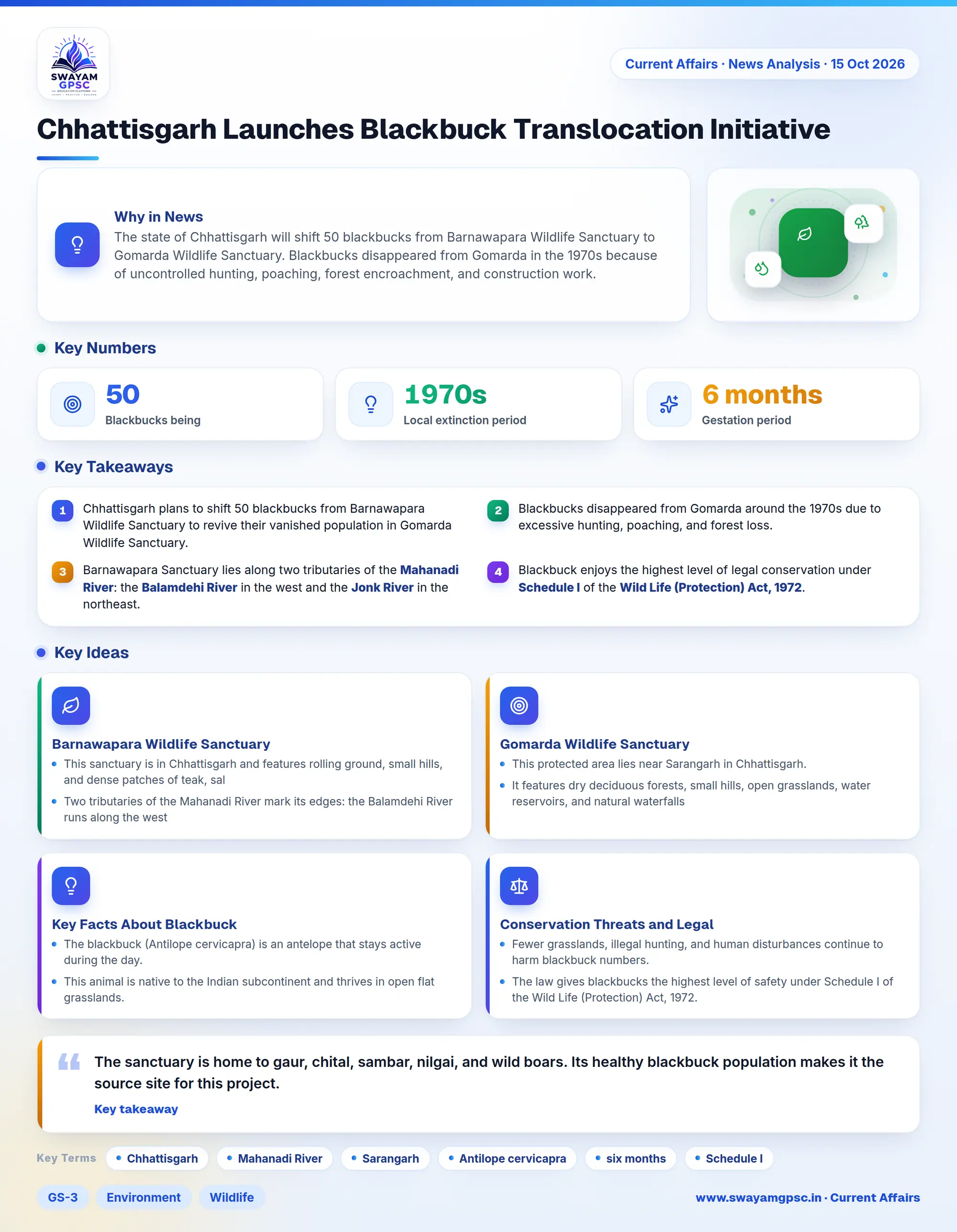
Chhattisgarh Launches Blackbuck Translocation Initiative
#GS-3 #Environment #Wildlife #Biodiversity #Current Events #National
Key takeaways
- Chhattisgarh plans to shift 50 blackbucks from Barnawapara Wildlife Sanctuary to revive their vanished population in Gomarda Wildlife Sanctuary.
- Blackbucks disappeared from Gomarda around the 1970s due to excessive hunting, poaching, and forest loss.
- Barnawapara Sanctuary lies along two tributaries of the Mahanadi River: the Balamdehi River in the west and the Jonk River in the northeast.
- Blackbuck enjoys the highest level of legal conservation under Schedule I of the Wild Life (Protection) Act, 1972.
Why in News
- The state of Chhattisgarh will shift 50 blackbucks from Barnawapara Wildlife Sanctuary to Gomarda Wildlife Sanctuary.
- Blackbucks disappeared from Gomarda in the 1970s because of uncontrolled hunting, poaching, forest encroachment, and construction work.
Barnawapara Wildlife Sanctuary
- This sanctuary is in Chhattisgarh and features rolling ground, small hills, and dense patches of teak, sal, and mixed forests.
- Two tributaries of the Mahanadi River mark its edges: the Balamdehi River runs along the west, and the Jonk River flows on the north-east.
- The sanctuary is home to gaur, chital, sambar, nilgai, and wild boars. Its healthy blackbuck population makes it the source site for this project.
Gomarda Wildlife Sanctuary
- This protected area lies near Sarangarh in Chhattisgarh.
- It features dry deciduous forests, small hills, open grasslands, water reservoirs, and natural waterfalls, which offer ideal conditions for blackbuck revival.
Key Facts About Blackbuck
- The blackbuck (Antilope cervicapra) is an antelope that stays active during the day. Male blackbucks stand out due to their twisted spiral horns and dark upper coat.
- This animal is native to the Indian subcontinent and thrives in open flat grasslands. It mostly eats grass, but feeds on leaves and shrubs when grass becomes scarce.
- Female blackbucks have a pregnancy period of around six months and can give birth at any time of the year.
Conservation Threats and Legal Protection
- Fewer grasslands, illegal hunting, and human disturbances continue to harm blackbuck numbers. Stray dogs and jackals frequently attack and kill young fawns.
- The law gives blackbucks the highest level of safety under Schedule I of the Wild Life (Protection) Act, 1972.