CERVAVAC Becomes India's First WHO-Prequalified Indigenous HPV Vaccine
#Health #Government Policies & Interventions #Biotechnology #Achievements of Indians in Science & Technology #GS-2 #Governance & Social Justice #GS-3 #Science & Technology
Key takeaways
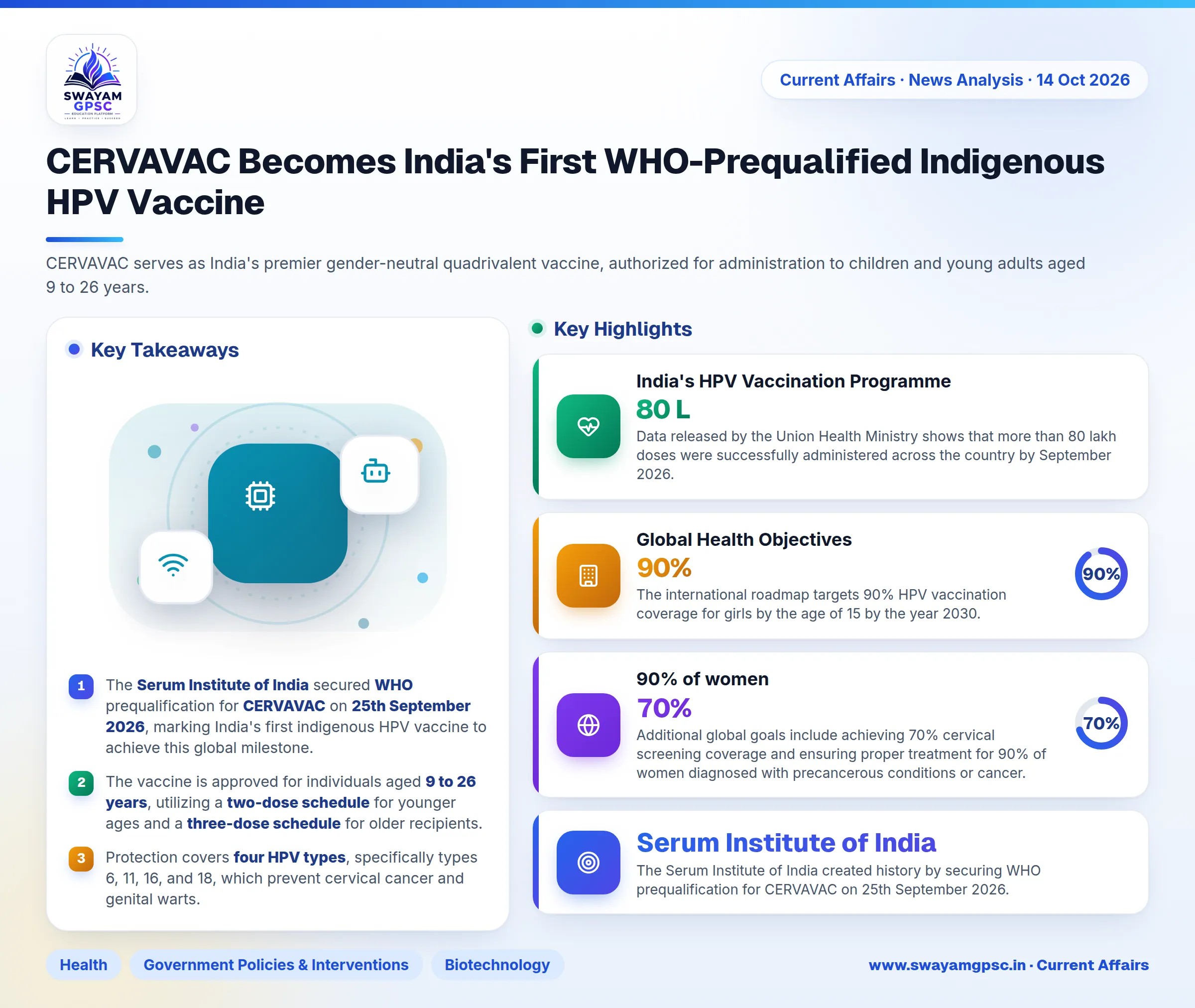
- The Serum Institute of India secured WHO prequalification for CERVAVAC on 25th September 2026, marking India's first indigenous HPV vaccine to achieve this global milestone.
- The vaccine is approved for individuals aged 9 to 26 years, utilizing a two-dose schedule for younger ages and a three-dose schedule for older recipients.
- Protection covers four HPV types, specifically types 6, 11, 16, and 18, which prevent cervical cancer and genital warts.
- More than 80 lakh doses were administered across India under the national immunization program by September 2026.
- Founded in 1966 in Pune, Maharashtra, the Serum Institute of India is the world's largest vaccine producer by volume.
Why in News
- The Serum Institute of India created history by securing WHO prequalification for CERVAVAC on 25th September 2026.
- This achievement marks India's first indigenously developed human papillomavirus vaccine to earn global endorsement.
- The approval makes the vaccine eligible for direct procurement by international organizations and global immunization programs.
Key Features of CERVAVAC
- The vaccine was designed and manufactured by the Serum Institute of India with backing from the Department of Biotechnology (DBT) and the Biotechnology Industry Research Assistance Council (BIRAC).
- Additional support for its creation came from the Gates Foundation and the WHO's International Agency for Research on Cancer (IARC).
- CERVAVAC serves as India's premier gender-neutral quadrivalent vaccine, authorized for administration to children and young adults aged 9 to 26 years.
- The immunization timeline requires a two-dose schedule for individuals aged 9 to 14 years and a three-dose schedule for those aged 15 to 26 years.
- Protection is provided against four HPV types, specifically types 6, 11, 16, and 18.
- High-risk strains 16 and 18 are directly linked to cervical and related cancers, whereas types 6 and 11 are responsible for genital warts.
Significance of WHO Prequalification
- The evaluation by the WHO guarantees that the vaccine adheres to strict global standards for quality, safety, and effectiveness.
- Regulatory validation relies on comprehensive reviews of product data, manufacturing protocols, and production facilities.
- While not a direct substitute for local market authorization, the certification delivers globally recognized assurance for international procurement agencies.
India's HPV Vaccination Programme
- The national immunization drive began on 28th February 2026, offering free inoculations to eligible 14-year-old girls using a single-dose format of Gardasil-4.
- Securing international prequalification for CERVAVAC does not instantly guarantee its automatic integration into the ongoing national immunization schedule.
- Data released by the Union Health Ministry shows that more than 80 lakh doses were successfully administered across the country by September 2026.
Global Health Objectives
- The milestone directly contributes to the overarching WHO strategy aimed at global cervical cancer elimination.
- The international roadmap targets 90% HPV vaccination coverage for girls by the age of 15 by the year 2030.
- Additional global goals include achieving 70% cervical screening coverage and ensuring proper treatment for 90% of women diagnosed with precancerous conditions or cancer.
About Serum Institute of India
- Established in 1966 by Cyrus Poonawalla, the organization maintains its headquarters in Pune, Maharashtra.
- The company currently stands as the largest vaccine manufacturer in the world when measured by the total volume of doses produced.