Centre Tightens Norms For Foreign Donations
#GS-2 #Governance & Social Justice #Regulatory Bodies #Economy #Internal Security #NGOs & SHGs
Key takeaways
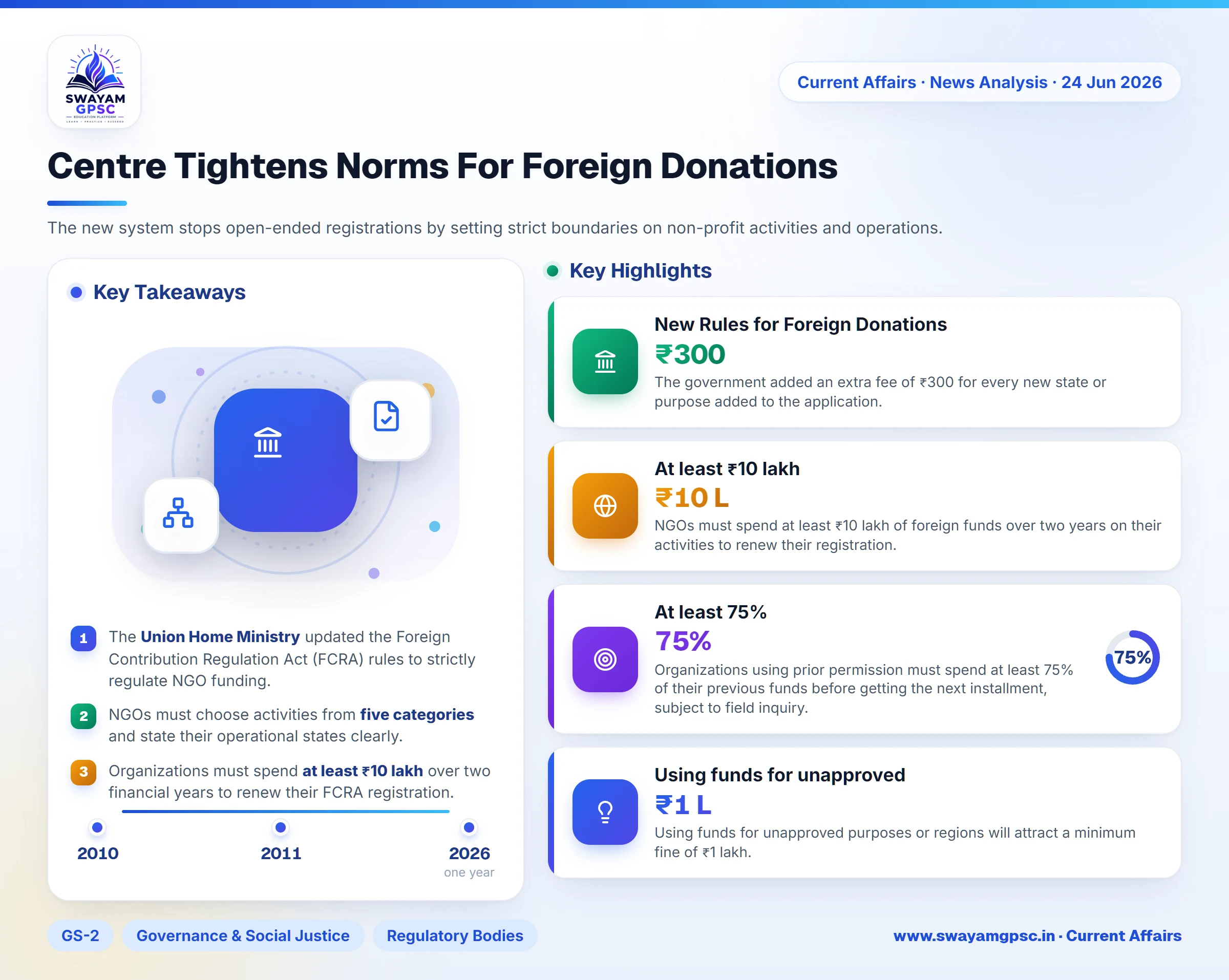
- The Union Home Ministry updated the Foreign Contribution Regulation Act (FCRA) rules to strictly regulate NGO funding.
- NGOs must choose activities from five categories and state their operational states clearly.
- Organizations must spend at least ₹10 lakh over two financial years to renew their FCRA registration.
- Misuse of foreign funds will attract a minimum fine of ₹1 lakh or up to 30% of the involved amount.
Why in News
- The Union Home Ministry has updated the Foreign Contribution Regulation Act (FCRA) rules to strictly monitor foreign donations.
- The government introduced separate activity lists for non-governmental organizations based on their specific categories and operational regions.
About the New Framework
- This is a major legislative change by the central government to track and standardize how NGOs spend foreign funds.
- The new system stops open-ended registrations by setting strict boundaries on non-profit activities and operations.
Law Governed
- The amendments change the Foreign Contribution Regulation Rules, 2011, made under the parent Foreign Contribution Regulation Act (FCRA), 2010.
- The Union Ministry of Home Affairs (MHA) regulates and monitors all foreign donations in India under this legal authority.
Aim of the Amendments
- The main goal is to bring uniformity to Foreign Contribution forms and stop administrative duplication.
- The rules also aim to remove inactive shell non-profits from the system.
New Rules for Foreign Donations
- Every NGO must pick its activities from a predefined list divided into five categories: social, economic, educational, cultural, and religious.
- Application forms must state the exact purposes and the specific States or Union Territories where the NGO will work.
- The government added an extra fee of ₹300 for every new state or purpose added to the application.
- Existing registrations approved before 2026 get a strict window of one year to update their declarations.
- The legal definition of key functionaries now includes trustees, corporate partners, governing body members, and family heads.
- Associations with foreign nationals, except Persons of Indian Origin, are generally ineligible for FCRA registration without special government exemption.
- Educational and cultural programs must exclude political content, while programs on civic duties must stay strictly non-political.
- Religious activities like faith documentation are allowed, but the rules strictly exclude proselytisation.
- NGOs must spend at least ₹10 lakh of foreign funds over two years on their activities to renew their registration.
- Organizations using prior permission must spend at least 75% of their previous funds before getting the next installment, subject to field inquiry.
- NGOs must declare their social media handles, official websites, and any publications they produce.
- Non-profits must declare that their publications do not violate the ban on producing news or current affairs.
- NGOs receiving money through donor-advised funds must disclose the identity of the original donor.
- Annual returns must now include a detailed activity report alongside standard financial statements.
- Using funds for unapproved purposes or regions will attract a minimum fine of ₹1 lakh.
- Direct misuse of funds will attract a penalty of up to 30% of the total amount involved or ₹1 lakh, whichever is higher.