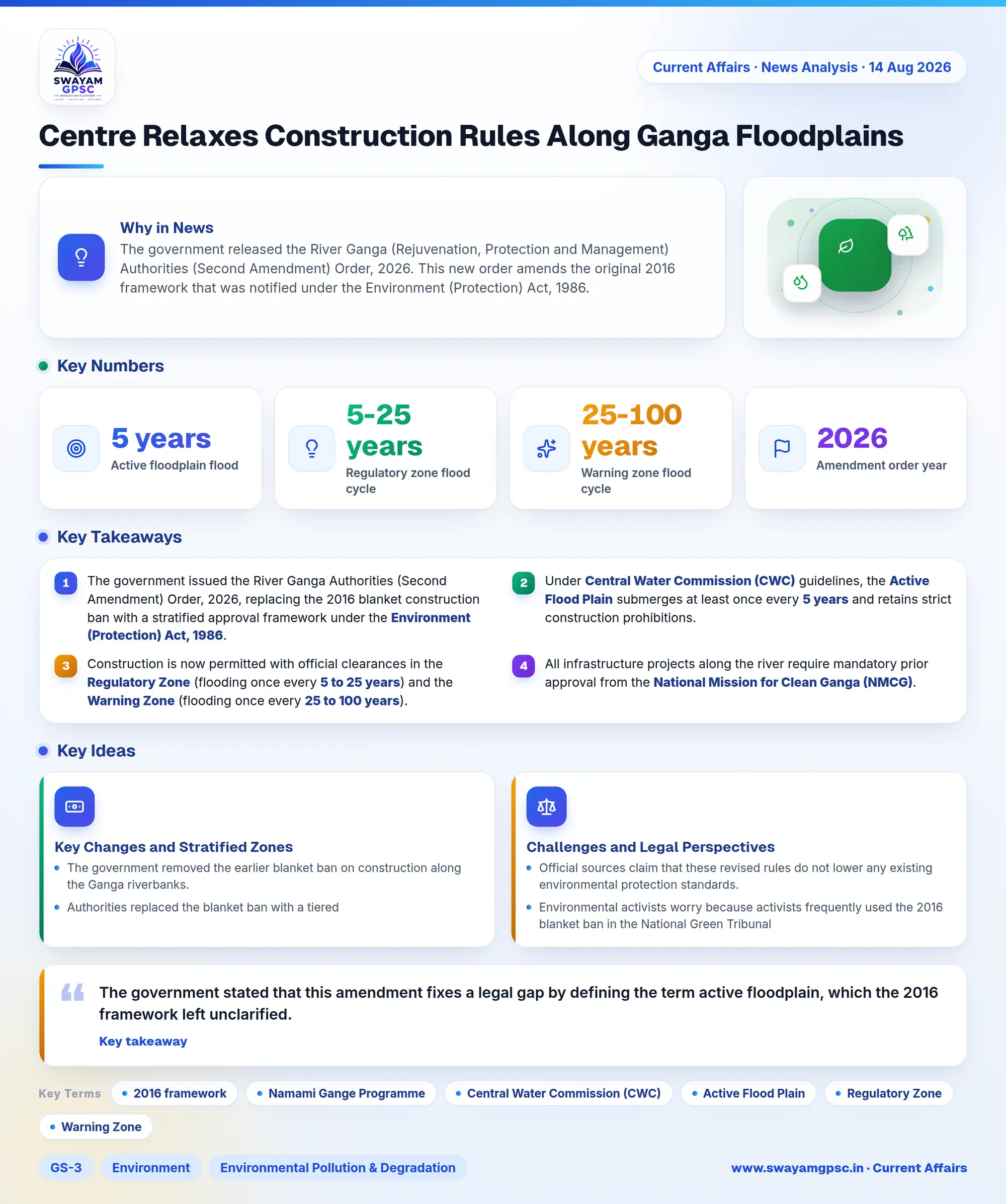
Centre Relaxes Construction Rules Along Ganga Floodplains
#GS-3 #Environment #Environmental Pollution & Degradation #GS-2 #Current Events #National #Infrastructure
Key takeaways
- The government issued the River Ganga Authorities (Second Amendment) Order, 2026, replacing the 2016 blanket construction ban with a stratified approval framework under the Environment (Protection) Act, 1986.
- Under Central Water Commission (CWC) guidelines, the Active Flood Plain submerges at least once every 5 years and retains strict construction prohibitions.
- Construction is now permitted with official clearances in the Regulatory Zone (flooding once every 5 to 25 years) and the Warning Zone (flooding once every 25 to 100 years).
- All infrastructure projects along the river require mandatory prior approval from the National Mission for Clean Ganga (NMCG).
Why in News
- The government released the River Ganga (Rejuvenation, Protection and Management) Authorities (Second Amendment) Order, 2026.
- This new order amends the original 2016 framework that was notified under the Environment (Protection) Act, 1986.
- This framework provides the core legal support for implementing the Namami Gange Programme.
Key Changes and Stratified Zones
- The government removed the earlier blanket ban on construction along the Ganga riverbanks.
- Authorities replaced the blanket ban with a tiered, approval-based system that allows controlled construction while maintaining environmental protection.
- The government created three distinct floodplain zones based on flooding frequency guidelines from the Central Water Commission (CWC).
- The Active Flood Plain submerges at least once every 5 years and remains under strict construction bans, with exceptions only for temporary setups like religious events.
- The Regulatory Zone covers areas that flood once every 5 to 25 years, where construction is allowed if developers obtain official clearances.
- The Warning Zone forms the outer band that floods once every 25 to 100 years, where building is permitted after getting proper approvals.
- Developers must secure prior permission from the National Mission for Clean Ganga (NMCG) and local authorities before constructing riverfront projects, bridges, or roads.
Challenges and Legal Perspectives
- The government stated that this amendment fixes a legal gap by defining the term active floodplain, which the 2016 framework left unclarified.
- Official sources claim that these revised rules do not lower any existing environmental protection standards.
- Environmental activists worry because activists frequently used the 2016 blanket ban in the National Green Tribunal (NGT) to stop harmful riverfront developments.