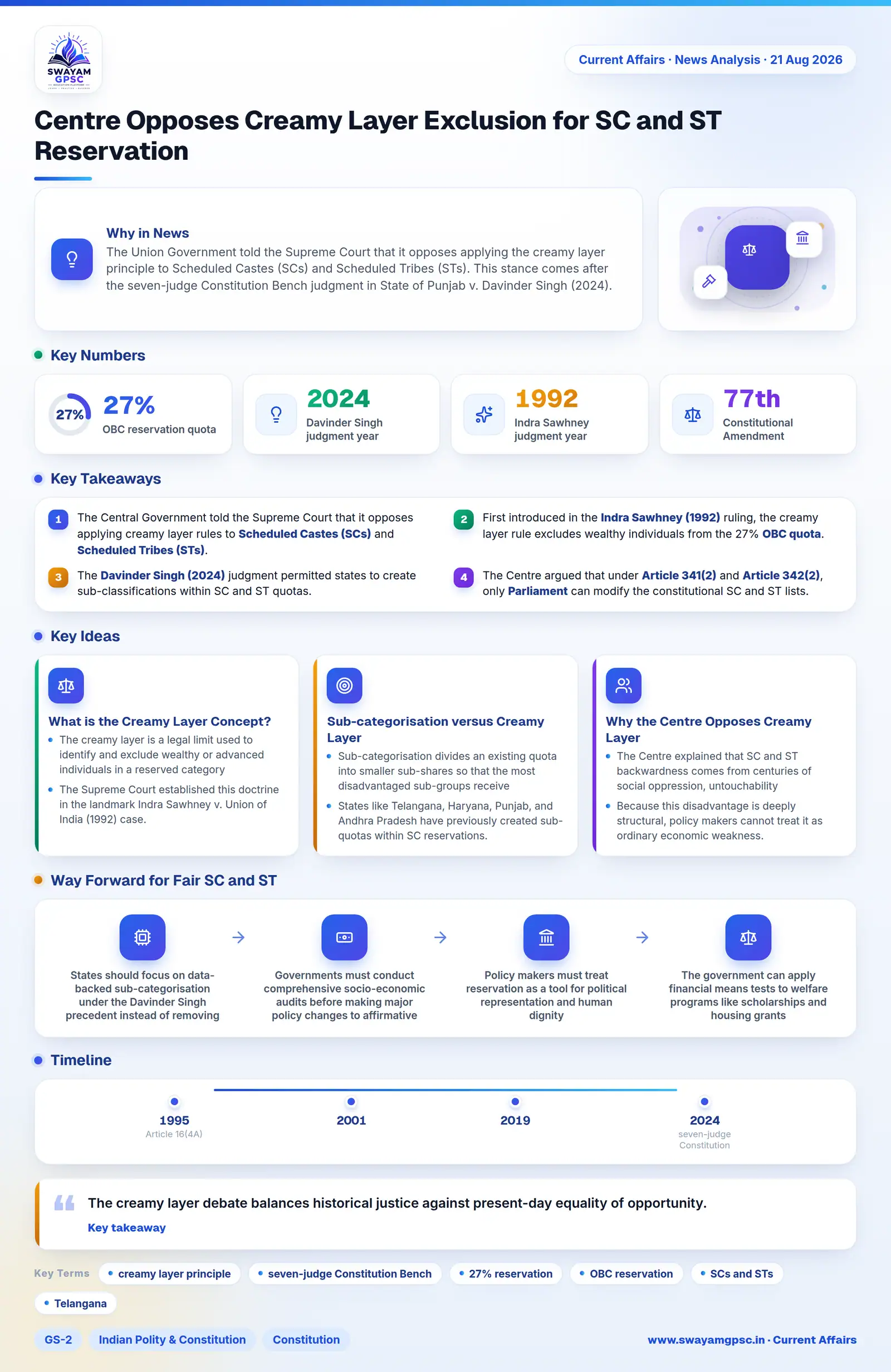
Centre Opposes Creamy Layer Exclusion for SC and ST Reservation
#GS-2 #Indian Polity & Constitution #Constitution #Judiciary #Governance & Social Justice #Vulnerable Sections #Social Justice #Current Events #National #Judgements & Cases #Government Policies & Interventions #Welfare Schemes
Key takeaways
- The Central Government told the Supreme Court that it opposes applying creamy layer rules to Scheduled Castes (SCs) and Scheduled Tribes (STs).
- First introduced in the Indra Sawhney (1992) ruling, the creamy layer rule excludes wealthy individuals from the 27% OBC quota.
- The Davinder Singh (2024) judgment permitted states to create sub-classifications within SC and ST quotas.
- The Centre argued that under Article 341(2) and Article 342(2), only Parliament can modify the constitutional SC and ST lists.
- Reservation in promotions for SCs and STs receives explicit constitutional protection under Article 16(4A), added by the 77th Constitutional Amendment (1995).
Why in News
- The Union Government told the Supreme Court that it opposes applying the creamy layer principle to Scheduled Castes (SCs) and Scheduled Tribes (STs).
- This stance comes after the seven-judge Constitution Bench judgment in State of Punjab v. Davinder Singh (2024).
- That landmark ruling permitted state governments to introduce sub-classification within SC and ST quotas.
- The court also suggested setting up a creamy layer system to prevent elite groups from taking all quota benefits.
- This observation prompted the Central Government to file a counter-affidavit against applying creamy layer rules to SCs and STs.
What is the Creamy Layer Concept?
- The creamy layer is a legal limit used to identify and exclude wealthy or advanced individuals in a reserved category from getting affirmative action benefits.
- The Supreme Court established this doctrine in the landmark Indra Sawhney v. Union of India (1992) case.
- That judgment upheld 27% reservation for Other Backward Classes (OBCs) while directing the exclusion of affluent individuals.
- The concept relies on the idea of relative equality, meaning that treating rich and poor members of a caste as equals hurts genuine equality.
- Today, the government strictly applies the non-creamy layer rule to OBC reservation in government jobs and college admissions.
- However, authorities have historically excluded SCs and STs from creamy layer checks because their backwardness stems from social discrimination and untouchability under Article 17, rather than simple income poverty.
Sub-categorisation versus Creamy Layer Exclusion
- Sub-categorisation divides an existing quota into smaller sub-shares so that the most disadvantaged sub-groups receive fair benefits.
- States like Telangana, Haryana, Punjab, and Andhra Pradesh have previously created sub-quotas within SC reservations.
- Similarly, Mizoram created sub-categories within its ST quota.
- At the national level, the Centre uses sub-classification in Eklavya Model Residential Schools to protect Particularly Vulnerable Tribal Groups (PVTGs).
- In contrast, creamy layer exclusion removes advanced individuals entirely from reservation eligibility.
- To put it simply, sub-categorisation redistributes quota shares among sub-groups, while the creamy layer excludes specific individuals.
- The Economically Weaker Sections (EWS) quota introduced in 2019 also uses income limits, but it applies only to non-SC, non-ST, and non-OBC groups.
Why the Centre Opposes Creamy Layer for SCs and STs
- The Centre explained that SC and ST backwardness comes from centuries of social oppression, untouchability, and geographical isolation.
- Because this disadvantage is deeply structural, policy makers cannot treat it as ordinary economic weakness.
- Higher income does not automatically erase caste stigma or build social networks in elite spaces.
- Unlike OBCs identified under Article 340 for social and educational backwardness, SC and ST classifications target historical subjugation.
- Under Article 341(2) and Article 342(2), only Parliament holds the constitutional power to modify Presidential SC and ST lists.
- The government noted that judicial imposition of a creamy layer would alter these lists without parliamentary approval, as affirmed in State of Maharashtra v. Milind (2001).
- Special protections like Article 16(4A), added through the 77th Constitutional Amendment (1995), explicitly safeguard SC and ST promotion reservations.
- Lastly, enforcing income cutoffs without fresh empirical data from a Socio-Economic Caste Census (SECC) would be arbitrary and scientifically unsound.
Way Forward for Fair SC and ST Reservation
- States should focus on data-backed sub-categorisation under the Davinder Singh precedent instead of removing people through income limits.
- Governments must conduct comprehensive socio-economic audits before making major policy changes to affirmative action.
- Policy makers must treat reservation as a tool for political representation and human dignity, not just a poverty alleviation scheme.
- The government can apply financial means tests to welfare programs like scholarships and housing grants while leaving constitutional quotas intact.
Conclusion
- The creamy layer debate balances historical justice against present-day equality of opportunity.
- Because SC and ST reservations protect social representation and dignity, empirical sub-categorisation offers a more constitutional path forward than blanket income exclusions.