Centenary of Union Public Service Commission: History, Mandate, and Digital Evolution
#GS-2 #Governance & Social Justice #Constitutional Bodies #Good Governance #GS-1 #History #Modern India #Current Events #National #UPSC #Public Service Commission #Civil Services
Key takeaways
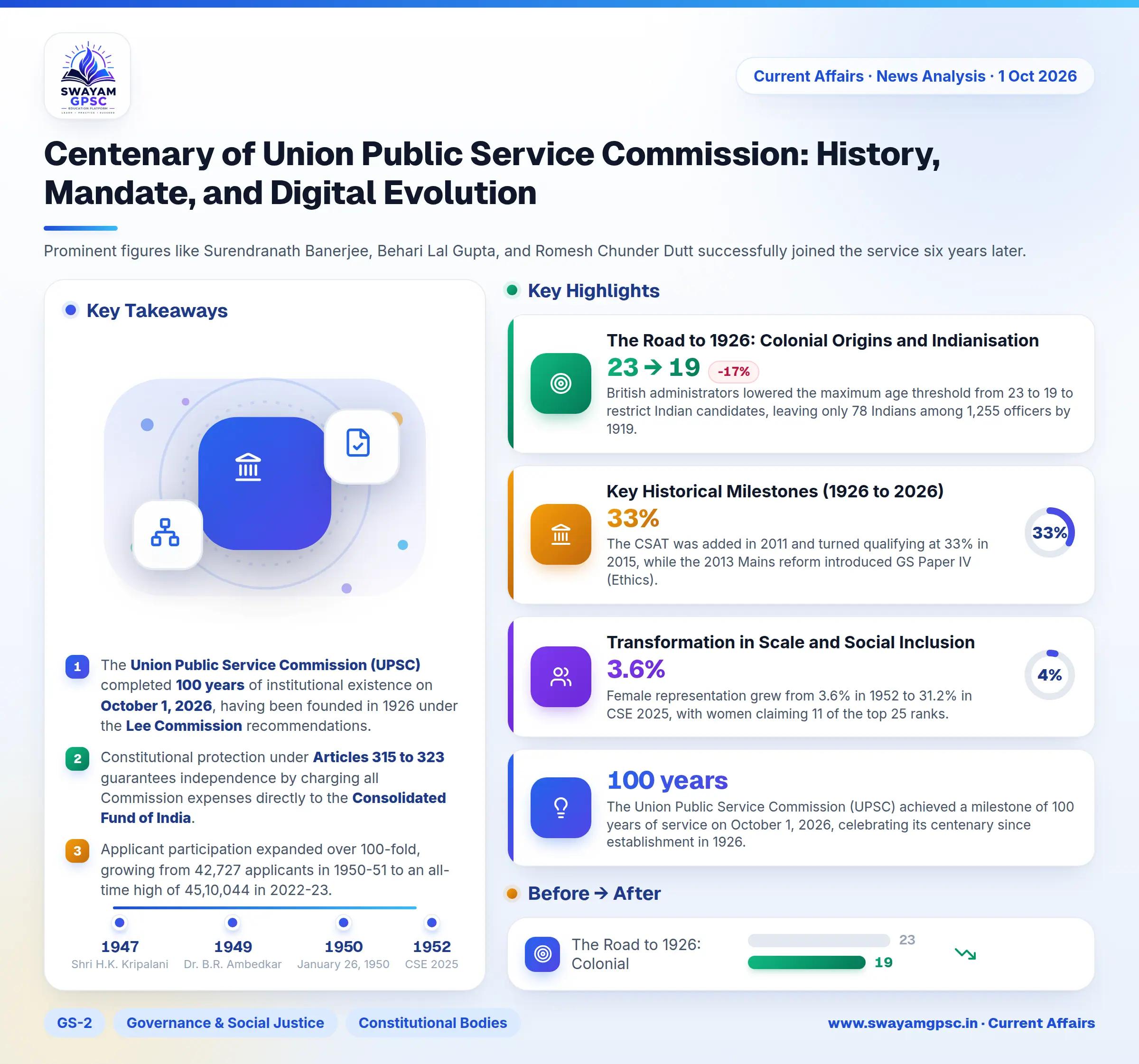
- The Union Public Service Commission (UPSC) completed 100 years of institutional existence on October 1, 2026, having been founded in 1926 under the Lee Commission recommendations.
- Constitutional protection under Articles 315 to 323 guarantees independence by charging all Commission expenses directly to the Consolidated Fund of India.
- Applicant participation expanded over 100-fold, growing from 42,727 applicants in 1950-51 to an all-time high of 45,10,044 in 2022-23.
- In the CSE 2025 results, women secured 31.2% of total recommendations (299 out of 958) and claimed 11 of the top 25 ranks.
- Modern tech upgrades introduced in 2025-2026 include AI Facial Authentication with 6 to 8 second candidate verifications and automated auditing that caught 569 fraudulent applicants.
Why in News
- The Union Public Service Commission (UPSC) achieved a milestone of 100 years of service on October 1, 2026, celebrating its centenary since establishment in 1926.
The Road to 1926: Colonial Origins and Indianisation
- In 1855, an open competitive examination for the Indian Civil Service (ICS) replaced the East India Company's direct nomination method in London.
- The initial ICS testing format favoured British applicants because it featured classical subjects like Greek and Latin and took place only in London.
- Satyendranath Tagore became the first Indian to pass the ICS in 1863, entering service in 1864 and working for over thirty years in the Bombay Presidency.
- Prominent figures like Surendranath Banerjee, Behari Lal Gupta, and Romesh Chunder Dutt successfully joined the service six years later.
- British administrators lowered the maximum age threshold from 23 to 19 to restrict Indian candidates, leaving only 78 Indians among 1,255 officers by 1919.
- The Government of India Act, 1919 created statutory provisions for a recruitment body, leading to the first Indian-held ICS exam in Allahabad in 1922.
- The Lee Commission, chaired by Arthur Hamilton Lee in 1924, recommended establishing a permanent body to manage public service recruitment.
- The first Public Service Commission formed on October 1, 1926, under the leadership of Sir Ross Barker at Metcalfe House, Delhi.
Constitutional Mandate: Part XIV (Articles 315 to 323)
- Dr. B.R. Ambedkar introduced constitutional draft provisions for the Commission on August 22, 1949, to safeguard public recruitment from political interference.
- Article 315 establishes Public Service Commissions for both the Union and individual States, while also allowing Joint State Commissions.
- Article 316 delegates the power to appoint the Commission's Chairman and Members to the President of India.
- Article 317 guarantees tenure security by allowing removal or suspension only through a Presidential order after a Supreme Court inquiry.
- Article 318 authorizes the regulation of service conditions and staff requirements for the Commission members.
- Article 319 bars the outgoing Chairman from taking up any subsequent government employment under the Government of India or any State.
- Article 320 defines core duties, including holding competitive exams and offering mandatory advice on recruitment, promotions, and disciplinary issues.
- Article 321 grants powers to Parliament or State Legislatures to expand the functional scope of the Commission.
- Article 322 ensures financial independence by charging all administrative expenses, salaries, and pensions directly on the Consolidated Fund of India.
- Article 323 mandates submitting an Annual Report to the President, requiring the government to explain any refusal of the Commission's advice in Parliament.
Key Historical Milestones (1926 to 2026)
- The Government of India Act, 1935 renamed the body as the Federal Public Service Commission on April 1, 1937.
- Indian officers outnumbered European officers for the first time in 1940, with 625 Indians and 575 Europeans serving in the ICS.
- Shri H.K. Kripalani took charge as the first Indian Chairman in 1947, as the service transitioned into the Indian Administrative Service (IAS).
- The body transformed into the Union Public Service Commission on January 26, 1950, under the leadership of Shri R.N. Banerjee.
- The Indian Forest Service (IFoS) was set up as the third All India Service in 1966, and Eighth Schedule languages were added as medium options in 1969.
- Following the D.S. Kothari Committee suggestions, the modern three-stage examination structure was introduced in 1979.
- The Satish Chandra Reforms between 1989 and 1993 introduced negative marking, OMR sheets, and a separate 200-mark Essay paper.
- Smt. Rose Millian Bathew Kharbuli made history in 1992 by becoming the first female Chairperson of the Commission.
- The CSAT was added in 2011 and turned qualifying at 33% in 2015, while the 2013 Mains reform introduced GS Paper IV (Ethics).
- Women earned eligibility to sit for the National Defence Academy (NDA) examinations for the first time in 2021.
Transformation in Scale and Social Inclusion
- Exam application volume experienced over a 100-fold jump, rising from 42,727 applicants in 1950-51 to 45,10,044 in 2022-23.
- The network of examination centers expanded from 8 locations in 1950 to 86 locations by 2026.
- Female representation grew from 3.6% in 1952 to 31.2% in CSE 2025, with women claiming 11 of the top 25 ranks.
- Selected Scheduled Caste (SC) candidates rose from 9 in 1955 to 158 in 2025, alongside a massive jump in total applicant numbers.
- Selected Scheduled Tribe (ST) candidates expanded from 2 in 1956-57 to 73 in 2025.
- Successful candidates with Benchmark Disabilities (PwBD) increased from 3 in 2002 to 42 in 2025.
- While interviews were English-only in 1970-71, candidates gained the right to speak in any Eighth Schedule Indian language with an interpreter starting in 1980-81.
Operational Machinery and Technological Modernisation
- The Universal Registration Number (URN) launched in May 2025 to replace single-use registration with a single candidate profile.
- An AI Facial Authentication system verified candidates across nationwide centers during the May 24, 2026 Prelims within 6 to 8 seconds per person.
- An automated Algorithmic Data Audit checked 15 years of candidate records before Prelims 2026, barring 569 applicants for fake attempt claims.
- A Randomized Interview Boards system introduced software-driven candidate sequencing in 2025 to prevent potential interview bias.
- The Pratibha Setu platform launched in June 2025 to connect non-selected interview candidates with private and public recruiters.
- The QPRep Portal introduced in 2026 allowed candidates to submit digital, time-bound representations regarding Preliminary question papers.
- An Online DPC Platform was built in 2026 across 101 Ministries to accelerate departmental promotions and cadre inductions without paperwork.
Institutional Anecdotes of Historical Significance
- Sardar Vallabhbhai Patel delivered the Steel Frame Address on April 21, 1947, which is now observed as National Civil Services Day.
- The Commission moved into Dholpur House on Shahjahan Road in 1952, a property originally built in 1920 in the Art Deco style.
- Kiran Bedi joined as the first female Indian Police Service (IPS) officer in 1972, filling the only female slot out of 80 vacancies.
- The Commission regularly supported candidates during crises, including offering relaxations during the 1971 war and providing travel reimbursements during COVID-19.
Way Forward
- The Commission continues to blend strict merit-based testing with broader social inclusion to serve as a strong constitutional pillar.
- Future growth relies on adopting advanced AI-driven verification, increasing regional language choices, and maintaining high public trust across the nation.