The Census (Amendment) Rules 2026: Key Changes and Impact
#GS-2 #Indian Polity & Constitution #Executive #Governance & Social Justice #Regulatory Bodies #Current Events #National #Census #Census Act 1948 #Ministry of Home Affairs
Key takeaways
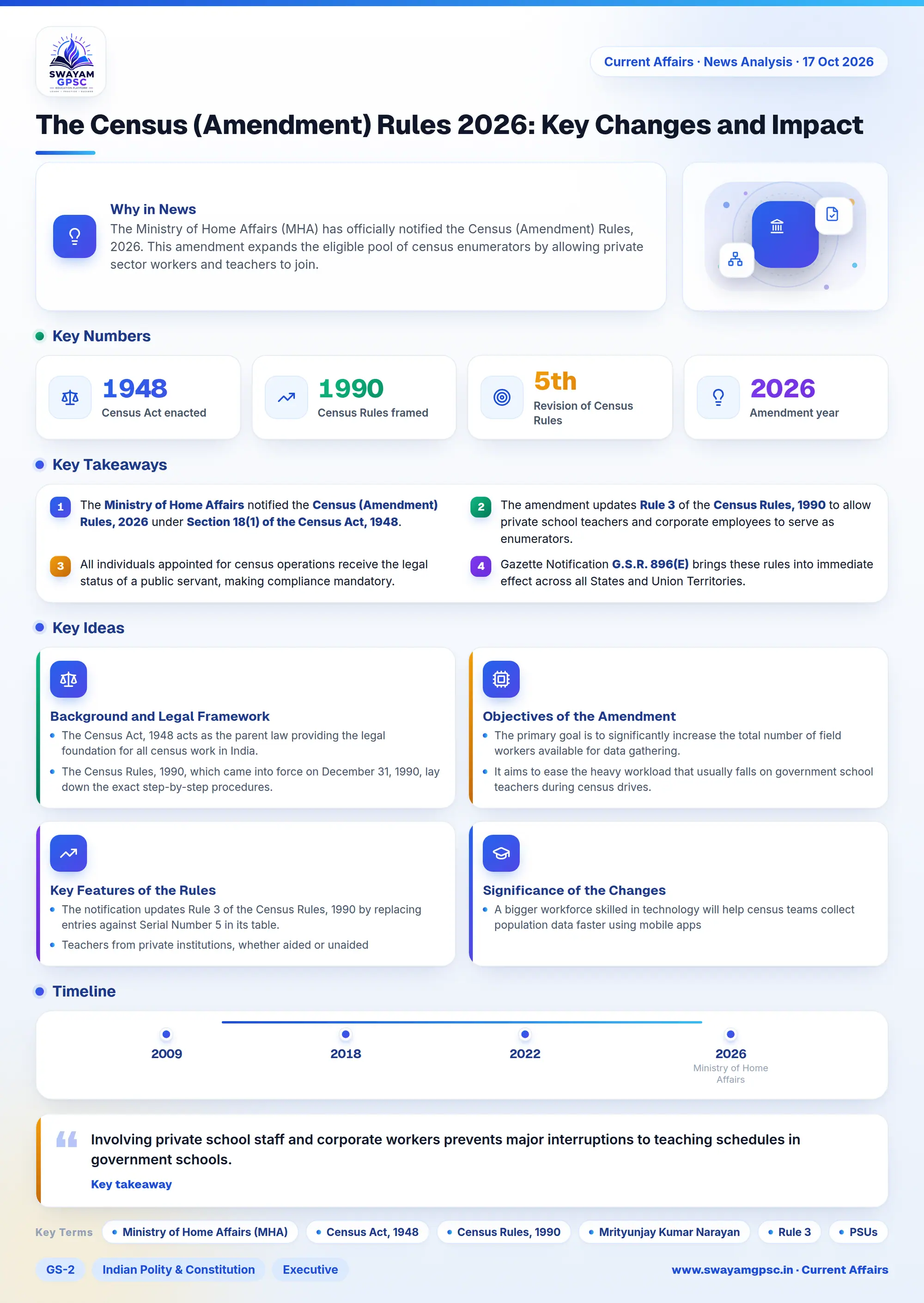
- The Ministry of Home Affairs notified the Census (Amendment) Rules, 2026 under Section 18(1) of the Census Act, 1948.
- The amendment updates Rule 3 of the Census Rules, 1990 to allow private school teachers and corporate employees to serve as enumerators.
- All individuals appointed for census operations receive the legal status of a public servant, making compliance mandatory.
- Gazette Notification G.S.R. 896(E) brings these rules into immediate effect across all States and Union Territories.
- This expansion reduces reliance on government school teachers and speeds up digital data collection through mobile applications.
Why in News
- The Ministry of Home Affairs (MHA) has officially notified the Census (Amendment) Rules, 2026.
- This amendment expands the eligible pool of census enumerators by allowing private sector workers and teachers to join.
- The government issued this notification using powers under Section 18(1) of the Census Act, 1948.
- The main objective is to boost overall manpower for conducting India's upcoming digital census smoothly.
Background and Legal Framework
- The Census Act, 1948 acts as the parent law providing the legal foundation for all census work in India.
- The Census Rules, 1990, which came into force on December 31, 1990, lay down the exact step-by-step procedures.
- Authorities previously amended these rules in 1994, 2009, 2018, and 2022 before bringing this fifth update in 2026.
- Mrityunjay Kumar Narayan, serving as the Registrar General and Census Commissioner of India under the MHA, issued the latest notification.
- The new rules became effective immediately after their publication in the Official Gazette.
Objectives of the Amendment
- The primary goal is to significantly increase the total number of field workers available for data gathering.
- It aims to ease the heavy workload that usually falls on government school teachers during census drives.
- The expansion ensures timely and accurate door-to-door data collection across all rural and urban areas.
Key Features of the Rules
- The notification updates Rule 3 of the Census Rules, 1990 by replacing entries against Serial Number 5 in its table.
- Teachers from private institutions, whether aided or unaided, can now be assigned census duties alongside government school staff.
- Clerical employees from PSUs, statutory bodies, commercial banks, private firms, societies, and trusts are now eligible.
- State governments and Union Territory administrations have full discretion to appoint any other individual they deem suitable.
- Anyone assigned to census work under the Census Act, 1948 gains the legal status of a public servant.
- Refusing census duty without a valid legal reason is an offence that attracts statutory criminal penalties.
- The updated rules came into effect right away through Gazette Notification G.S.R. 896(E) across India.
Significance of the Changes
- Involving private school staff and corporate workers prevents major interruptions to teaching schedules in government schools.
- A bigger workforce skilled in technology will help census teams collect population data faster using mobile apps and digital tools.