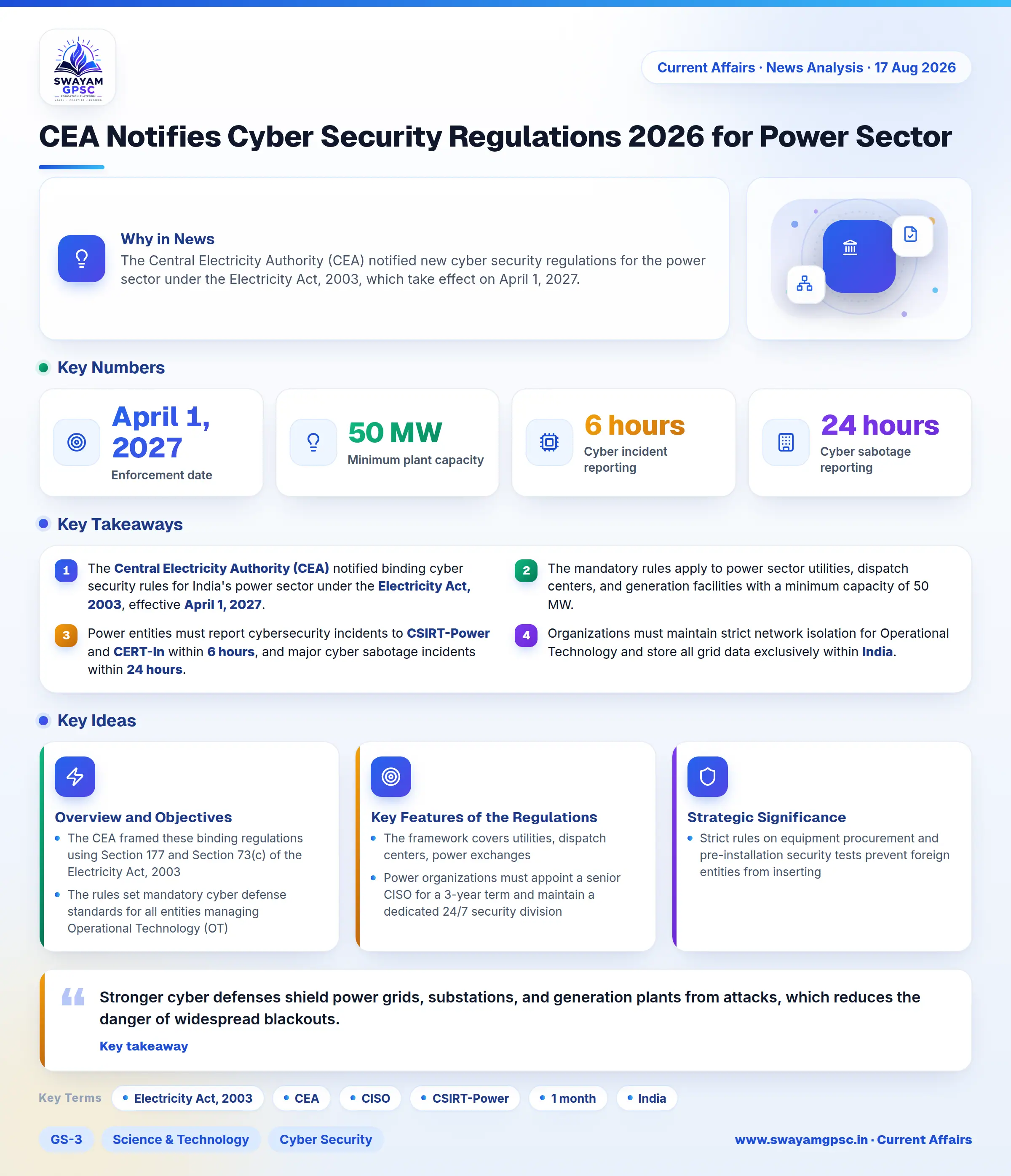
CEA Notifies Cyber Security Regulations 2026 for Power Sector
#GS-3 #Science & Technology #Cyber Security #Economy #Infrastructure #Governance & Social Justice #Regulatory Bodies #Central Electricity Authority #Electricity Act 2003
Key takeaways
- The Central Electricity Authority (CEA) notified binding cyber security rules for India's power sector under the Electricity Act, 2003, effective April 1, 2027.
- The mandatory rules apply to power sector utilities, dispatch centers, and generation facilities with a minimum capacity of 50 MW.
- Power entities must report cybersecurity incidents to CSIRT-Power and CERT-In within 6 hours, and major cyber sabotage incidents within 24 hours.
- Organizations must maintain strict network isolation for Operational Technology and store all grid data exclusively within India.
Why in News
- The Central Electricity Authority (CEA) notified new cyber security regulations for the power sector under the Electricity Act, 2003, which take effect on April 1, 2027.
Overview and Objectives
- The CEA framed these binding regulations using Section 177 and Section 73(c) of the Electricity Act, 2003, after obtaining formal agreement from MeitY.
- The rules set mandatory cyber defense standards for all entities managing Operational Technology (OT) and interconnected Information Technology (IT) systems in the energy sector.
- The main goal is to strengthen institutional cyber security, guard Critical Information Infrastructure (CII) and Industrial Control Systems (ICS) against sabotage, and guarantee reliable power supply.
Key Features of the Regulations
- The framework covers utilities, dispatch centers, power exchanges, and generating units with a capacity of 50 MW or more.
- Power organizations must appoint a senior CISO for a 3-year term and maintain a dedicated 24/7 security division inside India.
- Grid operators must completely isolate Operational Technology (OT) and Critical Information Infrastructure (CII) from the public internet and corporate IT networks.
- Entities must report any cybersecurity incident to CSIRT-Power and CERT-In within 6 hours, and report critical sabotage cases within 24 hours.
- Mandatory security audits (VAPT) are required before commissioning, followed by annual audits, with critical defects resolved within 1 month and low-risk defects within 3 months.
- All sensitive operational data and cloud-hosted grid information must be encrypted and stored strictly within India.
- Companies must buy hardware and software from verified vendors with a clear Bill of Materials (BoM), while local green energy suppliers must use end-to-end encryption.
Strategic Significance
- Stronger cyber defenses shield power grids, substations, and generation plants from attacks, which reduces the danger of widespread blackouts.
- Strict rules on equipment procurement and pre-installation security tests prevent foreign entities from inserting secret malware or backdoors into grid controllers.