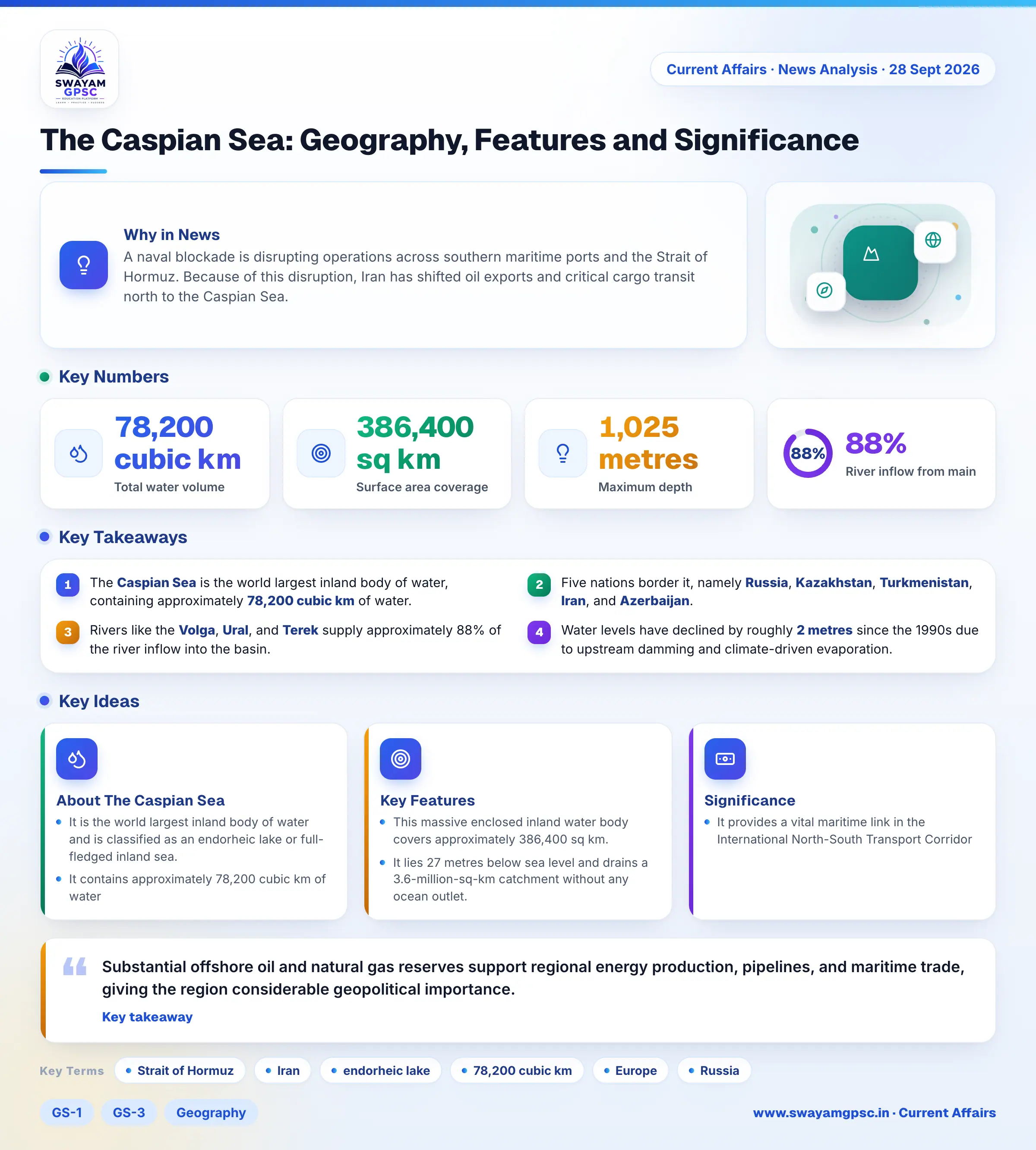
The Caspian Sea: Geography, Features and Significance
#GS-1 #GS-3 #Geography #Resources #Economy #Infrastructure #Current Events #International
Key takeaways
- The Caspian Sea is the world largest inland body of water, containing approximately 78,200 cubic km of water.
- Five nations border it, namely Russia, Kazakhstan, Turkmenistan, Iran, and Azerbaijan.
- Rivers like the Volga, Ural, and Terek supply approximately 88% of the river inflow into the basin.
- Water levels have declined by roughly 2 metres since the 1990s due to upstream damming and climate-driven evaporation.
Why in News
- A naval blockade is disrupting operations across southern maritime ports and the Strait of Hormuz.
- Because of this disruption, Iran has shifted oil exports and critical cargo transit north to the Caspian Sea.
About The Caspian Sea
- It is the world largest inland body of water and is classified as an endorheic lake or full-fledged inland sea.
- It contains approximately 78,200 cubic km of water, which is nearly one-third of the total inland surface water on Earth.
- It sits at the junction of Europe and Asia, lying east of the Caucasus Mountains, west of the Central Asian steppe, and north of the Iranian plateau.
- Five nations border it, namely Russia, Kazakhstan, Turkmenistan, Iran, and Azerbaijan.
Key Features
- This massive enclosed inland water body covers approximately 386,400 sq km.
- It lies 27 metres below sea level and drains a 3.6-million-sq-km catchment without any ocean outlet.
- Its depth varies across a tripartite profile, featuring a shallow northern basin averaging 4 to 8 metres, a moderately deep central basin, and a southern basin reaching a maximum depth of 1,025 metres.
- Rivers like the Volga, Ural, and Terek supply approximately 88% of the river discharge, making northern freshwater inflows crucial to its hydrological balance.
- Upstream damming and climate-driven evaporation are accelerating Water Level Depletion.
- Recent annual water level falls have exceeded 20 cm, showing an overall decline of roughly 2 metres since the 1990s.
- As a remnant of the ancient Paratethys Sea, the Caspian Sea became isolated when geological changes severed its former connections with the Black Sea and Mediterranean.
Significance
- Substantial offshore oil and natural gas reserves support regional energy production, pipelines, and maritime trade, giving the region considerable geopolitical importance.
- It provides a vital maritime link in the International North-South Transport Corridor, connecting Indian Ocean trade through Iran with Russia, Central Asia, and northern Europe.