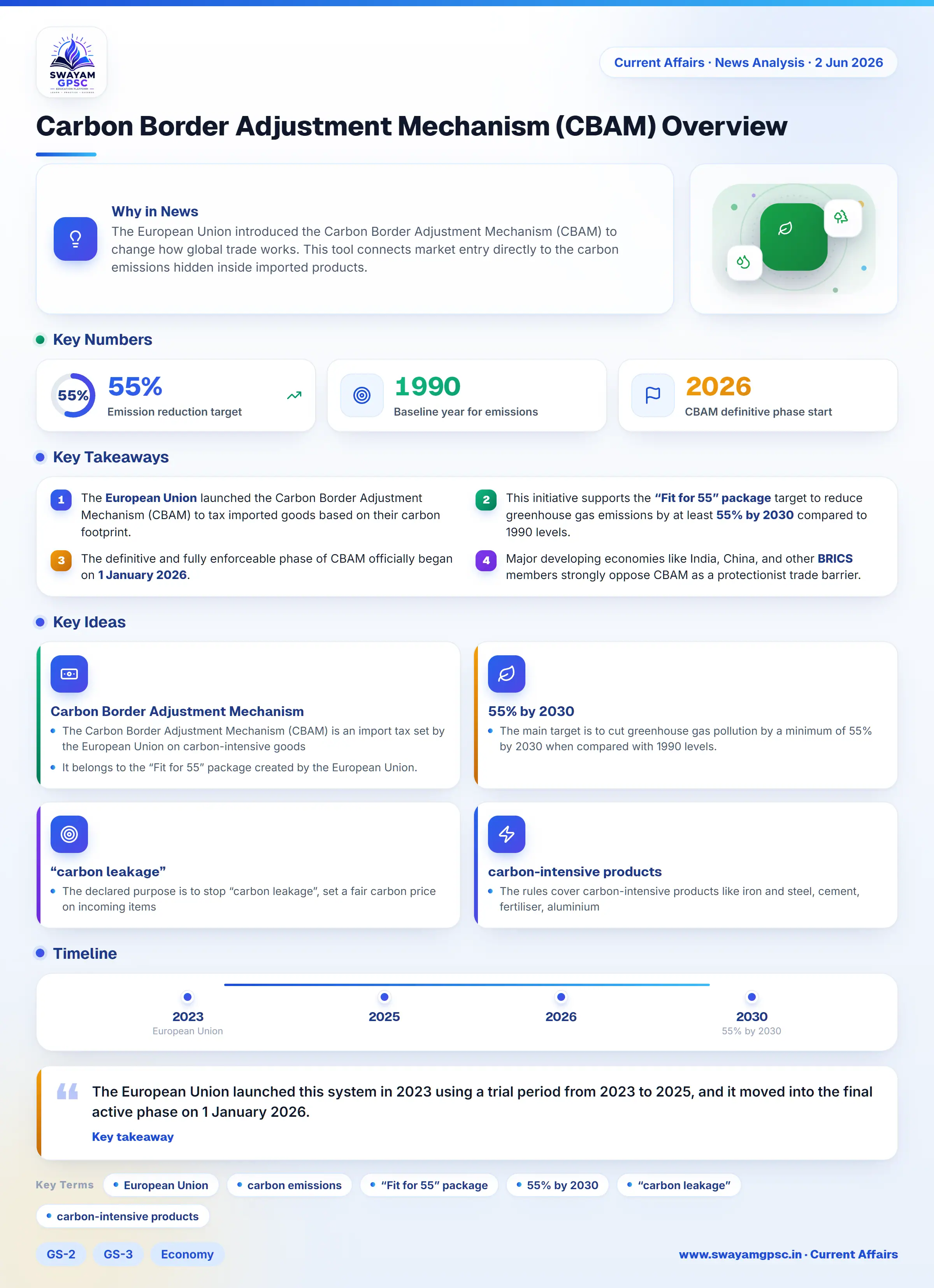
Carbon Border Adjustment Mechanism (CBAM) Overview
#GS-2 #GS-3 #Economy #Climate Change #Environment #Current Events #International #Bilateral Groupings & Agreements
Key takeaways
- The European Union launched the Carbon Border Adjustment Mechanism (CBAM) to tax imported goods based on their carbon footprint.
- This initiative supports the “Fit for 55” package target to reduce greenhouse gas emissions by at least 55% by 2030 compared to 1990 levels.
- The definitive and fully enforceable phase of CBAM officially began on 1 January 2026.
- Major developing economies like India, China, and other BRICS members strongly oppose CBAM as a protectionist trade barrier.
Why in News
- The European Union introduced the Carbon Border Adjustment Mechanism (CBAM) to change how global trade works.
- This tool connects market entry directly to the carbon emissions hidden inside imported products.
Carbon Border Adjustment Mechanism (CBAM)
- The Carbon Border Adjustment Mechanism (CBAM) is an import tax set by the European Union on carbon-intensive goods made outside the region using methods that release more carbon than EU rules permit.
- It belongs to the “Fit for 55” package created by the European Union.
- The main target is to cut greenhouse gas pollution by a minimum of 55% by 2030 when compared with 1990 levels.
- The declared purpose is to stop “carbon leakage”, set a fair carbon price on incoming items, and push factories in non-EU nations to adopt cleaner manufacturing methods.
- The rules cover carbon-intensive products like iron and steel, cement, fertiliser, aluminium, and electricity generation, and officials might add more items later.
- European Union buyers must purchase CBAM certificates that match the EU Emissions Trading System (EU ETS) pricing.
- This price matches the carbon expenses that would apply if those products faced local EU carbon rules.
- If a non-EU manufacturer already paid a carbon fee back home, that sum gets subtracted from the total CBAM bill.
- The European Union launched this system in 2023 using a trial period from 2023 to 2025, and it moved into the final active phase on 1 January 2026.
- Nations like India, China, and other BRICS partners see CBAM as a one-sided, unfair trade barrier meant to protect local markets.
- Developing countries worry this tax will damage their export power and break the rule of shared climate duties.
- This policy helps wealthy nations with strict emission rules while harming developing economies, making it a major flashpoint in world trade talks.