CAG Audit Exposes Major Failure in Green India Mission
#GS-2 #Governance & Social Justice #Good Governance #GS-3 #Environment #Conservation #Climate Change #National
Key takeaways
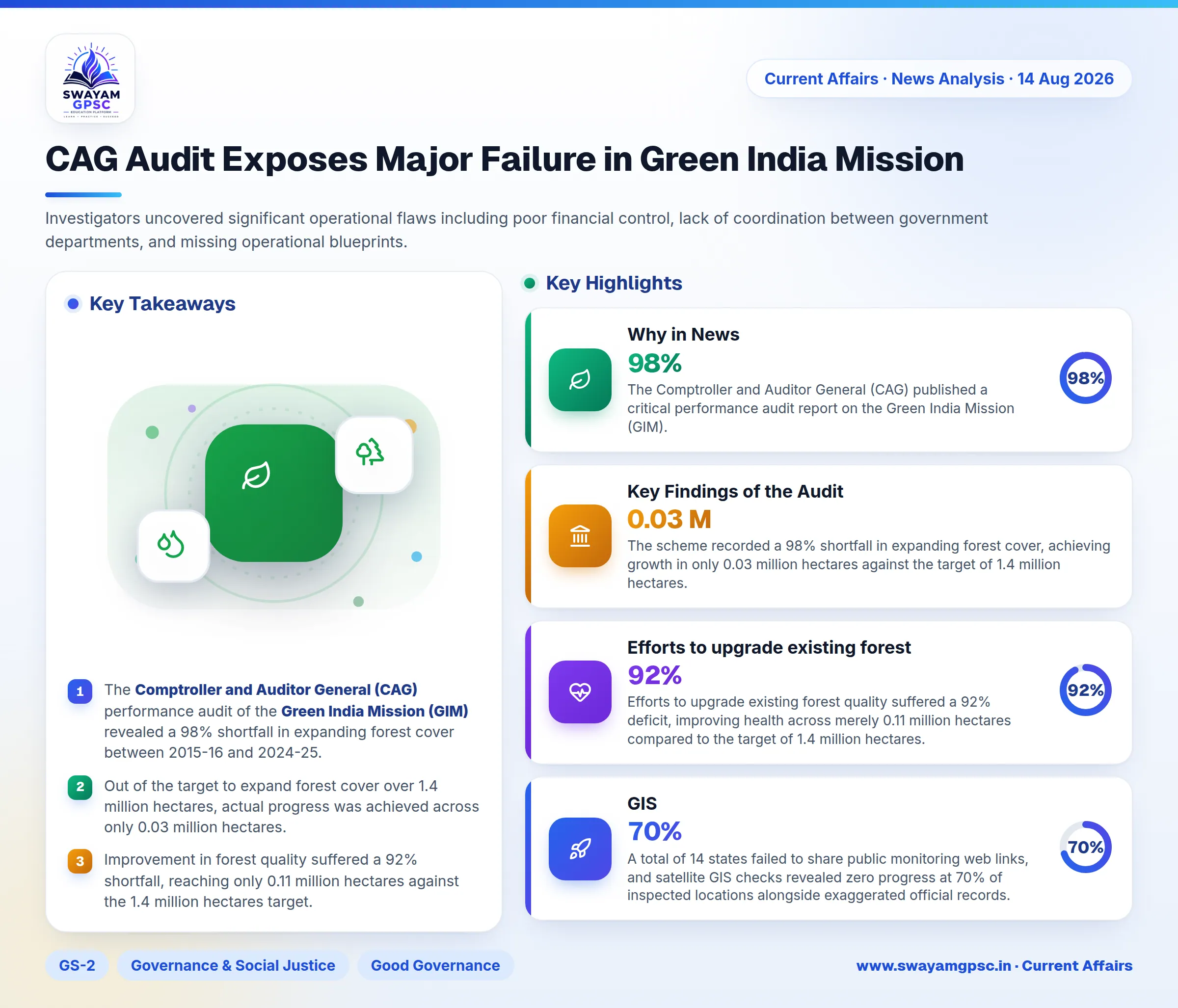
- The Comptroller and Auditor General (CAG) performance audit of the Green India Mission (GIM) revealed a 98% shortfall in expanding forest cover between 2015-16 and 2024-25.
- Out of the target to expand forest cover over 1.4 million hectares, actual progress was achieved across only 0.03 million hectares.
- Improvement in forest quality suffered a 92% shortfall, reaching only 0.11 million hectares against the 1.4 million hectares target.
- GIS satellite analysis showed no noticeable change attributable to the mission at 70% of the sampled sites, with 14 states failing to provide public monitoring links.
Why in News
- The Comptroller and Auditor General (CAG) published a critical performance audit report on the Green India Mission (GIM). This report highlights severe execution failures and reveals a 98% shortfall in achieving forest-expansion goals between 2015-16 and 2024-25.
About CAG Audit of Green India Mission
- The CAG evaluated four core areas of the scheme: planning, execution, fund management, and tracking across 16 states and union territories for the 2015-16 to 2024-25 period.
- The audit carefully assessed four major goals: expanding total tree cover, improving overall forest health, enhancing nature services, and generating income options for local communities.
Key Findings of the Audit
- The scheme recorded a 98% shortfall in expanding forest cover, achieving growth in only 0.03 million hectares against the target of 1.4 million hectares.
- Efforts to upgrade existing forest quality suffered a 92% deficit, improving health across merely 0.11 million hectares compared to the target of 1.4 million hectares.
- Authorities chose locations poorly by selecting regions with low climate risk rather than prioritizing high-risk vulnerable landscapes.
- Investigators uncovered significant operational flaws including poor financial control, lack of coordination between government departments, and missing operational blueprints.
- A total of 14 states failed to share public monitoring web links, and satellite GIS checks revealed zero progress at 70% of inspected locations alongside exaggerated official records.
Key Implications
- Failed tree planting campaigns directly harm national climate goals, reducing nature ability to absorb carbon emissions and protect native wildlife.
- Flawed tracking systems and distorted data damage public trust, proving that government money spent on environment protection is being wasted without measurable outcomes.
- Neglecting degraded forest ecosystems directly threatens local tribal populations who rely on forest produce for daily income and shelter.