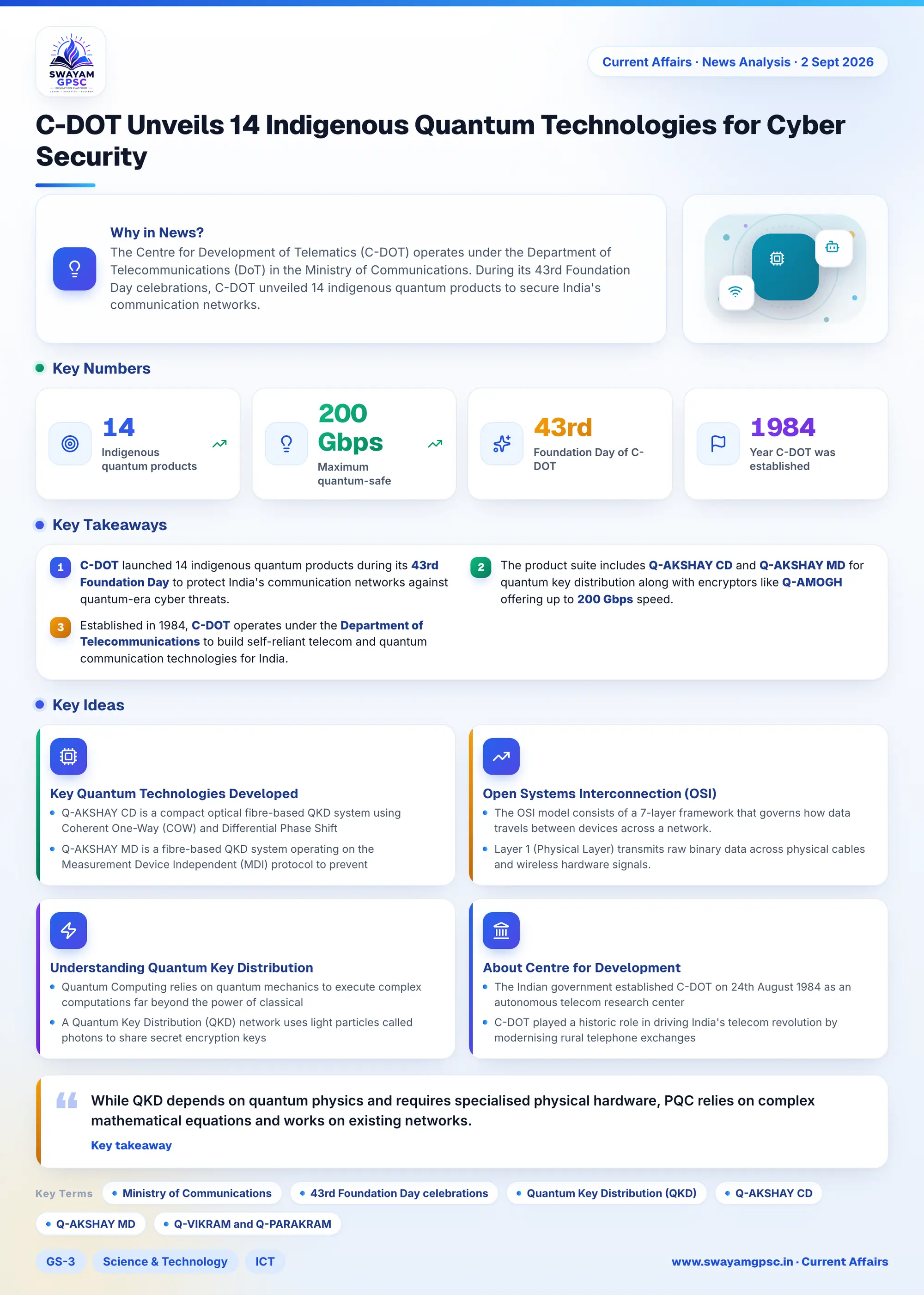
C-DOT Unveils 14 Indigenous Quantum Technologies for Cyber Security
#GS-3 #Science & Technology #ICT #GS-2 #Current Events #National #Quantum Technology #Cybersecurity #C-DOT
Key takeaways
- C-DOT launched 14 indigenous quantum products during its 43rd Foundation Day to protect India's communication networks against quantum-era cyber threats.
- The product suite includes Q-AKSHAY CD and Q-AKSHAY MD for quantum key distribution along with encryptors like Q-AMOGH offering up to 200 Gbps speed.
- Established in 1984, C-DOT operates under the Department of Telecommunications to build self-reliant telecom and quantum communication technologies for India.
Why in News?
- The Centre for Development of Telematics (C-DOT) operates under the Department of Telecommunications (DoT) in the Ministry of Communications.
- During its 43rd Foundation Day celebrations, C-DOT unveiled 14 indigenous quantum products to secure India's communication networks.
- These new technologies focus primarily on Quantum Key Distribution (QKD) and Post-Quantum Cryptography (PQC) to protect against advanced cyber threats.
Key Quantum Technologies Developed by C-DOT
- Q-AKSHAY CD is a compact optical fibre-based QKD system using Coherent One-Way (COW) and Differential Phase Shift (DPS) protocols for secure key distribution over fibre networks.
- Q-AKSHAY MD is a fibre-based QKD system operating on the Measurement Device Independent (MDI) protocol to prevent measurement-device vulnerabilities.
- Q-VIKRAM and Q-PARAKRAM are defence-grade encryptors using PQC algorithms at Layer 2 and Layer 3 of the OSI model to protect strategic communications.
- Q-AMOGH is a high-capacity optical encryptor offering quantum-safe protection up to 200 Gbps at Layer 1 for high-speed optical networks.
- Q-MAHASETU is a commercial-grade quantum-safe encryptor that supports data transfer speeds up to 40 Gbps at Layer 2 and Layer 3 for enterprises.
- Q-SETU is a quantum-safe encryptor designed for commercial data communications delivering speeds up to 80 Mbps at Layer 3.
- The system incorporates global standards from the National Institute of Standards and Technology (NIST) to shield data from quantum computing risks.
- C-SPD is a single-photon detector hardware component designed to catch individual photon signals in quantum networks.
- C-RD is a wideband Radio Frequency driver used to control intensity and phase modulators within quantum communication systems.
Open Systems Interconnection (OSI) Model
- The OSI model consists of a 7-layer framework that governs how data travels between devices across a network.
- Layer 1 (Physical Layer) transmits raw binary data across physical cables and wireless hardware signals.
- Layer 2 (Data Link Layer) manages direct data communication between two physically connected devices on the same network.
- Layer 3 (Network Layer) handles the routing, addressing, and forwarding of data packets across different networks.
- Layer 4 (Transport Layer) ensures reliable end-to-end delivery of data segments with error checks and flow control.
- Layer 5 (Session Layer) establishes, maintains, and terminates active communication channels between software applications.
- Layer 6 (Presentation Layer) formats, encrypts, and compresses data so that applications can read it clearly.
- Layer 7 (Application Layer) provides direct network services and interfaces to software applications used by human beings.
Understanding Quantum Key Distribution and Post-Quantum Cryptography
- Quantum Computing relies on quantum mechanics to execute complex computations far beyond the power of classical supercomputers.
- A Quantum Key Distribution (QKD) network uses light particles called photons to share secret encryption keys between users without leakage risks.
- If an eavesdropper tries to intercept a QKD key, the disturbance in quantum states immediately exposes the intrusion to both users.
- Post-Quantum Cryptography (PQC) uses mathematical algorithms built to resist decryption attempts by future quantum computers.
- While QKD depends on quantum physics and requires specialised physical hardware, PQC relies on complex mathematical equations and works on existing networks.
About Centre for Development of Telematics (C-DOT)
- The Indian government established C-DOT on 24th August 1984 as an autonomous telecom research center under the Department of Telecommunications.
- C-DOT played a historic role in driving India's telecom revolution by modernising rural telephone exchanges and digitising the national grid.
- The institute has built core solutions across Next Generation Networks (NGN), Terabit Routers, DWDM, Wi-Fi, and cybersecurity software.
- For IoT and smart cities, C-DOT created the oneM2M standard-based Common Services Platform (CCSP).
- The center actively researches futuristic technologies including 5G, 6G, Artificial Intelligence (AI), and quantum communication.
- Through its technology transfer model, C-DOT supports domestic telecom equipment manufacturers under the Atmanirbhar Bharat mission.
- Its technical innovations provide critical infrastructure for BharatNet, bringing high-speed optical broadband to thousands of rural villages.