Building India's Comprehensive Strategic Fuel System
#GS-1 #GS-2 #GS-3 #Mineral & Energy Resources #Government Policies & Interventions #Governance & Social Justice #Infrastructure #Energy Security #Current Events
Key takeaways
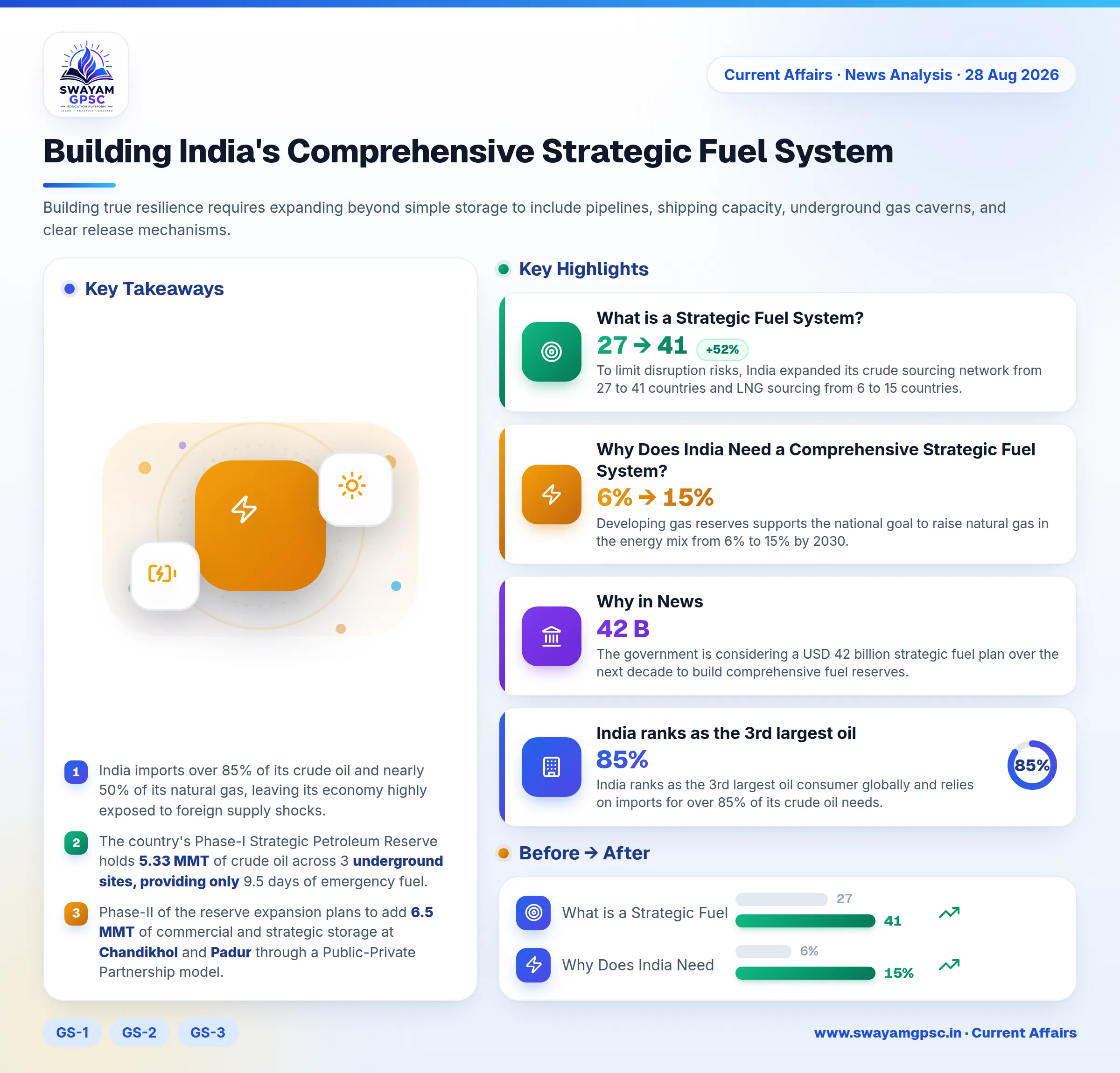
- India imports over 85% of its crude oil and nearly 50% of its natural gas, leaving its economy highly exposed to foreign supply shocks.
- The country's Phase-I Strategic Petroleum Reserve holds 5.33 MMT of crude oil across 3 underground sites, providing only 9.5 days of emergency fuel.
- Phase-II of the reserve expansion plans to add 6.5 MMT of commercial and strategic storage at Chandikhol and Padur through a Public-Private Partnership model.
- The government is planning a USD 42 billion expansion to build fuel reserves covering 2 months of crude oil and LNG demand alongside 6 weeks of LPG supply.
Why in News
- Recent supply disruptions in West Asia have highlighted vulnerabilities in the energy security framework of India.
- These supply concerns have renewed focus on Phase-II of the Strategic Petroleum Reserves (SPR) programme.
- The government is considering a USD 42 billion strategic fuel plan over the next decade to build comprehensive fuel reserves.
Overview of Strategic Fuel Initiative
- India is transitioning toward a broad Strategic Fuel System covering crude oil, LNG, and LPG to mitigate import risks.
- Building true resilience requires expanding beyond simple storage to include pipelines, shipping capacity, underground gas caverns, and clear release mechanisms.
What is a Strategic Fuel System?
- A holistic fuel system expands beyond traditional Strategic Petroleum Reserves (SPRs) that store only crude oil.
- Crude oil storage relies on underground rock caverns built to hold emergency crude supplies.
- Gas reserves require surface infrastructure and underground facilities to store LNG and LPG.
- Alternative fuel integration focuses on expanding E20 ethanol blends and compressed biogas to cut hydrocarbon imports.
- Diversified sourcing reduces supply risks by expanding fuel procurement across multiple geographic regions.
- The Indian Strategic Petroleum Reserves Limited (ISPRL) manages the construction of national strategic oil reserves.
- Phase-I created 5.33 MMT of crude storage capacity at Visakhapatnam, Mangaluru, and Padur, covering about 9.5 days of national demand.
- Phase-II will build 6.5 MMT of additional capacity at Chandikhol and Padur through a Public-Private Partnership model supported by Viability Gap Funding.
- India plans to construct reserves covering 2 months of crude and LNG consumption alongside 6 weeks of LPG demand.
- The proposed USD 42 billion infrastructure plan may be funded through small levies on natural gas and LPG consumers.
- To limit disruption risks, India expanded its crude sourcing network from 27 to 41 countries and LNG sourcing from 6 to 15 countries.
Why Does India Need a Comprehensive Strategic Fuel System?
- India ranks as the 3rd largest oil consumer globally and relies on imports for over 85% of its crude oil needs.
- In Q1 FY27, India imported 60.48 million tonnes of crude oil worth USD 49.66 billion, showing heavy dependence on foreign supplies.
- Critical maritime transit routes such as the Strait of Hormuz and the Red Sea expose Indian imports to severe geopolitical disruptions.
- Existing Phase-I crude reserves supply only 9.5 days of demand, remaining well below the IEA benchmark of 90 days.
- Global crude price spikes increase India's import bill, widen the Current Account Deficit (CAD), and drive imported inflation.
- Developing gas reserves supports the national goal to raise natural gas in the energy mix from 6% to 15% by 2030.
Challenges in Building a Strategic Fuel System
- Building and maintaining the proposed energy reserves requires an immense investment of USD 42 billion.
- Phase-II storage expansion at Chandikhol faces delays due to slow land acquisition and finalization of commercial frameworks.
- India currently has no operational underground natural gas storage facilities despite possessing crude caverns.
- Developing underground gas reserves requires strict geological site evaluations including cap-rock integrity and pressure behavior.
- Storage infrastructure remains ineffective without rapid withdrawal mechanisms, regasification units, and downstream pipelines.
- Heavy reliance on narrow sea routes means domestic reserves cannot fully protect against prolonged shipping blockades.
- Storing LNG requires complex cryogenic technology at -162°C, creating significant operational and engineering challenges.
- National security depends on deliverable fuel availability and withdrawal speed rather than total physical storage capacity alone.
Way Forward
- India must build underground natural gas storage facilities in depleted fields and salt caverns to safeguard gas supplies.
- Developing salt caverns in Rajasthan can enable rapid fuel injection and withdrawal during sudden emergency shocks.
- Adopting commercial-cum-strategic models will attract private investment while guaranteeing government access during national crises.
- Expanding distribution pipelines and regasification capacity will ensure prompt fuel delivery to refineries and major consumers.
- Boosting domestic shipping fleets and expanding trade partnerships with countries like Algeria and the US will diversify supply routes.
- Partnering through international platforms like the International Solar Alliance (ISA) can advance joint research on clean energy storage.
Conclusion
- India requires an integrated energy framework combining strategic fuel reserves, expanded pipelines, diverse supply channels, and clear release protocols to maintain energy security during supply shocks.