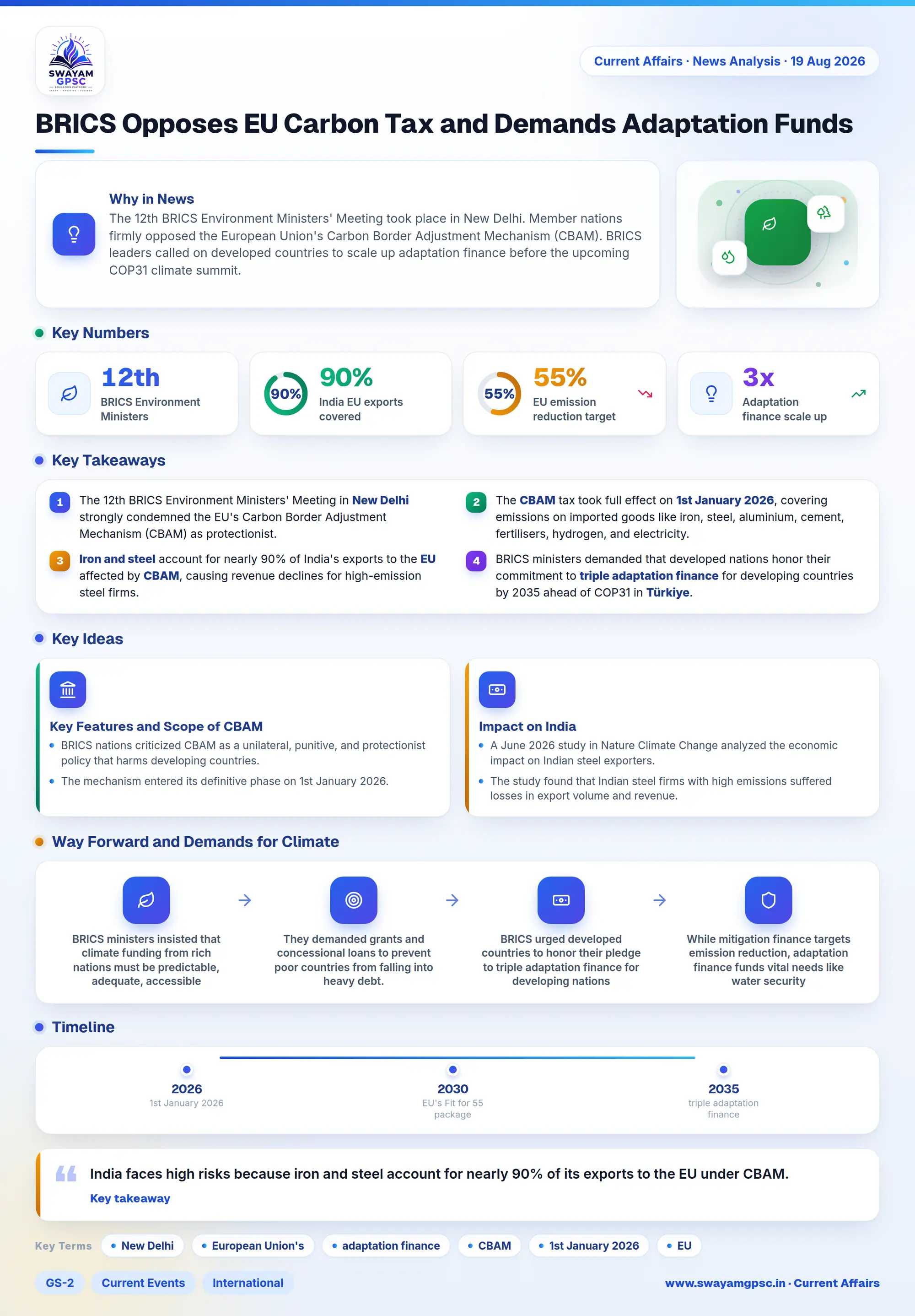
BRICS Opposes EU Carbon Tax and Demands Adaptation Funds
#GS-2 #Current Events #International #Bilateral Groupings & Agreements #GS-3 #Environment #Climate Change #Economy
Key takeaways
- The 12th BRICS Environment Ministers' Meeting in New Delhi strongly condemned the EU's Carbon Border Adjustment Mechanism (CBAM) as protectionist.
- The CBAM tax took full effect on 1st January 2026, covering emissions on imported goods like iron, steel, aluminium, cement, fertilisers, hydrogen, and electricity.
- Iron and steel account for nearly 90% of India's exports to the EU affected by CBAM, causing revenue declines for high-emission steel firms.
- BRICS ministers demanded that developed nations honor their commitment to triple adaptation finance for developing countries by 2035 ahead of COP31 in Türkiye.
Why in News
- The 12th BRICS Environment Ministers' Meeting took place in New Delhi.
- Member nations firmly opposed the European Union's Carbon Border Adjustment Mechanism (CBAM).
- BRICS leaders called on developed countries to scale up adaptation finance before the upcoming COP31 climate summit.
Key Features and Scope of CBAM
- BRICS nations criticized CBAM as a unilateral, punitive, and protectionist policy that harms developing countries.
- The mechanism entered its definitive phase on 1st January 2026.
- Importers of carbon-heavy products like iron and steel, aluminium, cement, fertilisers, hydrogen, and electricity must pay for production emissions.
- The EU claims this tax prevents carbon leakage, where companies shift production to countries with weaker climate rules.
- CBAM is a major element of the EU's Fit for 55 package, which aims to cut greenhouse gas emissions by 55% by 2030 compared to 1990 levels.
Impact on India
- India faces high risks because iron and steel account for nearly 90% of its exports to the EU under CBAM.
- A June 2026 study in Nature Climate Change analyzed the economic impact on Indian steel exporters.
- The study found that Indian steel firms with high emissions suffered losses in export volume and revenue.
- In contrast, Indian steel producers with lower emissions successfully maintained their export levels to European markets.
Way Forward and Demands for Climate Finance
- BRICS ministers insisted that climate funding from rich nations must be predictable, adequate, accessible, and additional.
- They demanded grants and concessional loans to prevent poor countries from falling into heavy debt.
- BRICS urged developed countries to honor their pledge to triple adaptation finance for developing nations by 2035.
- While mitigation finance targets emission reduction, adaptation finance funds vital needs like water security, resilient agriculture, infrastructure, and disaster management.
- Resolving adaptation finance is critical before COP31 in Türkiye in November 2026, especially after talks stalled at the June 2026 Bonn climate conference.