BRICS New Development Bank (NDB) Overview and Operations
#GS-2 #Current Events #International #GS-3 #Economy #Banking #Infrastructure #BRICS #New Development Bank
Key takeaways
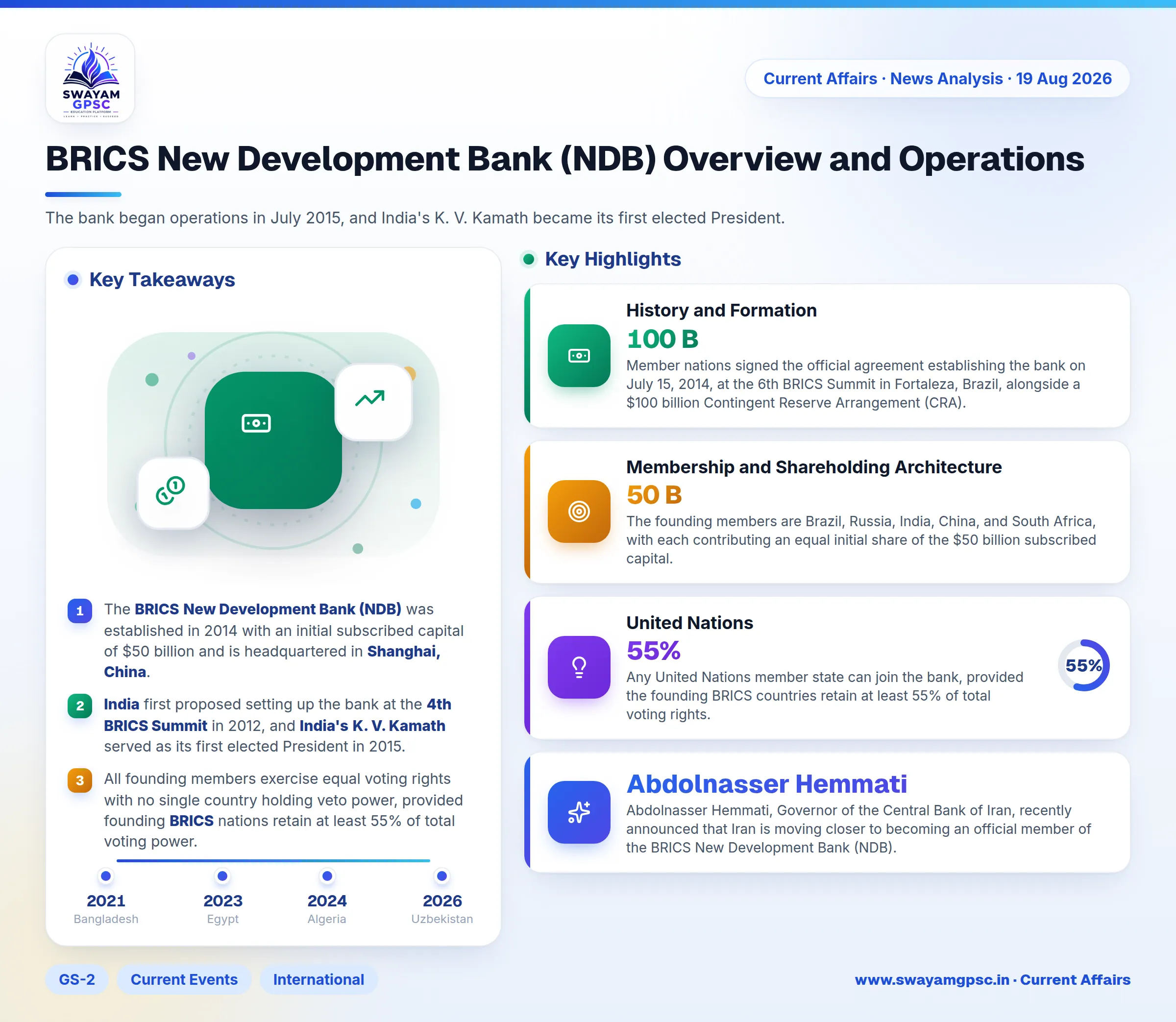
- The BRICS New Development Bank (NDB) was established in 2014 with an initial subscribed capital of $50 billion and is headquartered in Shanghai, China.
- India first proposed setting up the bank at the 4th BRICS Summit in 2012, and India's K. V. Kamath served as its first elected President in 2015.
- All founding members exercise equal voting rights with no single country holding veto power, provided founding BRICS nations retain at least 55% of total voting power.
- The bank has expanded beyond its founders to admit Bangladesh, UAE, Egypt, Algeria, and Uzbekistan, with Iran currently advancing toward membership.
Why in News
- Abdolnasser Hemmati, Governor of the Central Bank of Iran, recently announced that Iran is moving closer to becoming an official member of the BRICS New Development Bank (NDB).
What It Is
- The New Development Bank (NDB) was earlier known as the BRICS Development Bank, which was set up by the founding BRICS nations as a multilateral development institution.
- Its headquarters is located in Shanghai, China, and it provides loans, equity investments, guarantees, and technical help for sustainable infrastructure in developing countries.
History and Formation
- India first proposed setting up a South-South development bank in 2012 during the 4th BRICS Summit held in New Delhi.
- Member nations signed the official agreement establishing the bank on July 15, 2014, at the 6th BRICS Summit in Fortaleza, Brazil, alongside a $100 billion Contingent Reserve Arrangement (CRA).
- The bank began operations in July 2015, and India's K. V. Kamath became its first elected President.
- The bank established regional offices in Johannesburg (South Africa), São Paulo (Brazil), Moscow (Russia), and GIFT City, Gujarat (India).
Membership and Shareholding Architecture
- The founding members are Brazil, Russia, India, China, and South Africa, with each contributing an equal initial share of the $50 billion subscribed capital.
- Unlike the Bretton Woods institutions, no single country holds veto power, ensuring all founding members enjoy equal voting rights.
- Any United Nations member state can join the bank, provided the founding BRICS countries retain at least 55% of total voting rights.
- Bangladesh officially joined the bank as a member in 2021.
- The United Arab Emirates was admitted as a member state in 2021.
- Egypt joined the bank through membership approvals in 2021 and 2023.
- Algeria became an official member state of the bank in 2024.
- Uzbekistan is scheduled to join as a new member in 2026.
Key Functions of the NDB
- The bank provides long-term sovereign and non-sovereign loans, equity, and credit guarantees for key areas such as clean energy, transport, water management, and digital infrastructure.
- It offers loans in domestic currencies of member countries, protecting developing economies from foreign exchange volatility and global interest rate hikes.
- The bank focuses on climate-resilient projects and issues green bonds to support renewable energy transitions and environmental standards.
- It runs emergency assistance programs to offer budgetary support to member countries during major economic shocks or public health crises.
- It provides technical guidance, project feasibility studies, and capacity-building support to help developing nations prepare projects quickly.