Breaking the AI Hegemony: India's Path to AI Sovereignty
#GS-2 #GS-3 #Governance & Social Justice #Current Events #Economy #Science & Technology #Artificial Intelligence #Infrastructure #Government Policies & Interventions
Key takeaways
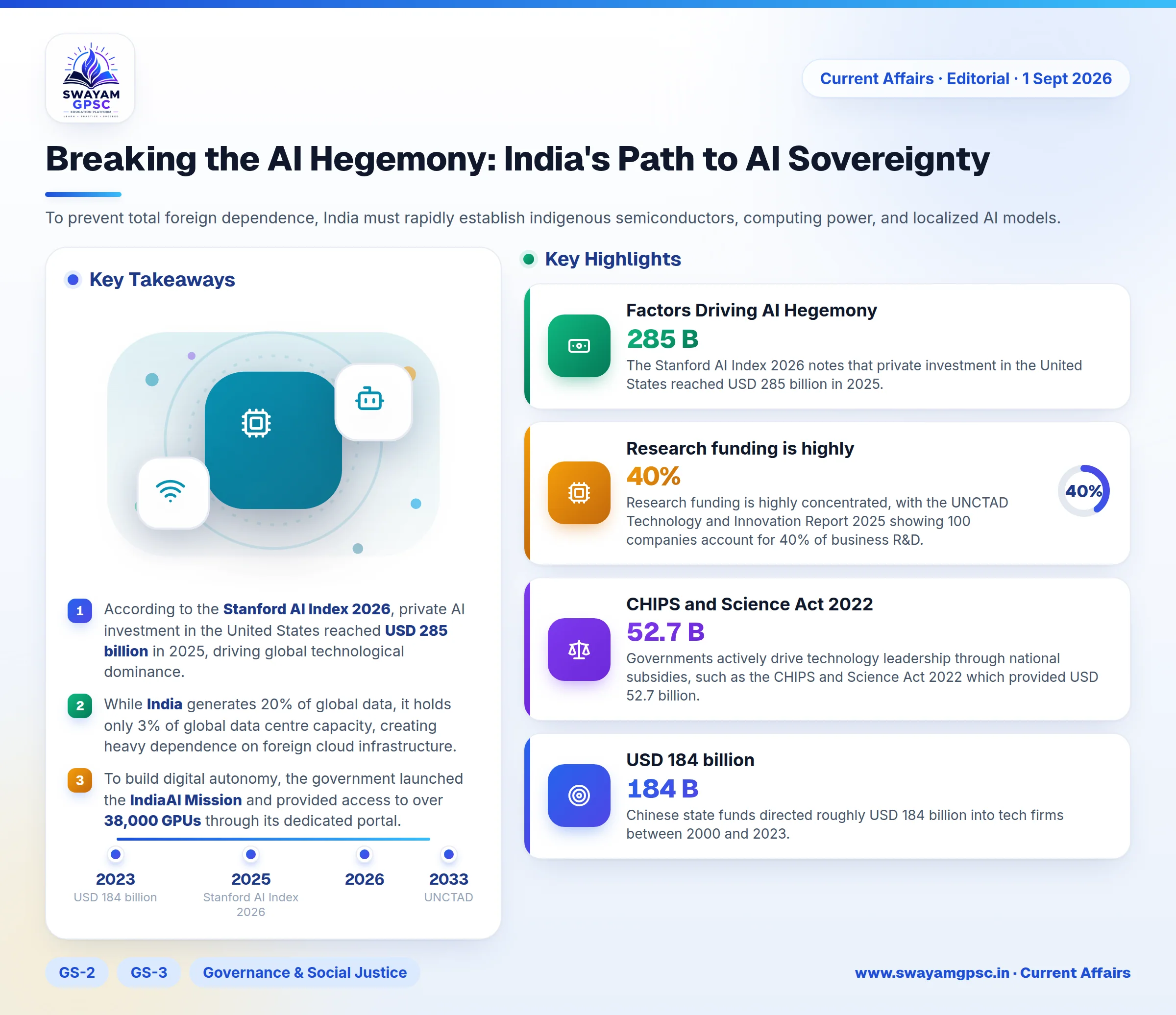
- According to the Stanford AI Index 2026, private AI investment in the United States reached USD 285 billion in 2025, driving global technological dominance.
- While India generates 20% of global data, it holds only 3% of global data centre capacity, creating heavy dependence on foreign cloud infrastructure.
- To build digital autonomy, the government launched the IndiaAI Mission and provided access to over 38,000 GPUs through its dedicated portal.
- India has approved 10 semiconductor projects worth Rs 1.60 lakh crore across 6 States to boost local chip design and manufacturing.
Why in News
- The growing technological competition between the United States and China threatens to create a digital divide for emerging economies.
- Major technological powers are fighting for dominance across chips, data centres, foundation models, and global governance rules.
- China is promoting its World Artificial Intelligence Cooperation Organization (WAICO) to build tech alliances across the Global South.
- To prevent total foreign dependence, India must rapidly establish indigenous semiconductors, computing power, and localized AI models.
Understanding AI Hegemony
- AI hegemony occurs when a few advanced nations and mega-corporations control critical computing chips, foundational models, data, and governance rules.
- This concentrated control allows dominant actors to dictate economic opportunities, public policy, cultural values, and national security choices for other countries.
- Rather than using physical military force, this power operates through control over algorithms and technological dependencies.
- On a geopolitical level, leading nations use their technological edge to influence international alliances, trade rules, and security agreements.
- A small cluster of tech corporations controls major cloud platforms and foundation models, setting prices and strict terms for global users.
- Dominance over computing infrastructure acts as a technological gateway because training advanced models requires massive clusters of specialised chips.
- Data colonialism happens when global firms extract behavioral data from developing nations without sharing the resulting financial rewards.
- Large-scale surveillance systems like facial recognition allow governments and corporations to monitor citizens without proper oversight.
- In military affairs, advanced software enhances autonomous weapons and battlefield intelligence, sparking a global arms race.
- Leading economies keep high-value tasks like chip design, leaving developing nations as consumers or low-wage data annotators.
- Technological leadership turns into hegemony when countries weaponize their advantage to create permanent foreign dependence.
- Ultimately, this dominance influences how other societies create knowledge, make decisions, and shape their future.
Factors Driving AI Hegemony
- Developing top-tier models requires billions of dollars in hardware, electricity, and skilled talent that only wealthy entities can afford.
- The Stanford AI Index 2026 notes that private investment in the United States reached USD 285 billion in 2025.
- In 2025, the United States added 1,953 newly funded AI companies, which is ten times more than any other country.
- High computing costs prevent smaller nations from training competitive foundation models, forcing them to rely on foreign cloud platforms.
- Global computing capacity has grown 30-fold since 2021, highlighting the massive scale of the ongoing technology race.
- The World Bank identifies computing capacity, connectivity, data, and skills as the four essentials for participating in the digital economy.
- Key components like GPUs and chip manufacturing equipment remain heavily concentrated within a few companies like NVIDIA, TSMC, and ASML.
- Powerful states use export controls on critical hardware to limit technological access for competing nations.
- Three major companies, Amazon Web Services, Microsoft Azure, and Google Cloud, host most of the world's model training systems.
- Tech giants use vertical integration across chips, cloud platforms, and end-user apps to block competition from smaller firms.
- Research funding is highly concentrated, with the UNCTAD Technology and Innovation Report 2025 showing 100 companies account for 40% of business R&D.
- Intellectual property mechanisms like patents and closed model weights force developing nations to pay costly licensing fees.
- Governments actively drive technology leadership through national subsidies, such as the CHIPS and Science Act 2022 which provided USD 52.7 billion.
- Chinese state funds directed roughly USD 184 billion into tech firms between 2000 and 2023.
- UNCTAD estimates the global AI market will expand from USD 189 billion in 2023 to USD 4.8 trillion by 2033.
Challenges: India's Vulnerability to AI Hegemony
- India relies entirely on foreign manufacturers like NVIDIA, AMD, and TSMC for high-end GPUs and AI accelerators.
- Trade restrictions or foreign supply chain disruptions could severely limit access to crucial computing hardware.
- Local research entities lack access to frontier-scale computing clusters compared to foreign tech giants.
- The World Bank reports that high-income nations host 77% of data centre capacity, while lower-middle-income nations hold just 5%.
- Although India generates 20% of global data, the country contains only 3% of global data centre capacity.
- Foreign firms like Microsoft Azure, AWS, and Google Cloud control an 87% market share in cloud infrastructure.
- Local initiatives like Sarvam, BharatGen, AI4Bharat, and Krutrim exist, but high-income countries account for 87% of top models.
- Domestic deep-tech startups struggle with capital shortages because high-income nations receive 91% of global venture capital funding.
- Using proprietary foreign software in public services like healthcare and policing exposes public data and creates vendor lock-in.
- Although India joined forums like Pax Silica, global standard-setting remains dominated by Western corporations without a unified global regulator.
- Reliance on models trained on Western datasets threatens local cultural context, language nuances, and epistemic sovereignty.
India's Initiatives for AI Sovereignty
- The government launched the comprehensive IndiaAI Mission structured around seven key operational pillars.
- The IndiaAI Compute Portal gives local researchers and startups subsidized access to 38,000 GPUs and 1,050 TPUs.
- Authorities are building a dedicated cluster of 3,000 next-generation GPUs specifically for sovereign and strategic applications.
- Domestic projects are creating native models, including Sarvam 30B, Sarvam 105B, and Soket AI's 120-billion-parameter model.
- The state-funded BharatGen initiative, launched in 2025, delivers a multimodal AI platform supporting 22 Indian languages.
- The BHASHINI platform provides language translation tools to preserve linguistic diversity across digital services.
- The AIKosh platform offers localized datasets and tools for health, agriculture, and governance to reduce reliance on foreign data.
- Under the India Semiconductor Mission, 10 projects worth Rs 1.60 lakh crore were sanctioned across 6 States by December 2025.
- Budget 2026-27 introduced Semiconductor Mission 2.0 to focus on advanced chip research and workforce skills.
- The IndiaAI FutureSkills program is establishing 570 AI Data Labs across Tier-2 and Tier-3 cities to train local talent.
- India uses global platforms like GPAI, G20, and the India-AI Impact Summit 2026 to help shape international technology rules.
Way Forward
- India must build end-to-end capabilities across silicon design, cloud setup, and foundation models rather than relying only on user applications.
- Public procurement should require local content rules, open APIs, and data portability clauses to protect national digital interests.
- The country should establish a vendor-neutral compute sharing network backed by public interest vouchers for startups and MSMEs.
- National strategy should include strategic GPU reserves for defense and emergency management, verified through regular stress tests.
- Long-term funding must support open chip designs like RISC-V, with government departments acting as primary buyers for local chips.
- Consortia combining universities, research labs, and industry should build open-weight foundation models optimized for local needs.
- Sensitive sectors like banking and healthcare should use multiple independent models under an algorithmic diversity mandate to avoid single-point failures.
- Legal framework should create data cooperatives and an Indic Intelligence Vault to protect civilisational knowledge while granting communities control over their data.
- Foreign firms operating in the country should offer reciprocal benefits like technology transfers and domestic compute investments.
- Public funds must provide long-term capital to deep-tech startups to prevent forced foreign buyouts of local intellectual property.
- India should maintain strategic non-alignment in technology policy, partnering with multiple countries while assisting the Global South.