Boosting Women's Workforce Participation for Economic Growth in India
#GS-2 #Indian Society #Women #Social Justice #GS-3 #Economy #Growth #Employment #Current Events #National
Why in News
- Leading economists emphasize that India cannot realize its ambition of becoming a developed nation (Viksit Bharat) by 2047 without a structural rise in female labor force participation.
What is Women's Work Participation?
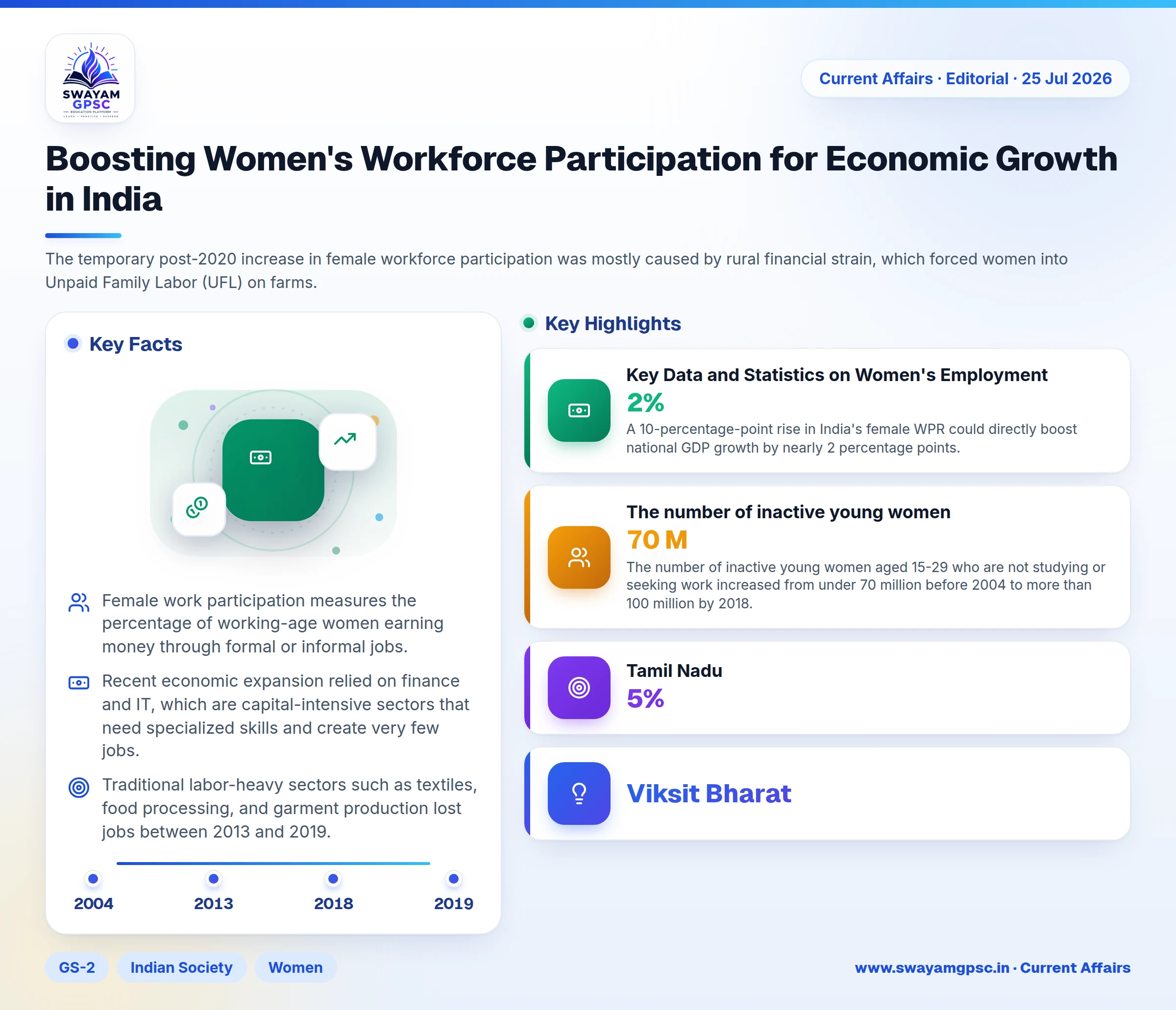
- Female work participation measures the percentage of working-age women earning money through formal or informal jobs. Historically, India's female Work Participation Rate (WPR) followed a U-shaped trend, dropping as rural women stopped doing manual farm labor without gaining non-farm jobs.
Key Data and Statistics on Women's Employment
- A 10-percentage-point rise in India's female WPR could directly boost national GDP growth by nearly 2 percentage points.
- The number of inactive young women aged 15-29 who are not studying or seeking work increased from under 70 million before 2004 to more than 100 million by 2018.
- The temporary post-2020 increase in female workforce participation was mostly caused by rural financial strain, which forced women into Unpaid Family Labor (UFL) on farms.
- Although Tamil Nadu accounts for only 5%-6% of India's population, it employs over 40% of the country's female factory workforce because of good garment factories, electronics units, and safe hostels.
Challenges
- Recent economic expansion relied on finance and IT, which are capital-intensive sectors that need specialized skills and create very few jobs.
- Traditional labor-heavy sectors such as textiles, food processing, and garment production lost jobs between 2013 and 2019.
- Greater farm automation cut the demand for manual field workers, while a shortage of non-farm jobs left educated young women without suitable options.
- Deeply rooted social expectations, safety concerns, and a lack of secure transport and housing keep young women from accepting formal jobs in cities.
Significance of Increasing Female Workforce Participation
- Bringing more women into the workforce expands the national labor supply, which increases total economic output.
- Providing paid jobs to women boosts family earnings, which increases consumer spending and household savings.
- Higher earnings for women lead to better nutrition, health, and schooling for children, strengthening national human capital over time.
- Building gender-diverse teams improves corporate productivity, workplace innovation, and overall business competitiveness.
Way Forward
- The government should support job-heavy industries such as footwear, garments, food processing, and electronics assembly through focused policies.
- States should build dedicated working-women hostels, improve female literacy, and offer safe public transit based on Tamil Nadu's successful model.
- Public spending on healthcare and schooling must increase across Hindi-belt states to resolve high child malnutrition and stunting rates.
- Creating formal non-farm jobs is essential to help rural women move away from unpaid work on family farms.
Conclusion
- India cannot reach its Viksit Bharat target while leaving half of its citizens out of productive employment. Solving this employment challenge requires boosting job-creating manufacturing and strengthening social infrastructure for working women.
- Helping educated young women switch from unpaid housework to formal jobs will serve as the most effective growth engine for the nation.