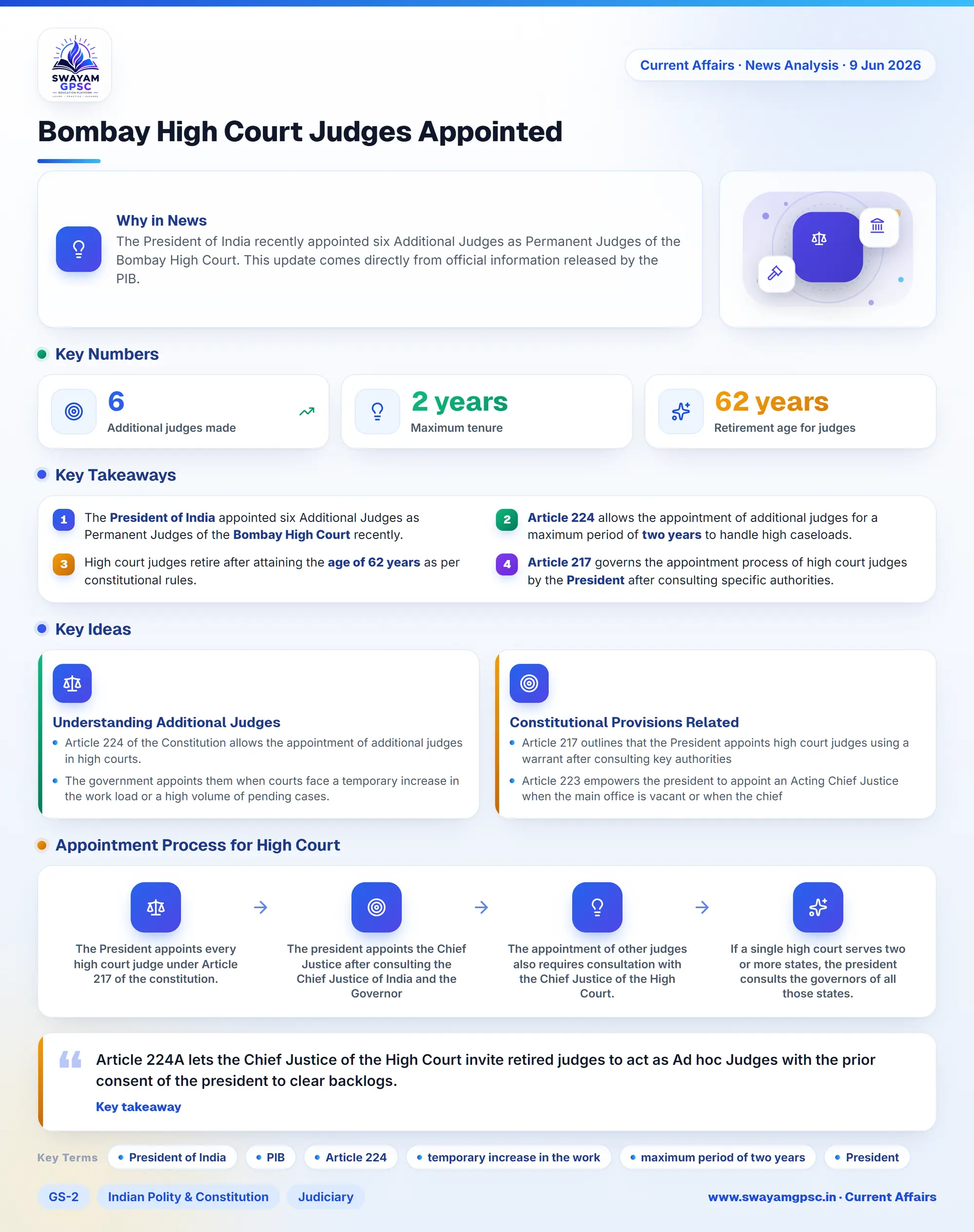
Bombay High Court Judges Appointed
#GS-2 #Indian Polity & Constitution #Judiciary #Constitutional Bodies #Current Events #National #Quick Facts For Prelims
Key takeaways
- The President of India appointed six Additional Judges as Permanent Judges of the Bombay High Court recently.
- Article 224 allows the appointment of additional judges for a maximum period of two years to handle high caseloads.
- High court judges retire after attaining the age of 62 years as per constitutional rules.
- Article 217 governs the appointment process of high court judges by the President after consulting specific authorities.
Why in News
- The President of India recently appointed six Additional Judges as Permanent Judges of the Bombay High Court.
- This update comes directly from official information released by the PIB.
Understanding Additional Judges
- Article 224 of the Constitution allows the appointment of additional judges in high courts.
- The government appoints them when courts face a temporary increase in the work load or a high volume of pending cases.
- An additional judge serves for a maximum period of two years and must retire after reaching the age of 62 years.
Appointment Process for High Court Judges
- The President appoints every high court judge under Article 217 of the constitution.
- The president appoints the Chief Justice after consulting the Chief Justice of India and the Governor of the respective state.
- The appointment of other judges also requires consultation with the Chief Justice of the High Court.
- If a single high court serves two or more states, the president consults the governors of all those states.
Constitutional Provisions Related to Appointments
- Article 217 outlines that the President appoints high court judges using a warrant after consulting key authorities like the Chief Justice of India and the Governor.
- Article 223 empowers the president to appoint an Acting Chief Justice when the main office is vacant or when the chief justice cannot perform duties.
- Article 224(1) allows the appointment of Additional Judges for up to 2 years to handle temporary workload spikes or case backlogs.
- Article 224(2) enables the President to appoint an Acting Judge when a sitting judge is absent or takes up the role of chief justice.
- Article 224A lets the Chief Justice of the High Court invite retired judges to act as Ad hoc Judges with the prior consent of the president to clear backlogs.