Blueprint for India's Climate Adaptation
#GS-3 #Environment #Climate Change #Sustainable Development #Economy #Agriculture #Infrastructure #National
Why in News
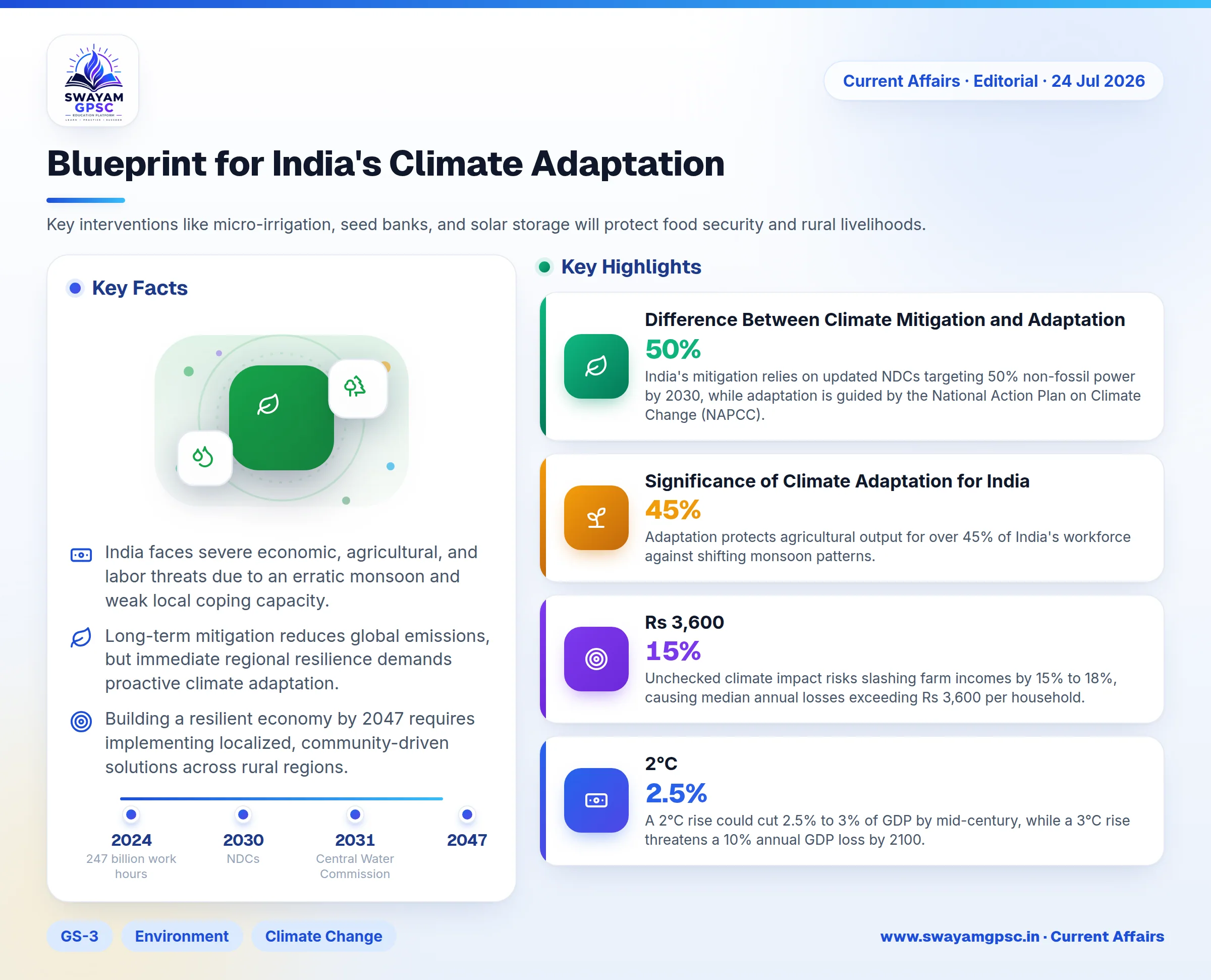
- India faces severe economic, agricultural, and labor threats due to an erratic monsoon and weak local coping capacity.
- Long-term mitigation reduces global emissions, but immediate regional resilience demands proactive climate adaptation.
- Building a resilient economy by 2047 requires implementing localized, community-driven solutions across rural regions.
- Key interventions like micro-irrigation, seed banks, and solar storage will protect food security and rural livelihoods.
Difference Between Climate Mitigation and Adaptation
- Climate mitigation reduces greenhouse gas (GHG) emissions or enhances carbon sinks, whereas climate adaptation adjusts systems to actual or expected climate effects.
- Mitigation aims to limit global temperature rise well below 2°C under the Paris Agreement, while adaptation focuses on short-term survival and resilience.
- Mitigation requires decades for energy transitions to yield atmospheric results, whereas adaptation addresses immediate weather extremes and vulnerabilities.
- Mitigation is measured globally in metric tons of carbon emissions reduced, while adaptation is tracked locally through livelihood and infrastructure resilience indexes.
- India's mitigation relies on updated NDCs targeting 50% non-fossil power by 2030, while adaptation is guided by the National Action Plan on Climate Change (NAPCC).
- Mitigation includes scaling up the National Solar Mission and green hydrogen, while adaptation involves retrofitting urban drainage and coastal embankments.
- Mitigation utilizes the Green India Mission and natural farming, whereas adaptation expands Pradhan Mantri Krishi Sinchayee Yojana (PMKSY) and drought-resilient crops.
- Mitigation uses sovereign green bonds and the National Clean Energy Fund (NCEF), while adaptation relies on the National Adaptation Fund for Climate Change (NAFCC) and NDMA funds.
Significance of Climate Adaptation for India
- Adaptation protects agricultural output for over 45% of India's workforce against shifting monsoon patterns.
- Unchecked climate impact risks slashing farm incomes by 15% to 18%, causing median annual losses exceeding Rs 3,600 per household.
- Strategic adaptation shields the economy from supply shocks, keeping India on track for its 2047 developed nation goal.
- A 2°C rise could cut 2.5% to 3% of GDP by mid-century, while a 3°C rise threatens a 10% annual GDP loss by 2100.
- Workplace cooling rules safeguard outdoor workers in construction, agriculture, and manufacturing from extreme heat stress.
- Extreme heat cost India 247 billion work hours in 2024, causing an estimated $194 billion loss in potential income.
- Advanced water management keeps industrial hubs and rural areas stable despite growing hydrological deficits.
- According to the Central Water Commission (CWC), per capita water dropped from 5,177 m3 in 1951 to 1,486 m3 in 2021, and will reach 1,367 m3 by 2031.
- Fortifying coasts protects ports and economic corridors from severe tropical cyclones and storm surges.
- Data from NDMA shows that nearly 5,700 km or 76% of India's mainland coastline is vulnerable to severe cyclones and tsunamis.
- Ministry of Earth Sciences reports reveal that 33.6% of India's mainland coastline currently faces active coastal erosion.
- Climate risk integration protects commercial banks against loan defaults and structural asset depreciation.
- The Reserve Bank of India (RBI) created the Climate Risk Information System to conduct stress tests across commercial banks.
- Upgrading primary health units insulates local health systems against expanding vector-borne disease zones.
- Expanded transmission windows for malaria and dengue add millions of dollars annually to direct public and household expenditures.
Strategies Required for Climate Adaptation
- Local volunteers should track water tables using rain gauges to prepare compulsory crop advisories before sowing seasons.
- Gram Panchayats must lead hydrological monitoring so farmers avoid drilling deep borewells during drought periods.
- Elevate home plinths using compressed blocks and resin-treated bamboo frame structures to withstand seasonal flooding.
- Rural employment schemes should incorporate flood-proof housing construction for marginalized families using local labor.
- Decentralized solar panels with thermal battery units can prevent produce spoilage during heatwaves and power cuts.
- Farmer Producer Organisations (FPOs) should manage community solar hubs to hold perishable crops until market prices normalize.
- Planting multi-layered root systems of native drought-resistant shrubs stops soil erosion and acts as a windbreak.
- Local communities should plant green belts along stream corridors without relying on costly civil construction contracts.
- Equipped field volunteers can use offline tablets to supply weather alerts and trigger parametric insurance claims.
- Facilitation desks at weekly rural markets (haats) can help small farmers assess risk and submit insurance documentation easily.
- Farmers should deposit drought-resistant millet and pulse seeds into local vaults to draw upon during uncertain monsoons.
- Women's Self-Help Groups (SHGs) should operate seed banks with technical support from agricultural universities.
- Farmers can dig plastic-lined micro-pits (gadiyas) within farm plots to retain rainwater runoff for dry spell irrigation.
- Linking farm water harvesting structures directly to rural labor budgets incentivizes plot-level micro-water security.
- Planting deep-rooted multi-purpose trees delivers continuous fodder for animals while preserving topsoil moisture for crops.
- Providing saplings of indigenous fodder trees to dairy farmers protects livestock against climate-driven feed shortages.
Conclusion
- India's gap in climate adaptation capacity poses severe risks to its agricultural economy, workforce, and financial stability.
- Closing this gap requires shifting from top-down policies to decentralized, community-managed climate action strategies.
- Building resilient water, food, and infrastructure systems remains essential to securing stable macroeconomic growth by 2047.
Frequently Asked Questions
- Mitigation reduces emissions to curb climate change roots, while adaptation manages existing impacts to build resilience.
- Adaptation protects GDP against projected 2.5% to 3% losses and safeguards millions of agrarian livelihoods.
- Water availability will drop to 1,367 m3 by 2031, creating intense hydrological stress across urban and rural regions.