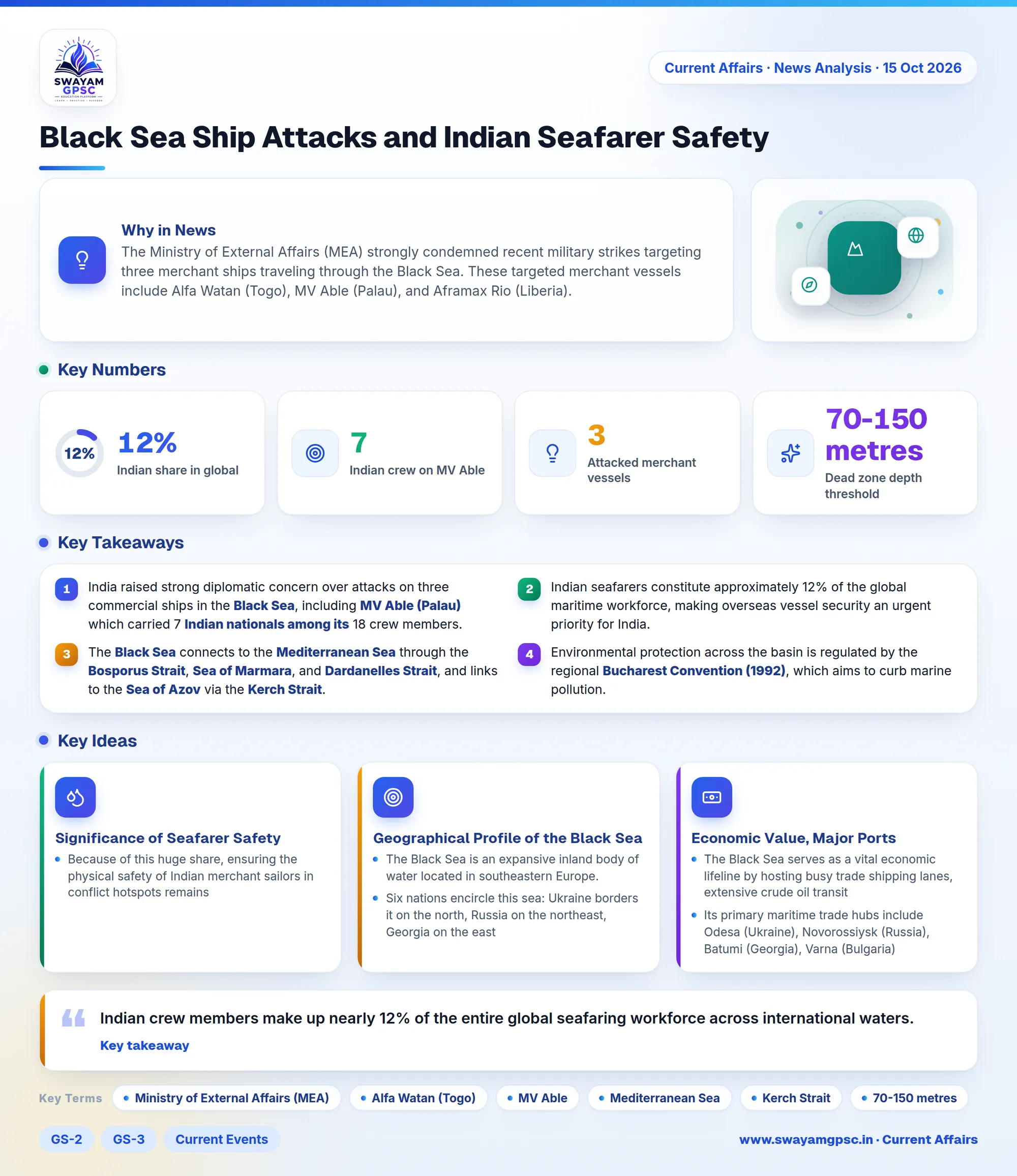
Black Sea Ship Attacks and Indian Seafarer Safety
#GS-2 #GS-3 #Current Events #International #Geography #Physical Geography #Resources #International Relations #Maritime Security
Key takeaways
- India raised strong diplomatic concern over attacks on three commercial ships in the Black Sea, including MV Able (Palau) which carried 7 Indian nationals among its 18 crew members.
- Indian seafarers constitute approximately 12% of the global maritime workforce, making overseas vessel security an urgent priority for India.
- The Black Sea connects to the Mediterranean Sea through the Bosporus Strait, Sea of Marmara, and Dardanelles Strait, and links to the Sea of Azov via the Kerch Strait.
- Environmental protection across the basin is regulated by the regional Bucharest Convention (1992), which aims to curb marine pollution.
Why in News
- The Ministry of External Affairs (MEA) strongly condemned recent military strikes targeting three merchant ships traveling through the Black Sea.
- These targeted merchant vessels include Alfa Watan (Togo), MV Able (Palau), and Aframax Rio (Liberia).
- Among the 18 sailors onboard the ship MV Able, 7 crew members are Indian citizens.
Significance of Seafarer Safety for India
- Indian crew members make up nearly 12% of the entire global seafaring workforce across international waters.
- Because of this huge share, ensuring the physical safety of Indian merchant sailors in conflict hotspots remains a vital priority.
Geographical Profile of the Black Sea
- The Black Sea is an expansive inland body of water located in southeastern Europe.
- Six nations encircle this sea: Ukraine borders it on the north, Russia on the northeast, Georgia on the east, Turkey on the south, and Bulgaria together with Romania on the west.
- It links with the Mediterranean Sea via the Bosporus Strait, the inland Sea of Marmara, and the Dardanelles Strait.
- In the northeast, the narrow Kerch Strait connects it directly into the Sea of Azov.
- Waters deeper than about 70-150 metres lack dissolved oxygen and hold toxic hydrogen sulphide, forming an extraordinary marine dead zone.
Economic Value, Major Ports, and Conservation
- The Black Sea serves as a vital economic lifeline by hosting busy trade shipping lanes, extensive crude oil transit, commercial fishing, and coastal tourism.
- Its primary maritime trade hubs include Odesa (Ukraine), Novorossiysk (Russia), Batumi (Georgia), Varna (Bulgaria), and Constanța (Romania).
- The regional Bucharest Convention (1992) sets up an environmental pact to limit maritime pollution and conserve marine species throughout the basin.