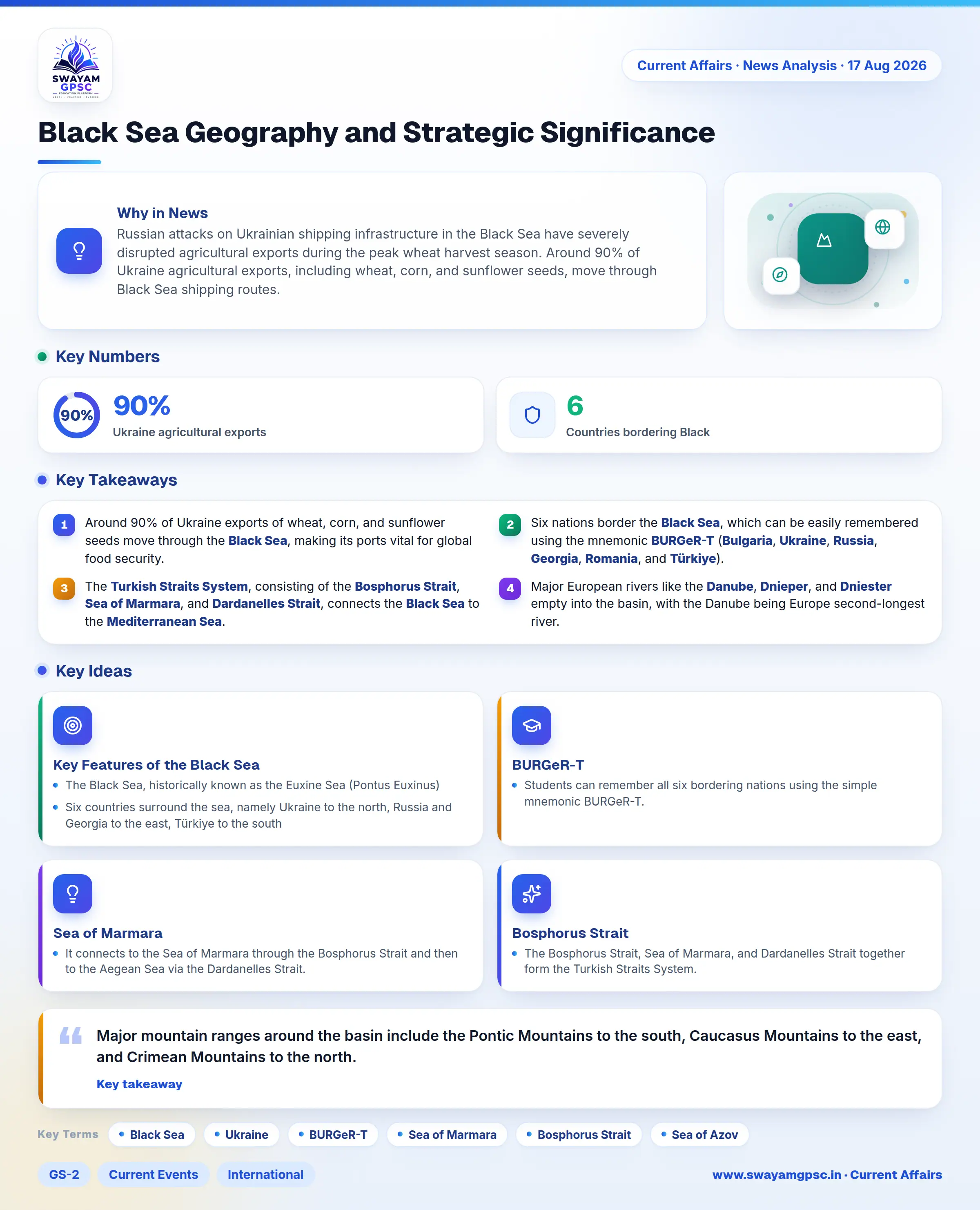
Black Sea Geography and Strategic Significance
#GS-2 #Current Events #International #GS-3 #Geography #Physical Geography #Resources #Black Sea
Key takeaways
- Around 90% of Ukraine exports of wheat, corn, and sunflower seeds move through the Black Sea, making its ports vital for global food security.
- Six nations border the Black Sea, which can be easily remembered using the mnemonic BURGeR-T (Bulgaria, Ukraine, Russia, Georgia, Romania, and Türkiye).
- The Turkish Straits System, consisting of the Bosphorus Strait, Sea of Marmara, and Dardanelles Strait, connects the Black Sea to the Mediterranean Sea.
- Major European rivers like the Danube, Dnieper, and Dniester empty into the basin, with the Danube being Europe second-longest river.
Why in News
- Russian attacks on Ukrainian shipping infrastructure in the Black Sea have severely disrupted agricultural exports during the peak wheat harvest season.
- Around 90% of Ukraine agricultural exports, including wheat, corn, and sunflower seeds, move through Black Sea shipping routes.
Key Features of the Black Sea
- The Black Sea, historically known as the Euxine Sea (Pontus Euxinus), is a large inland sea situated between Eastern Europe and Western Asia.
- Six countries surround the sea, namely Ukraine to the north, Russia and Georgia to the east, Türkiye to the south, and Bulgaria and Romania to the west.
- Students can remember all six bordering nations using the simple mnemonic BURGeR-T.
- It connects to the Sea of Marmara through the Bosphorus Strait and then to the Aegean Sea via the Dardanelles Strait.
- The Bosphorus Strait, Sea of Marmara, and Dardanelles Strait together form the Turkish Straits System.
- Towards the northeast, the sea connects with the Sea of Azov through the narrow Strait of Kerch.
- Major mountain ranges around the basin include the Pontic Mountains to the south, Caucasus Mountains to the east, and Crimean Mountains to the north.
- Important rivers flowing into the sea include the Danube, Dnieper, and Dniester, with the Danube being Europe second-longest river after the Volga.
- The maritime passage serves as a vital global trade route for essential commodities like grain, fertilisers, and energy products.
- During the conflict, Ukraine has used drones and anti-ship missiles to challenge Russian naval domination in these waters.