Birth Anniversary of Dr. Sarvepalli Radhakrishnan and Teachers' Day
#GS-1 #History #Modern India #Important Personalities #GS-4 #Ethics #Moral Thinkers #Current Events #National
Key takeaways
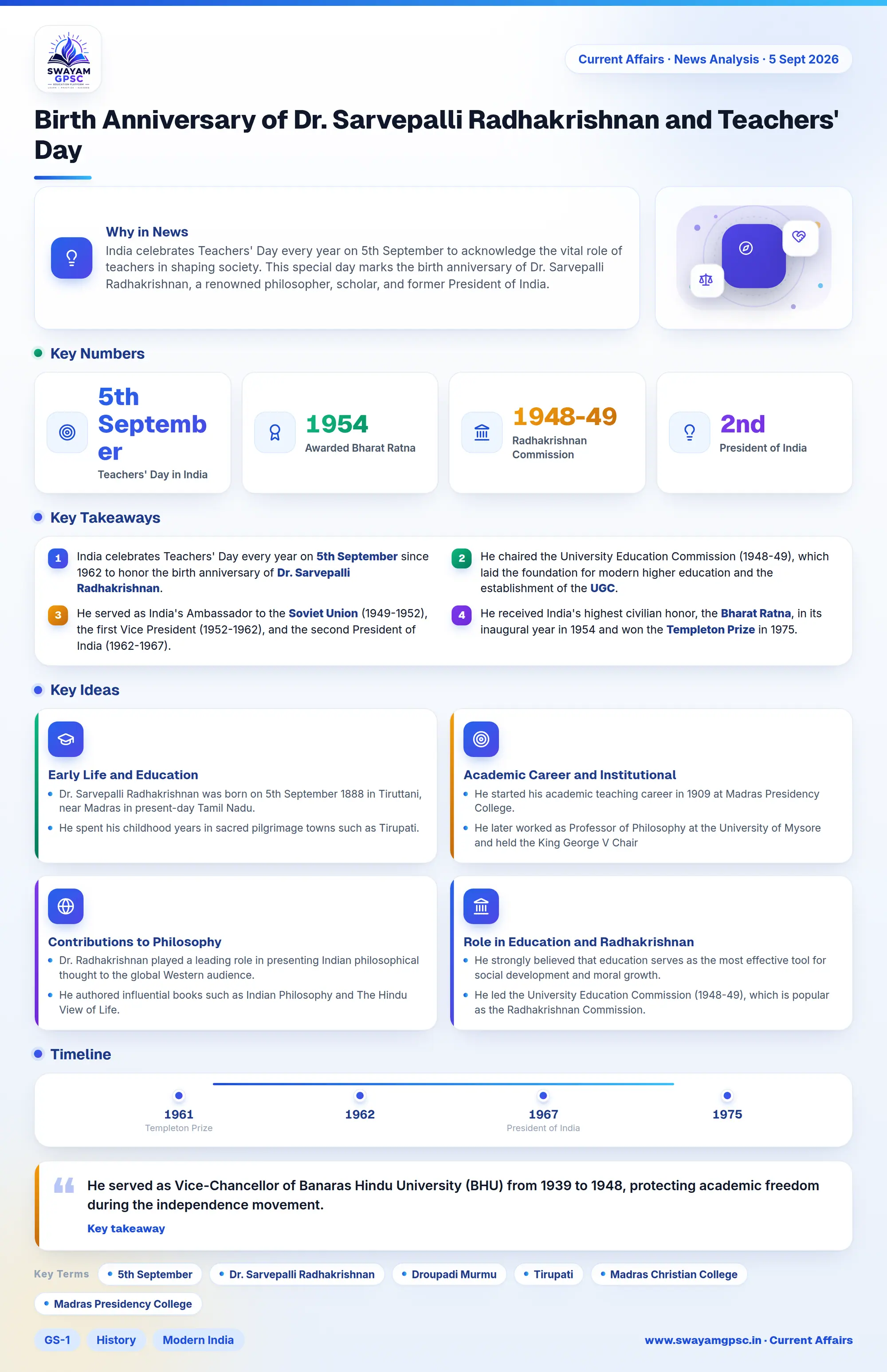
- India celebrates Teachers' Day every year on 5th September since 1962 to honor the birth anniversary of Dr. Sarvepalli Radhakrishnan.
- He chaired the University Education Commission (1948-49), which laid the foundation for modern higher education and the establishment of the UGC.
- He served as India's Ambassador to the Soviet Union (1949-1952), the first Vice President (1952-1962), and the second President of India (1962-1967).
- He received India's highest civilian honor, the Bharat Ratna, in its inaugural year in 1954 and won the Templeton Prize in 1975.
Why in News
- India celebrates Teachers' Day every year on 5th September to acknowledge the vital role of teachers in shaping society.
- This special day marks the birth anniversary of Dr. Sarvepalli Radhakrishnan, a renowned philosopher, scholar, and former President of India.
- President Droupadi Murmu extended her greetings to teachers and citizens across the nation on the eve of Teachers' Day.
- India has observed this national celebration annually since 1962.
Early Life and Education
- Dr. Sarvepalli Radhakrishnan was born on 5th September 1888 in Tiruttani, near Madras in present-day Tamil Nadu.
- He spent his childhood years in sacred pilgrimage towns such as Tirupati.
- He completed his studies at Madras Christian College and earned his Master's degree from Madras University.
- His MA dissertation titled The Ethics of the Vedanta and Its Metaphysical Presuppositions defended the ethical values of Hindu philosophy.
Academic Career and Institutional Leadership
- He started his academic teaching career in 1909 at Madras Presidency College.
- He later worked as Professor of Philosophy at the University of Mysore and held the King George V Chair at the University of Calcutta.
- He served as Vice-Chancellor of Banaras Hindu University (BHU) from 1939 to 1948, protecting academic freedom during the independence movement.
- He became the first Indian appointed to the Spalding Professorship of Eastern Religions and Ethics at Oxford University.
- The British Academy elected him as a Fellow in 1939 for his outstanding scholarly work.
Contributions to Philosophy
- Dr. Radhakrishnan played a leading role in presenting Indian philosophical thought to the global Western audience.
- He authored influential books such as Indian Philosophy and The Hindu View of Life.
- His writings built strong bridges between Western philosophy and Eastern spiritual traditions.
- He focused on comparative religion to encourage mutual understanding among different cultures.
Role in Education and Radhakrishnan Commission
- He strongly believed that education serves as the most effective tool for social development and moral growth.
- He led the University Education Commission (1948-49), which is popular as the Radhakrishnan Commission.
- This commission established the foundational policy guidelines for modern higher education in post-independence India.
- The recommendations of this commission directly brought about the creation of the University Grants Commission (UGC).
Diplomatic and Political Service
- He represented India internationally as the leader of the Indian delegation to UNESCO.
- He served as India's Ambassador to the Soviet Union from 1949 to 1952 during crucial Cold War years.
- He became the first Vice President of India and led the Rajya Sabha as Chairman from 1952 to 1962.
- He served as the second President of India from 13th May 1962 to 13th May 1967, guiding the nation through war periods.
Major Achievements, Awards, and Legacy
- The nation honored him with the inaugural Bharat Ratna in 1954, India's highest civilian award.
- The British Crown awarded him a Knighthood in 1931, though he set the title aside after independence.
- He received prestigious international honors including Germany's Pour le Mérite for Sciences and Arts (1954) and the Goethe Plaque (1959).
- He won the Peace Prize of the German Book Trade (1961) and the Templeton Prize in 1975 for his spiritual work.
- He passed away on 17th April 1975, leaving behind a timeless legacy in education and public leadership.