Biogas Sector and India's Strategic Energy Security Framework
#GS-3 #Economy #Infrastructure #Energy #Environment #Sustainable Development #Biogas #CBG
Why in News
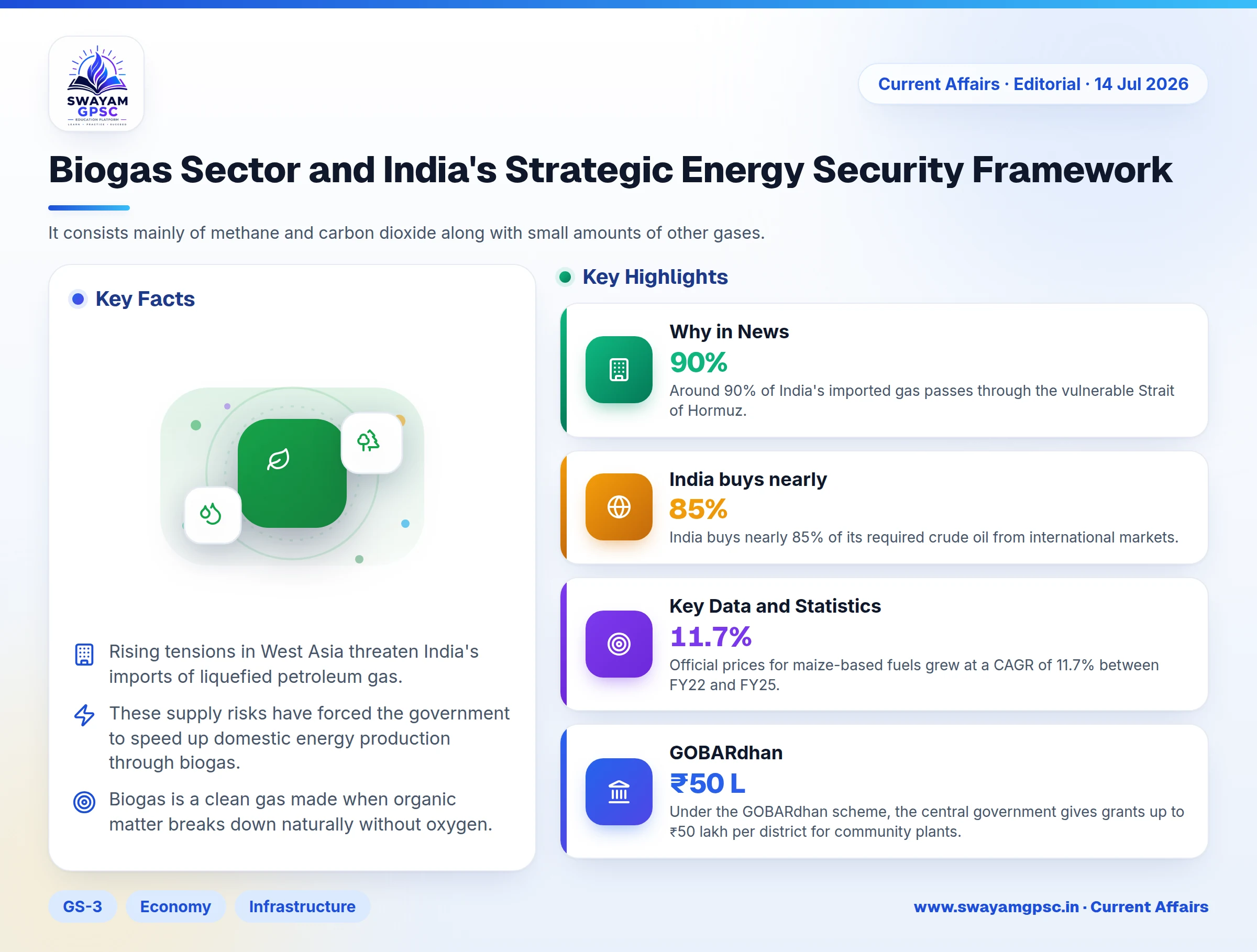
- Rising tensions in West Asia threaten India's imports of liquefied petroleum gas.
- Around 90% of India's imported gas passes through the vulnerable Strait of Hormuz.
- India buys nearly 85% of its required crude oil from international markets.
- These supply risks have forced the government to speed up domestic energy production through biogas.
Understanding Biogas and Compressed Biogas
- Biogas is a clean gas made when organic matter breaks down naturally without oxygen.
- It consists mainly of methane and carbon dioxide along with small amounts of other gases.
- Cleaning and compressing raw biogas creates Compressed Biogas (CBG).
- Chemically, CBG works exactly like standard fossil-derived Compressed Natural Gas (CNG).
Key Data and Statistics
- India depends on foreign countries for 85% of its total crude oil needs.
- Official prices for maize-based fuels grew at a CAGR of 11.7% between FY22 and FY25.
- This high price growth caused farmers to plant maize over other essential crops.
- Under the GOBARdhan scheme, the central government gives grants up to ₹50 lakh per district for community plants.
- The government set aside ₹994 crore to build gas pipelines that connect rural biogas units to the national network.
Process of Biogas Formation
- Bacteria break down wet waste like cow dung, crop leftovers, and sewage in airtight spaces.
- Special bacteria convert complex fats and proteins into simple organic acids during the initial stages.
- Methane-producing microbes then consume these acids to generate methane gas.
- Purification systems strip out carbon dioxide and moisture to boost methane purity above 90% before compressing it.
Strategic Role of Biogas
- Using CBG in vehicle transport directly cuts foreign fuel dependency. For example, the India-Japan Cooperative Biogas for Growth Initiative powers green buses across multiple states.
- Purified methane can run directly through city gas lines for home cooking. For instance, government rules mandate mixing CBG into local Piped Natural Gas (PNG) networks.
- Off-grid biogas plants generate cheap electricity for remote farms. For example, GOBARdhan community plants convert cattle dung into power for running local farm tools.
- Organic residue left after gas production serves as rich organic fertilizer. Integrated plants supply this natural fertilizer to improve soil health and replace costly chemical inputs.
Challenges
- Collecting seasonal crop waste like paddy straw from scattered small farms remains difficult and expensive.
- Artificially high prices for biofuel crops like maize encourage single-crop farming, which reduces pulse production.
- Modern purification machines require large upfront investments, making it tough for small businesses to get loans.
- Most rural plants sit far from main gas pipelines, making fuel transport by road slow and costly.
Way Forward
- India should follow the Danish Model by using animal dung and farm waste instead of food crops for energy.
- The government should replicate the ethanol program that achieved 20% petrol blending by late 2025 by offering fixed purchase prices.
- Tax benefits like accelerated depreciation and income tax exemptions will encourage private companies to invest.
- Using the allocated ₹1,558 crore budget will help buy biomass collection equipment and build grid connection pipelines.
Conclusion
- Programs like GOBARdhan have laid a strong foundation for green energy development.
- Fixing supply chain delays and speeding up SATAT project execution will guarantee success.
- Focusing on farm waste and giving financial incentives will turn rural waste into clean national energy.