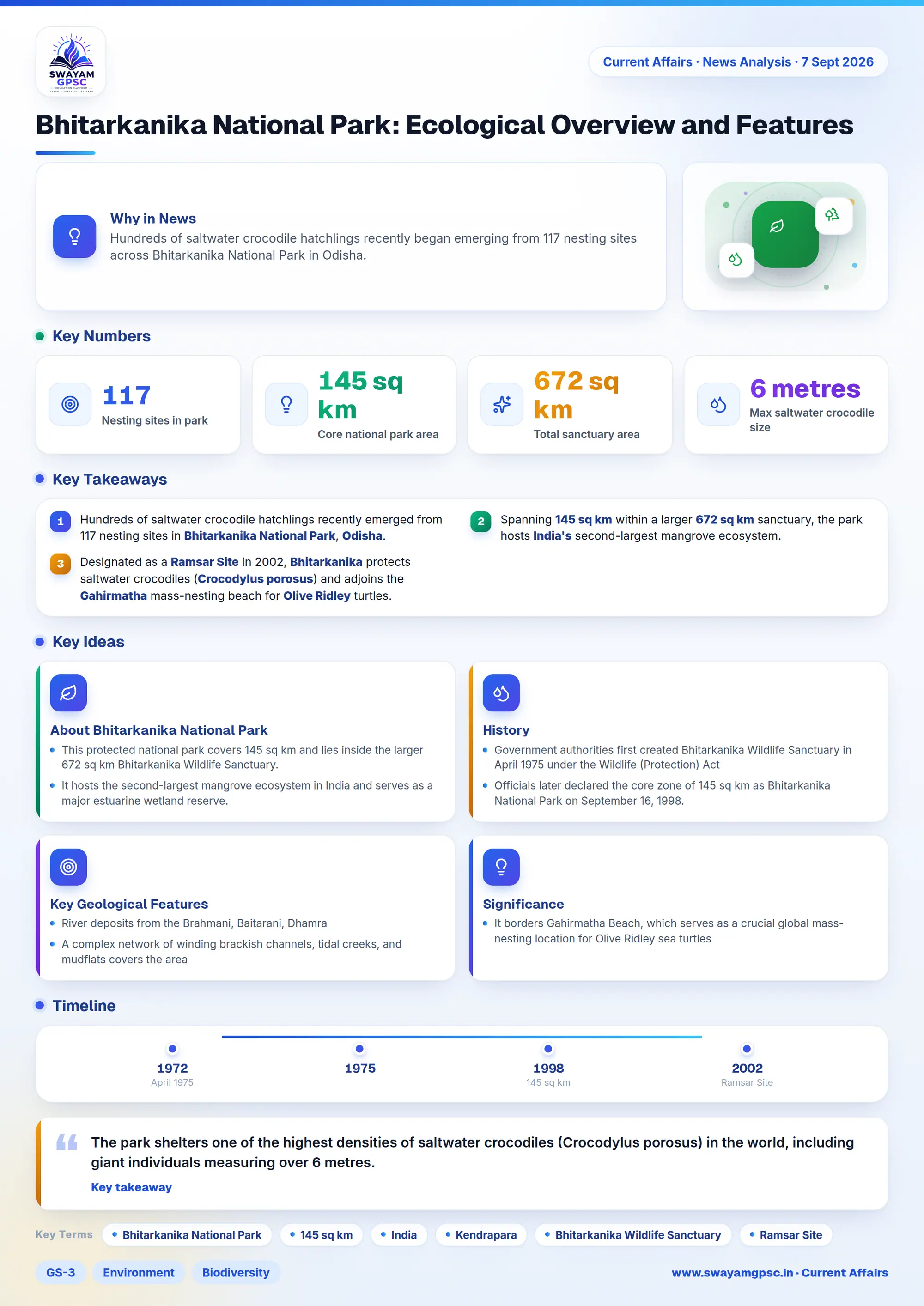
Bhitarkanika National Park: Ecological Overview and Features
#GS-3 #Environment #Biodiversity #Wildlife #Bhitarkanika National Park #Ramsar Site #Odisha
Key takeaways
- Hundreds of saltwater crocodile hatchlings recently emerged from 117 nesting sites in Bhitarkanika National Park, Odisha.
- Spanning 145 sq km within a larger 672 sq km sanctuary, the park hosts India's second-largest mangrove ecosystem.
- Designated as a Ramsar Site in 2002, Bhitarkanika protects saltwater crocodiles (Crocodylus porosus) and adjoins the Gahirmatha mass-nesting beach for Olive Ridley turtles.
Why in News
- Hundreds of saltwater crocodile hatchlings recently began emerging from 117 nesting sites across Bhitarkanika National Park in Odisha.
About Bhitarkanika National Park
- This protected national park covers 145 sq km and lies inside the larger 672 sq km Bhitarkanika Wildlife Sanctuary.
- It hosts the second-largest mangrove ecosystem in India and serves as a major estuarine wetland reserve.
- The park is located in the northeastern part of Kendrapara district in coastal Odisha, with the Bay of Bengal and Gahirmatha Marine Sanctuary to its east.
History
- Government authorities first created Bhitarkanika Wildlife Sanctuary in April 1975 under the Wildlife (Protection) Act, 1972 to save the declining saltwater crocodile population.
- Officials later declared the core zone of 145 sq km as Bhitarkanika National Park on September 16, 1998.
- The wetland received global recognition as a Ramsar Site on August 19, 2002, making it the second such site in Odisha after Chilika Lake.
Key Geological Features
- River deposits from the Brahmani, Baitarani, Dhamra, and Pathsala rivers form an estuarine delta where fresh river water mixes with salty sea tides.
- A complex network of winding brackish channels, tidal creeks, and mudflats covers the area, shifting constantly with daily ocean tides.
- River silt continuously builds up new land, creating low-lying marshes, tidal silt beds, and fertile floodplains.
- Natural sandbars and coastal beaches like Gahirmatha and Hukitola protect the inner wetlands from strong ocean waves.
- Highly saline hydromorphic soils create specialized intertidal conditions that nourish diverse mangrove species and salt-tolerant plants.
Significance
- The park shelters one of the highest densities of saltwater crocodiles (Crocodylus porosus) in the world, including giant individuals measuring over 6 metres.
- It borders Gahirmatha Beach, which serves as a crucial global mass-nesting location for Olive Ridley sea turtles (Lepidochelys olivacea).