Bharat Audyogik Vikas Yojna (BHAVYA) for Industrial Growth
#GS-2 #Governance & Social Justice #GS-3 #Economy #Infrastructure #National
Key takeaways
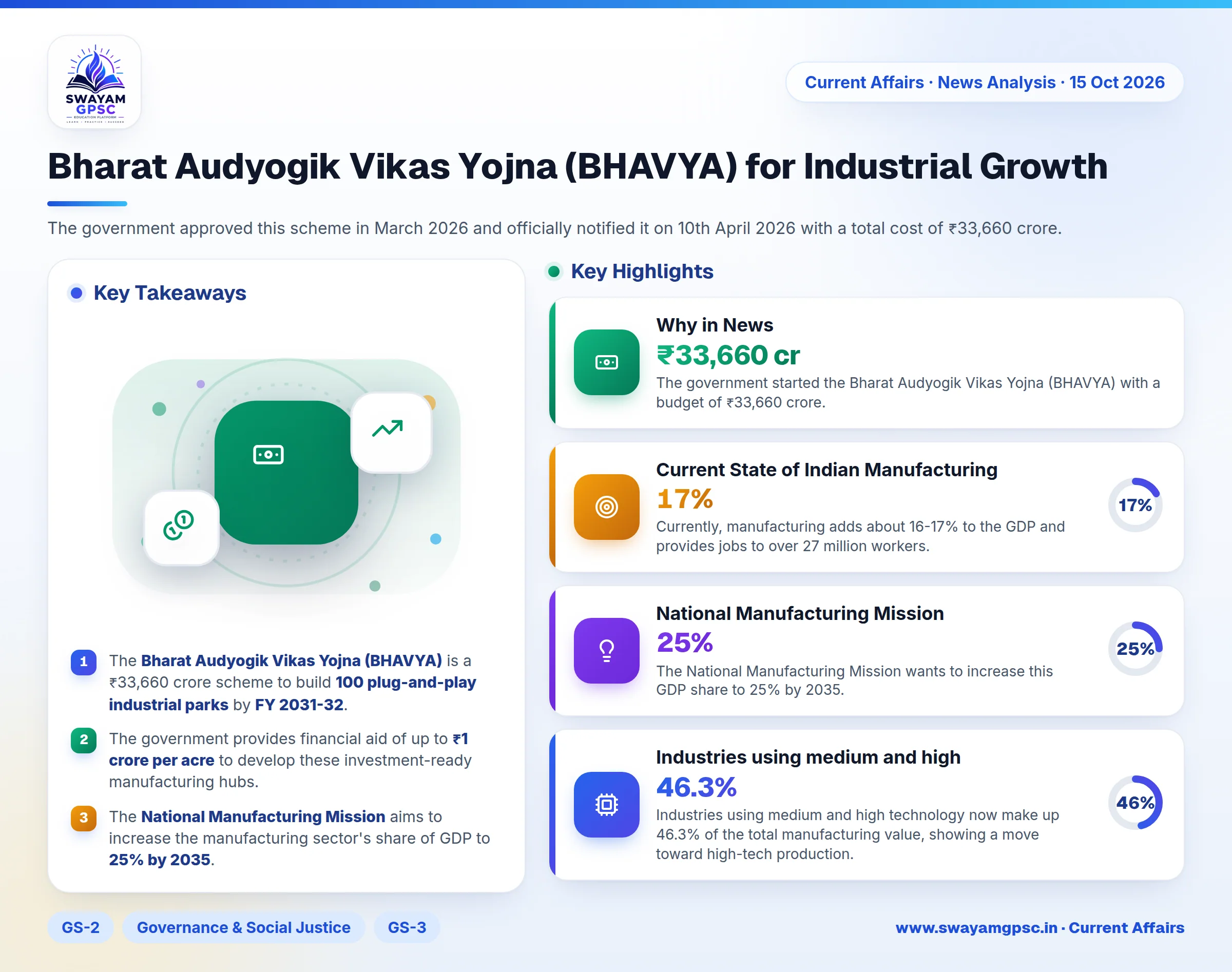
- The Bharat Audyogik Vikas Yojna (BHAVYA) is a ₹33,660 crore scheme to build 100 plug-and-play industrial parks by FY 2031-32.
- The government provides financial aid of up to ₹1 crore per acre to develop these investment-ready manufacturing hubs.
- The National Manufacturing Mission aims to increase the manufacturing sector's share of GDP to 25% by 2035.
- A specialized BHAVYA-Rasayan Scheme with ₹3,030 crore was launched in July 2026 for creating three dedicated chemical parks.
Why in News
- The government started the Bharat Audyogik Vikas Yojna (BHAVYA) with a budget of ₹33,660 crore.
- This initiative aims to build 100 plug-and-play industrial parks throughout the country.
- The goal is to improve manufacturing setups, bring in more investments, help MSMEs, create jobs, and make it easier to do business.
Current State of Indian Manufacturing
- Currently, manufacturing adds about 16-17% to the GDP and provides jobs to over 27 million workers.
- The National Manufacturing Mission wants to increase this GDP share to 25% by 2035.
- Industries using medium and high technology now make up 46.3% of the total manufacturing value, showing a move toward high-tech production.
- Because global supply chains are changing, India needs better infrastructure, faster logistics, and a predictable system for getting approvals.
Details of BHAVYA Scheme
- The government approved this scheme in March 2026 and officially notified it on 10th April 2026 with a total cost of ₹33,660 crore.
- It focuses on creating investment-ready infrastructure to reduce the time and money needed to start a factory.
- The government is working with state governments and private developers to ensure fast approvals and a smooth single-window system.
- Eligible parks can get financial help of up to ₹1 crore per acre, with different rules for government and private projects.
- The scheme covers basic needs like internal roads, electricity, water, drainage, sewage treatment, and digital administration.
- It will include underground utility corridors so that maintenance work does not require digging up roads or stopping factory work.
- Businesses will get ready-made factory sheds, custom-built units, warehouses, and centers for testing and certification.
- To help workers, the plan includes housing, clinics, and skill training centers.
- Up to 25% of the funds can be used for external links like roads, railways, and last-mile logistics.
- The project will run for six years, from FY 2026-27 to FY 2031-32.
- In the first step, the government will pick up to 50 industrial parks using a competitive challenge process in two rounds.
- The remaining parks will be chosen later to reach the total goal of 100 parks.
- Selection will depend on how ready the project is, if land is available, and the industrial potential of the area.
- For non-hilly states, the minimum land needed is 100 acres, while for hilly states, northeast states, and UTs, it is 25 acres.
- The scheme allows for very large parks of up to 1,000 acres.
- The Department for Promotion of Industry and Internal Trade (DPIIT) manages the scheme, and the National Industrial Corridor Development Corporation (NICDC) acts as the project manager.
- Special Purpose Vehicles (SPVs) will be created to handle the building, running, and maintenance of these parks.
- The BHAVYA Portal, launched in June 2026, handles everything from project applications to monitoring in a transparent way.
Evolution of Industrial Policy
- India first started with industrial estates and Special Economic Zones (SEZs) to give land and tax breaks for exports.
- By February 2026, there were 370 notified SEZs that brought in ₹7.82 lakh crore in investment and employed over 31.7 lakh people.
- The focus then shifted to larger hubs. By October 2026, 4,164 industrial parks were listed on the India Industrial Land Bank (IILB).
- The National Industrial Corridor Development Programme (NICDP) then combined industrial zones with modern cities and logistics.
- Key examples include the Dholera Special Investment Region (Gujarat), Shendra-Bidkin Industrial Area (Maharashtra), Vikram Udyogpuri (Madhya Pradesh), and Integrated Industrial Township Greater Noida (Uttar Pradesh).
- The BHAVYA scheme is the latest step, moving toward a nationwide network of ready-to-use manufacturing parks.
Understanding Plug-and-Play Industrial Parks
- These are pre-developed areas where land, roads, and utilities are already ready, so companies can start production almost immediately.
- Trunk infrastructure refers to the shared basic services like main roads, water lines, and power grids used by all factories in the park.
- These parks use single-window systems to make getting government permits much faster.
- They make India more competitive globally by lowering the starting costs for businesses.
- The Union Budget 2025-26 set aside ₹2,500 crore for these parks, and by October 2026, India had about 260 such parks.
- In July 2026, the government also started the BHAVYA-Rasayan Scheme with ₹3,030 crore to build three specialized chemical parks.
Way Forward
- The BHAVYA scheme moves India toward modern, investment-ready industrial hubs.
- If done well, it will help MSMEs, create more jobs, and make India a bigger part of global supply chains.
- Success depends on finishing projects on time, good teamwork between the Centre and States, and keeping the infrastructure in good shape.