The Bar Council of India: Structure, Role, and Key Functions
#GS-2 #Indian Polity & Constitution #Regulatory Bodies #Judiciary #National #Bar Council of India #Advocates Act 1961
Key takeaways
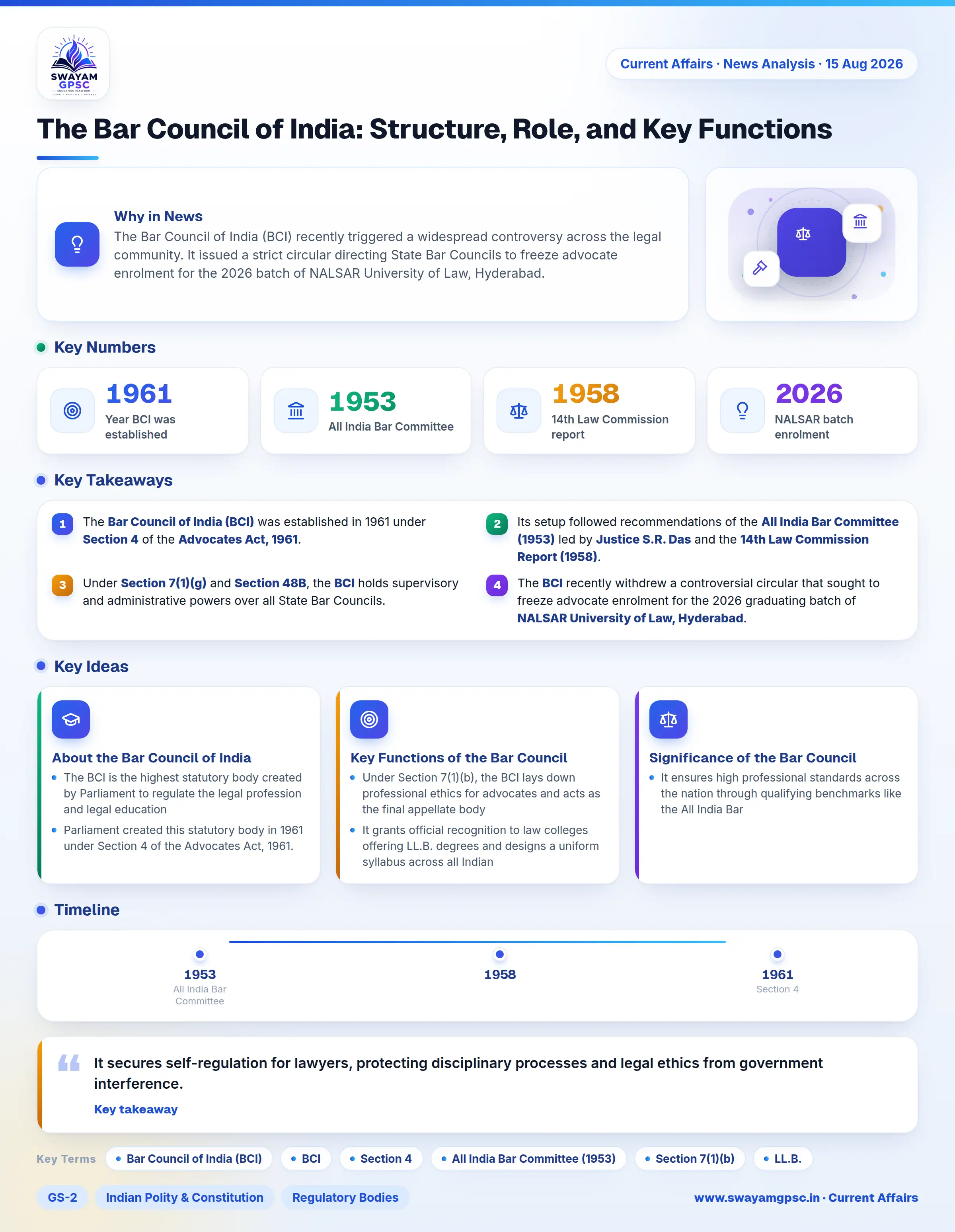
- The Bar Council of India (BCI) was established in 1961 under Section 4 of the Advocates Act, 1961.
- Its setup followed recommendations of the All India Bar Committee (1953) led by Justice S.R. Das and the 14th Law Commission Report (1958).
- Under Section 7(1)(g) and Section 48B, the BCI holds supervisory and administrative powers over all State Bar Councils.
- The BCI recently withdrew a controversial circular that sought to freeze advocate enrolment for the 2026 graduating batch of NALSAR University of Law, Hyderabad.
Why in News
- The Bar Council of India (BCI) recently triggered a widespread controversy across the legal community.
- It issued a strict circular directing State Bar Councils to freeze advocate enrolment for the 2026 batch of NALSAR University of Law, Hyderabad.
- Following intense pushback from law students and experts, the BCI quickly withdrew this controversial order.
About the Bar Council of India
- The BCI is the highest statutory body created by Parliament to regulate the legal profession and legal education in India.
- Parliament created this statutory body in 1961 under Section 4 of the Advocates Act, 1961.
- Its formation was recommended by the All India Bar Committee (1953) led by Justice S.R. Das and the 14th Law Commission Report (1958).
- The primary objective of the BCI is to maintain high ethical standards and discipline among lawyers while protecting their statutory rights.
- It also oversees and inspects university legal education standards throughout the country.
Key Functions of the Bar Council of India
- Under Section 7(1)(b), the BCI lays down professional ethics for advocates and acts as the final appellate body for State Bar disciplinary actions.
- It grants official recognition to law colleges offering LL.B. degrees and designs a uniform syllabus across all Indian law schools.
- The BCI exercises administrative control over State Bar Councils under Section 7(1)(g) and issues binding directives under Section 48B.
- Under Section 7(1)(m), it recognizes foreign law degrees on a reciprocal basis, allowing foreign-trained graduates to practice in India.
- It manages welfare funds to provide insurance and financial relief to needy advocates while funding legal aid for poor litigants.
Significance of the Bar Council of India
- It secures self-regulation for lawyers, protecting disciplinary processes and legal ethics from government interference.
- It ensures high professional standards across the nation through qualifying benchmarks like the All India Bar Examination (AIBE).