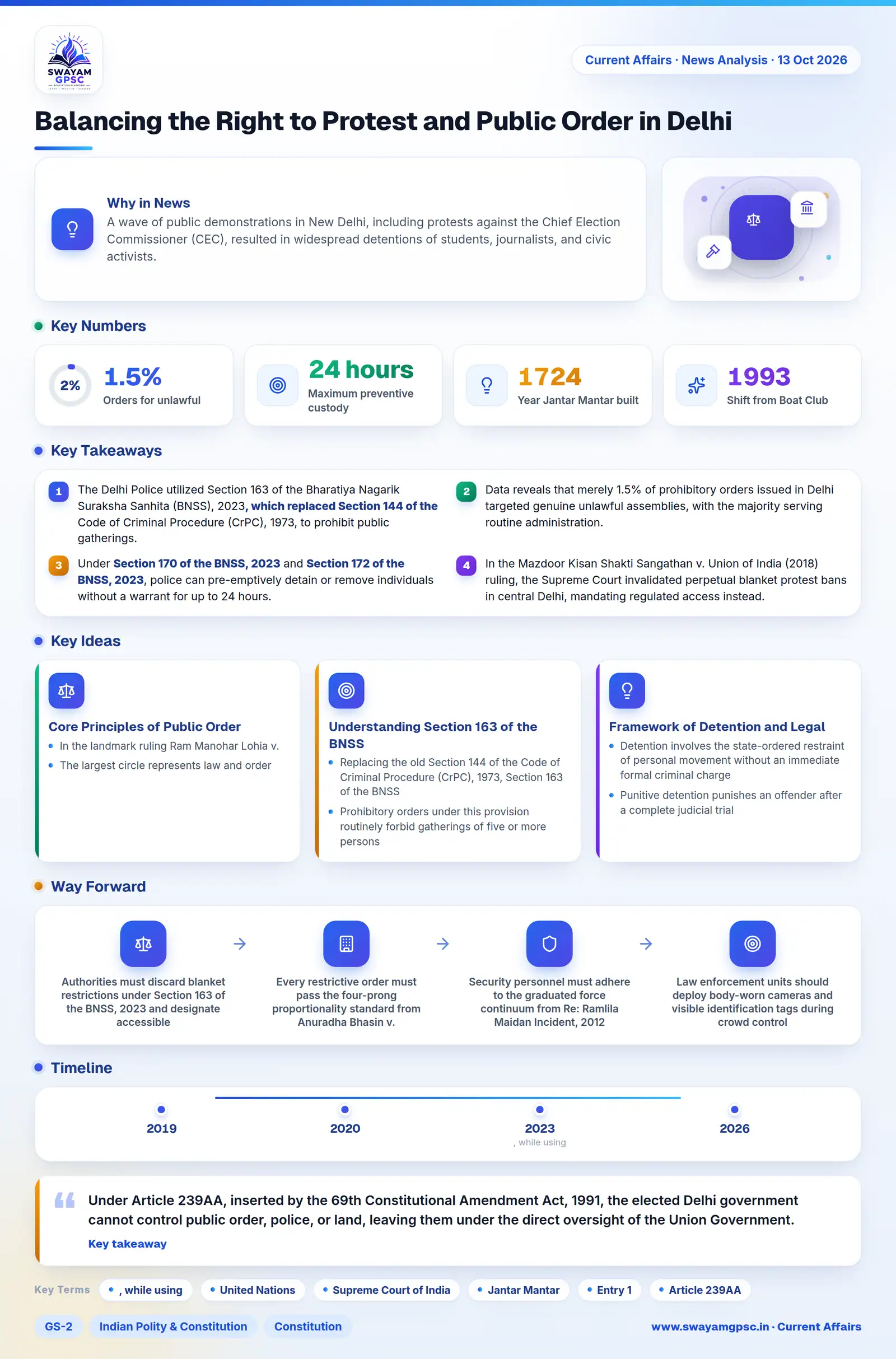
Balancing the Right to Protest and Public Order in Delhi
#GS-2 #Indian Polity & Constitution #Constitution #Executive #Judiciary #Governance & Social Justice #Good Governance #Current Events #National #Fundamental Rights #Public Order
Key takeaways
- The Delhi Police utilized Section 163 of the Bharatiya Nagarik Suraksha Sanhita (BNSS), 2023, which replaced Section 144 of the Code of Criminal Procedure (CrPC), 1973, to prohibit public gatherings.
- Data reveals that merely 1.5% of prohibitory orders issued in Delhi targeted genuine unlawful assemblies, with the majority serving routine administration.
- Under Section 170 of the BNSS, 2023 and Section 172 of the BNSS, 2023, police can pre-emptively detain or remove individuals without a warrant for up to 24 hours.
- In the *Mazdoor Kisan Shakti Sangathan v. Union of India (2018)* ruling, the Supreme Court invalidated perpetual blanket protest bans in central Delhi, mandating regulated access instead.
Why in News
- A wave of public demonstrations in New Delhi, including protests against the Chief Election Commissioner (CEC), resulted in widespread detentions of students, journalists, and civic activists.
- The Delhi Police imposed prohibitory orders under Section 163 of the Bharatiya Nagarik Suraksha Sanhita (BNSS), 2023, while using Section 170 of the BNSS, 2023 and Section 172 of the BNSS, 2023 for pre-emptive detentions.
- The United Nations publicly voiced deep concern regarding these mass detentions, while domestic legal experts questioned the statutory justification for such sweeping actions.
- Intervening in the controversy, the Supreme Court of India halted arbitrary detentions and reviewed the routine use of prohibitory orders, re-evaluating the balance between public order and the democratic right to demonstrate.
- In a related administrative shift, the Delhi Police de-notified Jantar Mantar as an approved protest location on the advice of a Ministry of Home Affairs (MHA) committee, designating Ramlila Ground, Burari Ground, and CBD Ground as substitute locations.
Core Principles of Public Order
- In the landmark ruling *Ram Manohar Lohia v. State of Bihar (1966)*, the Supreme Court illustrated public order through three concentric circles.
- The largest circle represents law and order, which involves isolated offences like petty theft affecting only specific individuals.
- The intermediate circle represents public order, which involves major disruptions like communal violence that upset the regular tempo of life across an entire locality.
- The innermost circle represents state security, which involves direct threats to the existence of the nation, such as armed rebellion or war.
- Under the Seventh Schedule of the Constitution, Entry 1 and Entry 2 of the State List (List II) assign public order and police exclusively to state governments.
- Under Article 239AA, inserted by the 69th Constitutional Amendment Act, 1991, the elected Delhi government cannot control public order, police, or land, leaving them under the direct oversight of the Union Government.
- Both criminal law and criminal procedure fall under Entry 1 and Entry 2 of the Concurrent List (List III), providing the statutory base for the Bharatiya Nagarik Suraksha Sanhita (BNSS), 2023.
- Preventive detention powers remain divided, as Entry 9 of the Union List governs defence and external affairs, while the Concurrent List permits preventative laws for public order and essential supplies.
Understanding Section 163 of the BNSS
- Replacing the old Section 144 of the Code of Criminal Procedure (CrPC), 1973, Section 163 of the BNSS, 2023 grants Executive Magistrates the authority to issue urgent directions to avert threats to civic peace.
- Prohibitory orders under this provision routinely forbid gatherings of five or more persons, borrowing the threshold from Section 189(1) of the Bharatiya Nyaya Sanhita (BNS), 2023 regarding unlawful assembly.
- Executive Magistrates invoke this emergency power to curb riots, violent demonstrations, obstructions, or imminent threats to human life.
- A regular prohibitory order under this section remains valid for up to two months, though state authorities can extend it to a maximum of six months.
- Recent empirical records in Delhi revealed that merely 1.5% of prohibitory orders targeted genuine unlawful assemblies, with the vast majority used for micro-management.
Framework of Detention and Legal Safeguards
- Detention involves the state-ordered restraint of personal movement without an immediate formal criminal charge, acting as an administrative precaution rather than a judicial sentence.
- Punitive detention punishes an offender after a complete judicial trial, whereas preventive detention restrains a person beforehand to stop impending harm to state security or peace.
- The Constitution authorizes preventive custody under Article 22, yet this tool directly limits personal liberty protected under Article 21.
- Neither the substantive penal code nor procedural law provides a formal definition of detention, but Chapter XII of the procedural code grants police sweeping preventive authority.
- Under Section 170 of the BNSS, 2023, police personnel can arrest individuals without a warrant for up to 24 hours if they detect a design to commit a cognizable offence.
- Under Section 172 of the BNSS, 2023, police can detain or remove anyone defying lawful instructions, allowing release within 24 hours without logging a formal arrest.
- Special statutory detention powers also operate nationwide, including the National Security Act (NSA), 1980, which permits up to 12 months of administrative detention.
- India's primary anti-terror statute, the Unlawful Activities (Prevention) Act (UAPA), 1967, allows authorities to hold individuals for up to 180 days prior to filing formal charges.
- Regional statutes such as the Public Safety Act (PSA), 1978 in Jammu and Kashmir permit detention without trial for up to two years.
- Economic offences encounter administrative custody under COFEPOSA, 1974, which targets smuggling and foreign exchange violations.
- In *A.K. Gopalan v. State of Madras (1950)*, the Supreme Court initially ruled that Article 22 operates as a self-contained code for preventive detentions.
- Overturning that narrow stance, *Maneka Gandhi v. Union of India (1978)* ruled that every detention statute must satisfy the combined tests of Article 14, Article 19, and Article 21.
- In *Rekha v. State of Tamil Nadu (2011)*, the Supreme Court held that preventive custody is an extraordinary measure that cannot substitute standard criminal prosecution.
- In *Pramod Singla v. Union of India (2023)*, the Supreme Court described preventive detention as a colonial legacy and ruled that ordinary law-and-order infractions cannot justify administrative detention.
Differences Between Detention and Punitive Arrest
- Detention works as a precautionary measure against anticipated public disorder, whereas an arrest holds an accused individual for an alleged past crime.
- Detention triggers purely on executive suspicion or intelligence tips, whereas an arrest requires an FIR or a credible complaint regarding a cognizable offence.
- Detainees face no immediate formal charge sheet, while arrested individuals face specific penal charges under statutes like the Bharatiya Nyaya Sanhita (BNS), 2023.
- Unlike an arrestee whose counsel rights stand protected under Article 22(1), a detainee's access to legal counsel remains restricted before an administrative Advisory Board under Article 22(3).
- While Article 22(2) mandates that arrested individuals appear before a magistrate within 24 hours, preventive detention involves review by an Advisory Board over a longer statutory window.
Judicial Precedents on Peaceful Assembly
- The Supreme Court protects the Right to Protest under Article 19(1)(a) and Article 19(1)(b), permitting state intervention only under reasonable restrictions defined in Articles 19(2) and 19(3).
- In *Babulal Parate v. State of Maharashtra, 1961*, the Supreme Court upheld anticipatory bans as constitutional but required magistrates to record explicit, reviewable reasons.
- In *Madhu Limaye v. Sub-Divisional Magistrate, Monghyr, 1970*, the Court ruled that emergency orders require urgent circumstances and cannot serve routine administrative needs.
- In *Re: Ramlila Maidan Incident, 2012*, the Supreme Court prohibited emergency crowd dispersal on mere speculation, mandating the use of the irreducible minimum force rule.
- In *Mazdoor Kisan Shakti Sangathan v. Union of India, 2018*, the Court struck down indefinite protest bans across central Delhi and instructed authorities to regulate designated spaces.
- In *Anuradha Bhasin v. Union of India, 2020*, the Court ruled that repeated prohibitory orders abuse state power, establishing a four-prong proportionality test.
- In *Amit Sahni v. Commissioner of Police (Shaheen Bagh Case), 2020*, the Court confirmed that protesters cannot occupy transit corridors indefinitely and must use designated demonstration zones.
- The Supreme Court continuously asserts that procedural infractions during preventive custody immediately violate the personal liberty guaranteed by Article 21.
Historical Context: Gandhi and Jantar Mantar
- During his 1922 trial, Mahatma Gandhi argued that affection cannot be manufactured by law, establishing the moral basis for non-violent resistance.
- Mahatma Gandhi maintained that true civil disobedience relies on non-violent protest coupled with voluntary submission to legal penalties rather than aggression.
- Indian courts subsequently translated this Gandhian philosophy of peaceful resistance into protected democratic liberties under Article 19.
- Built in 1724 by Maharaja Sawai Jai Singh II of Jaipur, the Jantar Mantar observatory in New Delhi represents the first of five historical astronomical sites.
- Derived from Sanskrit terms for instrument and calculation, the complex houses 13 architectural instruments designed for naked-eye celestial calculation.
- The complex features the Samrat Yantra as an equal-hour sundial, the Misra Yantra for calculating solstices, and the Jaya Prakash & Ram Yantras for mapping celestial coordinates.
- While the Archaeological Survey of India (ASI) oversees the Delhi complex, the observatory in Jaipur gained UNESCO World Heritage List recognition in 2010.
- Demonstrations shifted from the Boat Club to Jantar Mantar in 1993 due to mounting vehicular gridlock and security concerns near central administrative blocks.
- Operating as India's premier protest hub, Jantar Mantar hosted the 2011 Lokpal movement, the 2012 Nirbhaya demonstrations, citizenship law agitations in 2019, and recent education protests in 2026.
- In 2017, the National Green Tribunal (NGT) prohibited assemblies at Jantar Mantar over noise pollution concerns under Article 21.
- The Supreme Court overturned that blanket prohibition in 2018, ordering administrative agencies to establish balanced crowd regulations rather than total bans.
Way Forward
- Authorities must discard blanket restrictions under Section 163 of the BNSS, 2023 and designate accessible, well-managed protest hubs in line with Supreme Court directives.
- Every restrictive order must pass the four-prong proportionality standard from *Anuradha Bhasin v. Union of India, 2020*, ensuring that measures remain minimally intrusive.
- Security personnel must adhere to the graduated force continuum from *Re: Ramlila Maidan Incident, 2012*, deploying minimum necessary force and documenting escalation steps.
- Law enforcement units should deploy body-worn cameras and visible identification tags during crowd control duties to ensure operational accountability.
- Agencies must adopt the facilitation principle endorsed by the United Nations Office on Drugs and Crime (UNODC), treating peaceful assemblies as fundamental democratic exercises.
- Security forces should apply the principle of differentiation to isolate violent instigators without penalizing peaceful citizens who assemble lawfully.