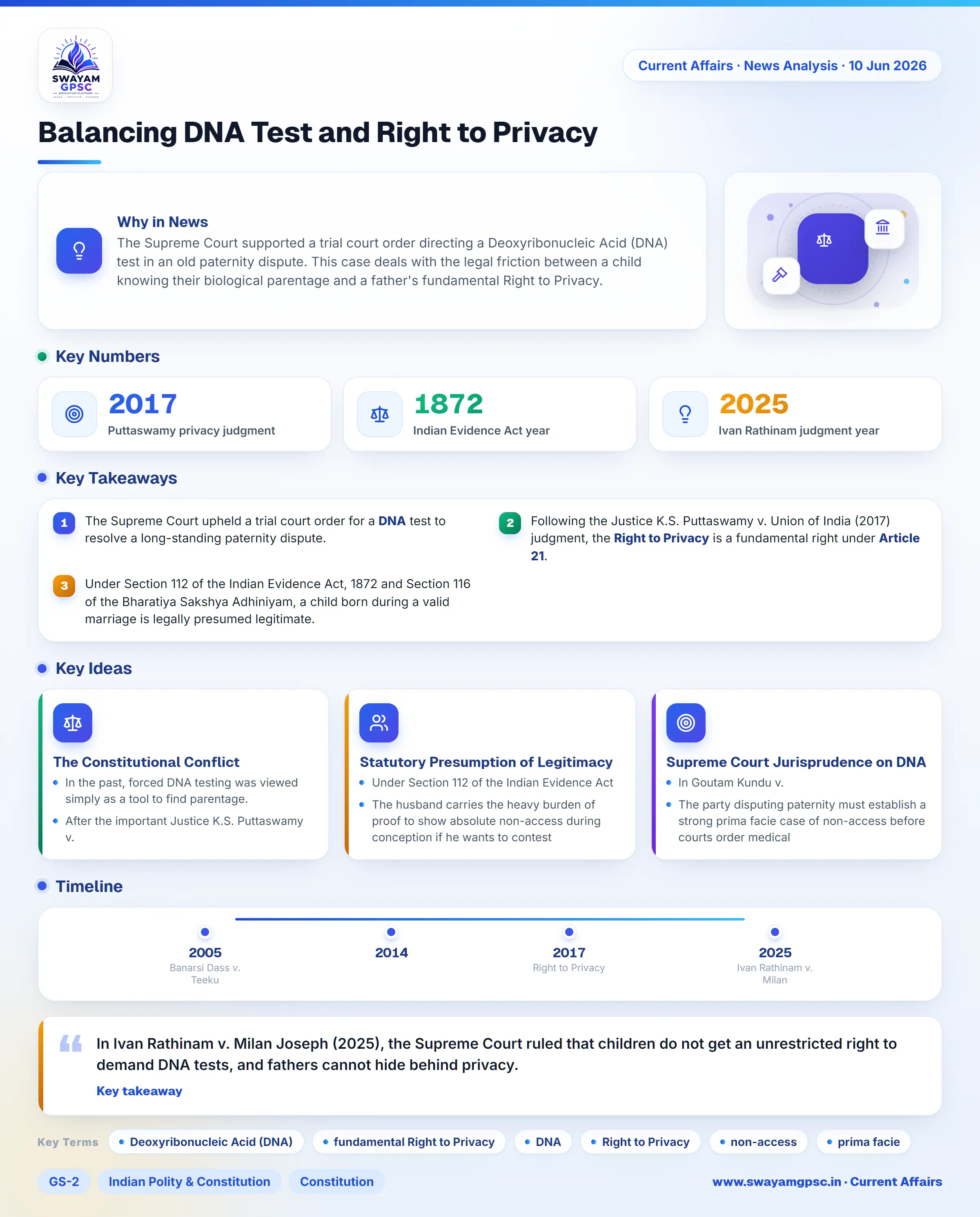
Balancing DNA Test and Right to Privacy
#GS-2 #Indian Polity & Constitution #Constitution #Judgements & Cases #Fundamental Rights #Biotechnology #GS-3 #Science & Technology #Current Events #National
Key takeaways
- The Supreme Court upheld a trial court order for a DNA test to resolve a long-standing paternity dispute.
- Following the Justice K.S. Puttaswamy v. Union of India (2017) judgment, the Right to Privacy is a fundamental right under Article 21.
- Under Section 112 of the Indian Evidence Act, 1872 and Section 116 of the Bharatiya Sakshya Adhiniyam, a child born during a valid marriage is legally presumed legitimate.
Why in News
- The Supreme Court supported a trial court order directing a Deoxyribonucleic Acid (DNA) test in an old paternity dispute.
- This case deals with the legal friction between a child knowing their biological parentage and a father's fundamental Right to Privacy.
The Constitutional Conflict
- In the past, forced DNA testing was viewed simply as a tool to find parentage.
- After the important Justice K.S. Puttaswamy v. Union of India (2017) ruling, the Right to Privacy became a fundamental right under Article 21.
- Courts now accept that forced DNA testing interferes with personal bodily autonomy and privacy.
Statutory Presumption of Legitimacy
- Under Section 112 of the Indian Evidence Act, 1872 which is now replaced by Section 116 of the Bharatiya Sakshya Adhiniyam, a child born during a valid marriage is considered legally legitimate.
- The husband carries the heavy burden of proof to show absolute non-access during conception if he wants to contest paternity.
Supreme Court Jurisprudence on DNA Testing
- In *Goutam Kundu v. State of West Bengal* (1993), the Supreme Court ruled that scientific tests cannot be used as a first resort.
- The party disputing paternity must establish a strong *prima facie* case of non-access before courts order medical tests.
- In *Banarsi Dass v. Teeku Dutta* (2005), the Supreme Court stated that DNA testing should not be ordered routinely and must be used only in rare situations.
- In *Nandlal Wasudeo Badwaik v. Lata Nandlal Badwaik* (2014), the Court held that scientific truth must prevail when legal presumptions clash with scientific evidence.
- In *Rohit Shekhar v. Narayan Dutt Tiwari* (2014), the Supreme Court prioritized the rights of a child over the biological father's privacy claims and ordered a DNA test.
- In *Ivan Rathinam v. Milan Joseph* (2025), the Supreme Court ruled that children do not get an unrestricted right to demand DNA tests, and fathers cannot hide behind privacy.
- Courts must carefully evaluate the eminent need for the test by balancing the social stigma of illegitimacy against the child's need for closure.