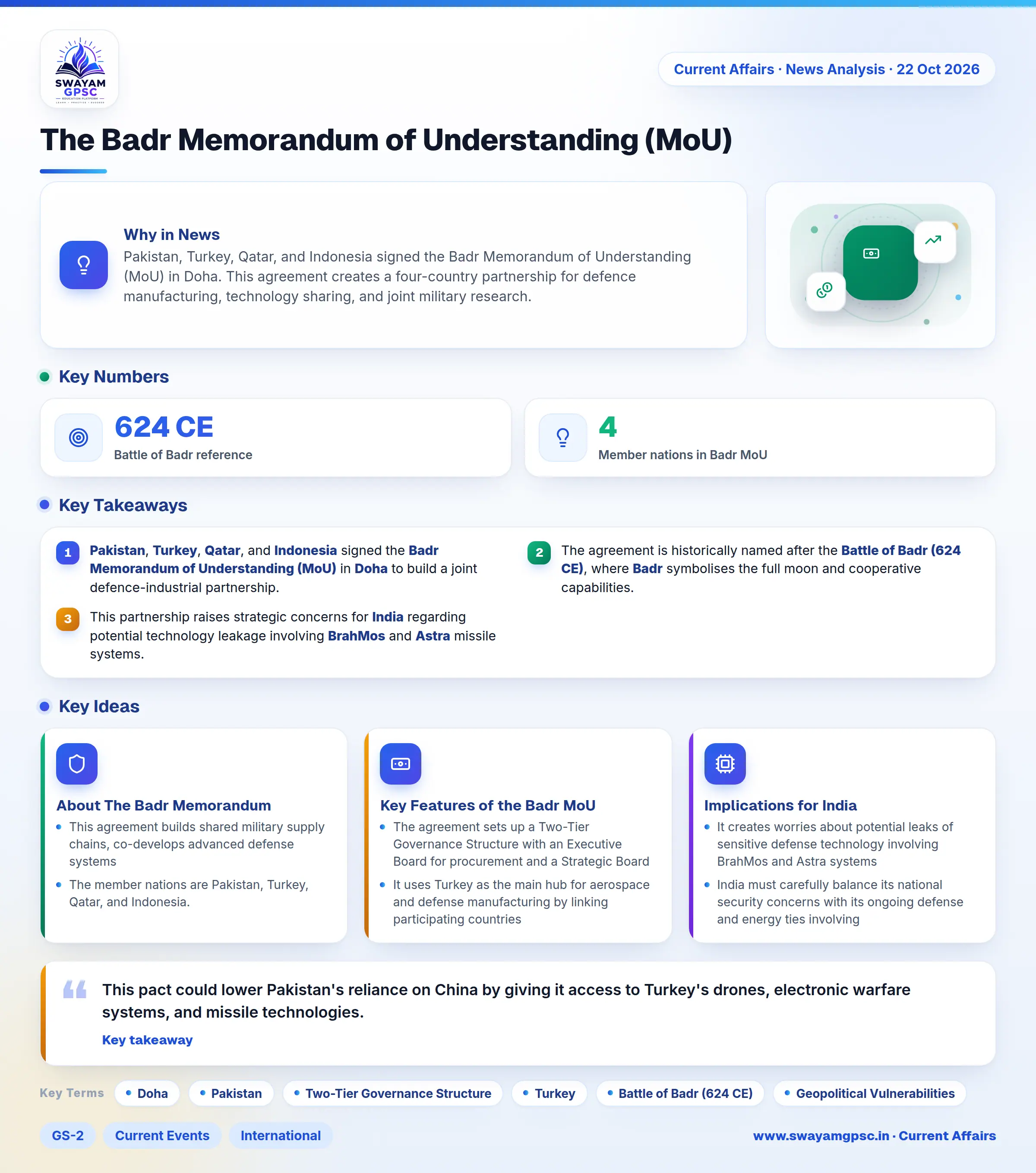
The Badr Memorandum of Understanding (MoU)
#GS-2 #Current Events #International #Economy #Infrastructure
Key takeaways
- Pakistan, Turkey, Qatar, and Indonesia signed the Badr Memorandum of Understanding (MoU) in Doha to build a joint defence-industrial partnership.
- The agreement is historically named after the Battle of Badr (624 CE), where Badr symbolises the full moon and cooperative capabilities.
- This partnership raises strategic concerns for India regarding potential technology leakage involving BrahMos and Astra missile systems.
Why in News
- Pakistan, Turkey, Qatar, and Indonesia signed the Badr Memorandum of Understanding (MoU) in Doha.
- This agreement creates a four-country partnership for defence manufacturing, technology sharing, and joint military research.
About The Badr Memorandum of Understanding
- This agreement builds shared military supply chains, co-develops advanced defense systems, and supports joint military research and technical training.
- The member nations are Pakistan, Turkey, Qatar, and Indonesia.
- The main goal is to combine Turkey's manufacturing skills, Qatar's financial resources, Indonesia's technology, and Pakistan's industrial capacity for self-reliance in defense production.
Key Features of the Badr MoU
- The agreement sets up a Two-Tier Governance Structure with an Executive Board for procurement and a Strategic Board for budgets and factory approvals.
- It uses Turkey as the main hub for aerospace and defense manufacturing by linking participating countries through joint production units.
- The partnership focuses on joint manufacturing, technology transfer, and research rather than military defense obligations or security guarantees.
- It is named after the Battle of Badr (624 CE) where Badr means full moon, symbolizing shared capabilities.
- It helps reduce Geopolitical Vulnerabilities by strengthening supply chains against West Asian instability and arms embargoes.
Implications for India
- This pact could lower Pakistan's reliance on China by giving it access to Turkey's drones, electronic warfare systems, and missile technologies.
- It creates worries about potential leaks of sensitive defense technology involving BrahMos and Astra systems, making strict safeguards necessary.
- India must carefully balance its national security concerns with its ongoing defense and energy ties involving Indonesia and Qatar.