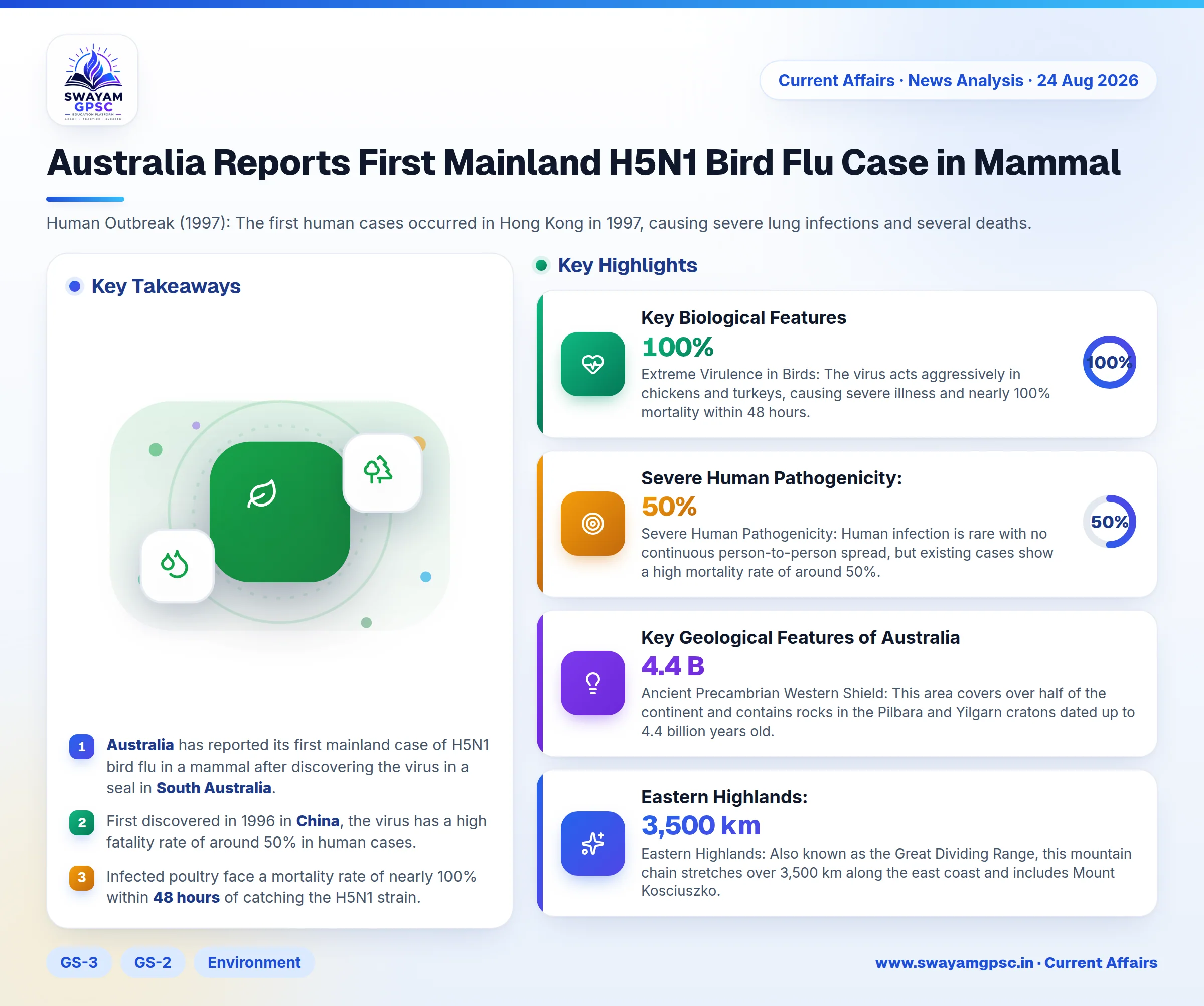
Australia Reports First Mainland H5N1 Bird Flu Case in Mammal
#GS-3 #GS-2 #Environment #Geography #Current Events #Wildlife #H5N1 Bird Flu #Australia
Key takeaways
- Australia has reported its first mainland case of H5N1 bird flu in a mammal after discovering the virus in a seal in South Australia.
- First discovered in 1996 in China, the virus has a high fatality rate of around 50% in human cases.
- Infected poultry face a mortality rate of nearly 100% within 48 hours of catching the H5N1 strain.
- Australia is the 6th largest country globally and houses the 2,300 km long Great Barrier Reef.
Why in News
- Australia recently confirmed its first mainland case of Highly Pathogenic Avian Influenza (HPAI) H5N1 in a mammal. Officials detected the virus in a dead long-nosed fur seal at Beachport, South Australia.
What is H5N1 Bird Flu?
- H5N1 is a subtype of the Influenza A virus from the Orthomyxoviridae family. It gets its name from two main surface proteins called Hemagglutinin type 5 (H5) and Neuraminidase type 1 (N1). While it mainly infects wild water birds and poultry, it can also jump to mammals and humans.
Origin and Evolution of H5N1
- First Detection (1996): Scientists first identified the virus in 1996 in a farmed goose in Guangdong Province, China, naming it the Gs/Gd lineage.
- Human Outbreak (1997): The first human cases occurred in Hong Kong in 1997, causing severe lung infections and several deaths.
- Global Clade 2.3.4.4b Outbreak: Recently, a new strain called Clade 2.3.4.4b spread rapidly across Europe, the Americas, Antarctica, and now Australia through migratory birds.
Key Biological Features
- Extreme Virulence in Birds: The virus acts aggressively in chickens and turkeys, causing severe illness and nearly 100% mortality within 48 hours.
- Mammalian Adaptation Risk: If the virus infects mammals repeatedly, it might mutate and attach easily to human-type α-2,6 receptors.
- Severe Human Pathogenicity: Human infection is rare with no continuous person-to-person spread, but existing cases show a high mortality rate of around 50%.
- Environmental Persistence: The virus survives for long periods in water, soil, and bird droppings, especially in cold and coastal areas.
About Australia
- Australia is the smallest continent and the 6th largest country in the world by land area, known for its unique wildlife like marsupials and monotremes.
- The continent lies entirely in the Southern Hemisphere, surrounded by the Pacific Ocean and the Indian Ocean.
- The national capital of Australia is Canberra.
Key Geological Features of Australia
- Ancient Precambrian Western Shield: This area covers over half of the continent and contains rocks in the Pilbara and Yilgarn cratons dated up to 4.4 billion years old.
- The Great Artesian Basin: Located in the central lowlands, it is one of the world's largest underground groundwater basins, stretching from the Gulf of Carpentaria to Lake Eyre.
- Eastern Highlands: Also known as the Great Dividing Range, this mountain chain stretches over 3,500 km along the east coast and includes Mount Kosciuszko.
- The Great Barrier Reef: Located off the coast of Queensland in the Coral Sea, this is the world's largest coral reef system, spanning 2,300 km.