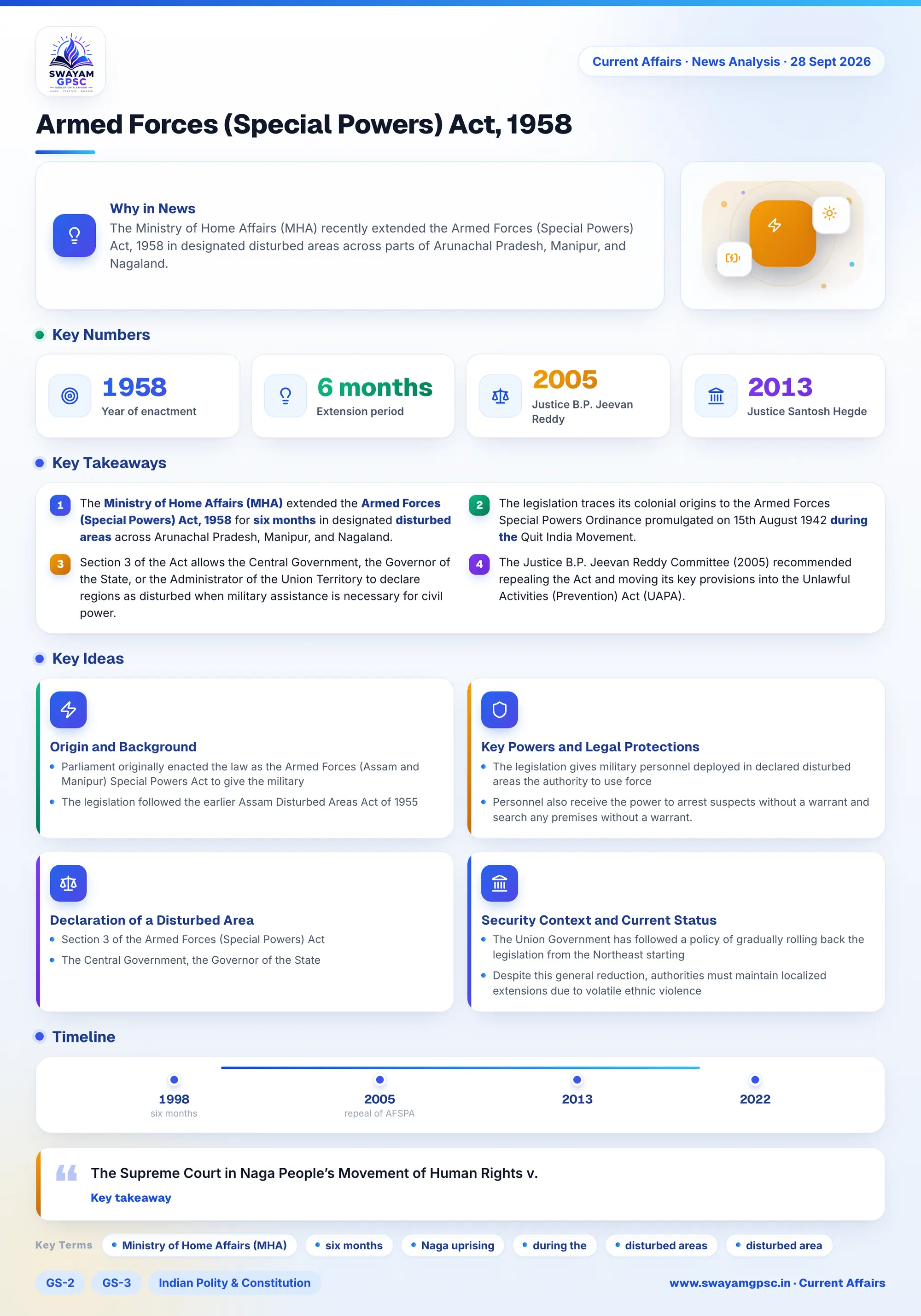
Armed Forces (Special Powers) Act, 1958
#GS-2 #GS-3 #Indian Polity & Constitution #Internal Security #Governance & Social Justice #Current Events #National #North East Insurgency #Left Wing Extremism #Various Security Forces & Agencies & Their Mandate
Key takeaways
- The Ministry of Home Affairs (MHA) extended the Armed Forces (Special Powers) Act, 1958 for six months in designated disturbed areas across Arunachal Pradesh, Manipur, and Nagaland.
- The legislation traces its colonial origins to the Armed Forces Special Powers Ordinance promulgated on 15th August 1942 during the Quit India Movement.
- Section 3 of the Act allows the Central Government, the Governor of the State, or the Administrator of the Union Territory to declare regions as disturbed when military assistance is necessary for civil power.
- The Justice B.P. Jeevan Reddy Committee (2005) recommended repealing the Act and moving its key provisions into the Unlawful Activities (Prevention) Act (UAPA).
Why in News
- The Ministry of Home Affairs (MHA) recently extended the Armed Forces (Special Powers) Act, 1958 in designated disturbed areas across parts of Arunachal Pradesh, Manipur, and Nagaland.
- This extension will remain in place for another six months to help maintain internal security and control active insurgent groups in these regions.
Origin and Background
- Parliament originally enacted the law as the Armed Forces (Assam and Manipur) Special Powers Act to give the military special powers against the Naga uprising.
- The legislation followed the earlier Assam Disturbed Areas Act of 1955, and authorities later renamed and expanded it to cover wider regions facing armed rebellions in the Northeast.
- The law traces its historical roots back to the Armed Forces Special Powers Ordinance promulgated on 15th August 1942 during the Quit India Movement.
Key Powers and Legal Protections
- The legislation gives military personnel deployed in declared disturbed areas the authority to use force, including lethal force, under specific conditions.
- Personnel also receive the power to arrest suspects without a warrant and search any premises without a warrant.
- The law offers legal protection to armed forces personnel, requiring prior Central Government sanction for prosecution in certain legal cases.
- A separate legislation named the Armed Forces (Jammu and Kashmir) Special Powers Act, 1990 governs operations in Jammu and Kashmir.
Declaration of a Disturbed Area
- Section 3 of the Armed Forces (Special Powers) Act, 1958 governs how an area receives the official designation of a disturbed area.
- The Central Government, the Governor of the State, or the Administrator of the Union Territory holds the power to declare an entire State or Union Territory, or parts of it, as disturbed.
- Authorities make this declaration when they decide that deploying armed forces to assist civil administrative powers is necessary.
Security Context and Current Status
- The Union Government has followed a policy of gradually rolling back the legislation from the Northeast starting in 2022, completely removing it from Tripura and Meghalaya.
- Despite this general reduction, authorities must maintain localized extensions due to volatile ethnic violence in Manipur and persistent cross-border threats from insurgent factions in the Naga hills.
Committees and Judicial Review
- The Justice B.P. Jeevan Reddy Committee (2005) critically recommended the repeal of AFSPA, suggesting that authorities should add its essential provisions into the Unlawful Activities (Prevention) Act (UAPA).
- The Justice Santosh Hegde Commission (2013), appointed by the Supreme Court to examine alleged extrajudicial killings in Manipur, raised serious concerns about fake encounters and demanded greater accountability.
- The Supreme Court in *Naga People’s Movement of Human Rights v. Union of India (1997/1998)* upheld the constitutional validity of the legislation but stressed that disturbed-area declarations need periodic review before every six months expire.