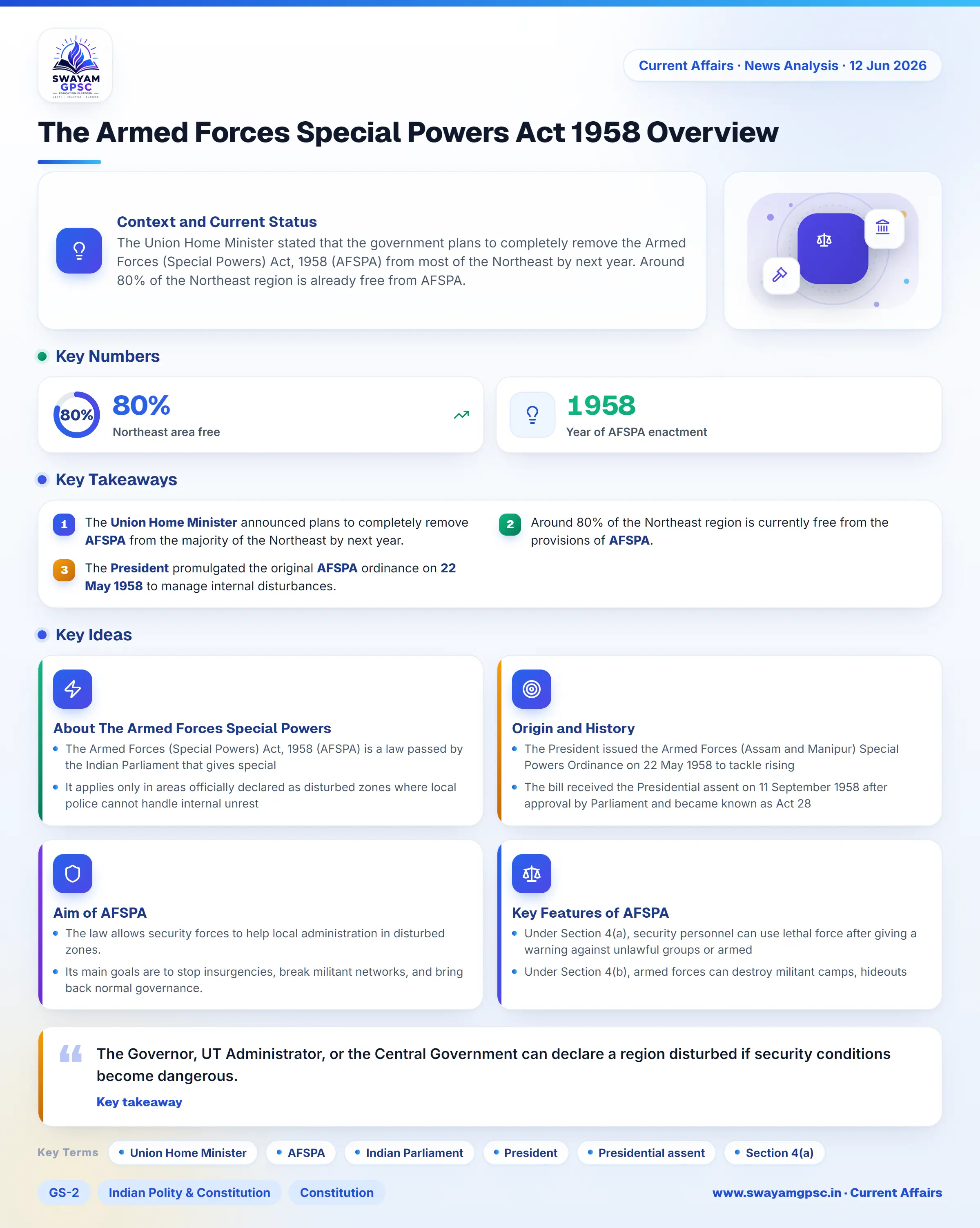
The Armed Forces Special Powers Act 1958 Overview
#GS-2 #Indian Polity & Constitution #Constitution #Internal Security #Northeast #AFSPA #Governance & Social Justice
Key takeaways
- The Union Home Minister announced plans to completely remove AFSPA from the majority of the Northeast by next year.
- Around 80% of the Northeast region is currently free from the provisions of AFSPA.
- The President promulgated the original AFSPA ordinance on 22 May 1958 to manage internal disturbances.
Context and Current Status
- The Union Home Minister stated that the government plans to completely remove the Armed Forces (Special Powers) Act, 1958 (AFSPA) from most of the Northeast by next year.
- Around 80% of the Northeast region is already free from AFSPA.
- The law remains active only in specific areas of Assam, Manipur, Nagaland, and Arunachal Pradesh following security reviews.
About The Armed Forces Special Powers Act 1958
- The Armed Forces (Special Powers) Act, 1958 (AFSPA) is a law passed by the Indian Parliament that gives special operational powers to central security forces.
- It applies only in areas officially declared as disturbed zones where local police cannot handle internal unrest or insurgencies.
Origin and History
- The President issued the Armed Forces (Assam and Manipur) Special Powers Ordinance on 22 May 1958 to tackle rising internal disturbances.
- The bill received the Presidential assent on 11 September 1958 after approval by Parliament and became known as Act 28 of 1958.
Aim of AFSPA
- The law allows security forces to help local administration in disturbed zones.
- Its main goals are to stop insurgencies, break militant networks, and bring back normal governance.
Key Features of AFSPA
- Under Section 4(a), security personnel can use lethal force after giving a warning against unlawful groups or armed individuals.
- Under Section 4(b), armed forces can destroy militant camps, hideouts, and training sites to reduce insurgent capabilities.
- Under Section 4(c), forces can arrest anyone without a warrant if they suspect the person has committed a serious crime.
- Under Section 4(d), personnel can enter and search buildings without a court warrant to find weapons or suspects.
- Under Section 5, arrested individuals must be handed over to the nearest police station quickly along with a report.
- Under Section 6, no legal case can be started against security personnel without prior approval from the Central Government.
Declaration of a Disturbed Area
- The Governor, UT Administrator, or the Central Government can declare a region disturbed if security conditions become dangerous.