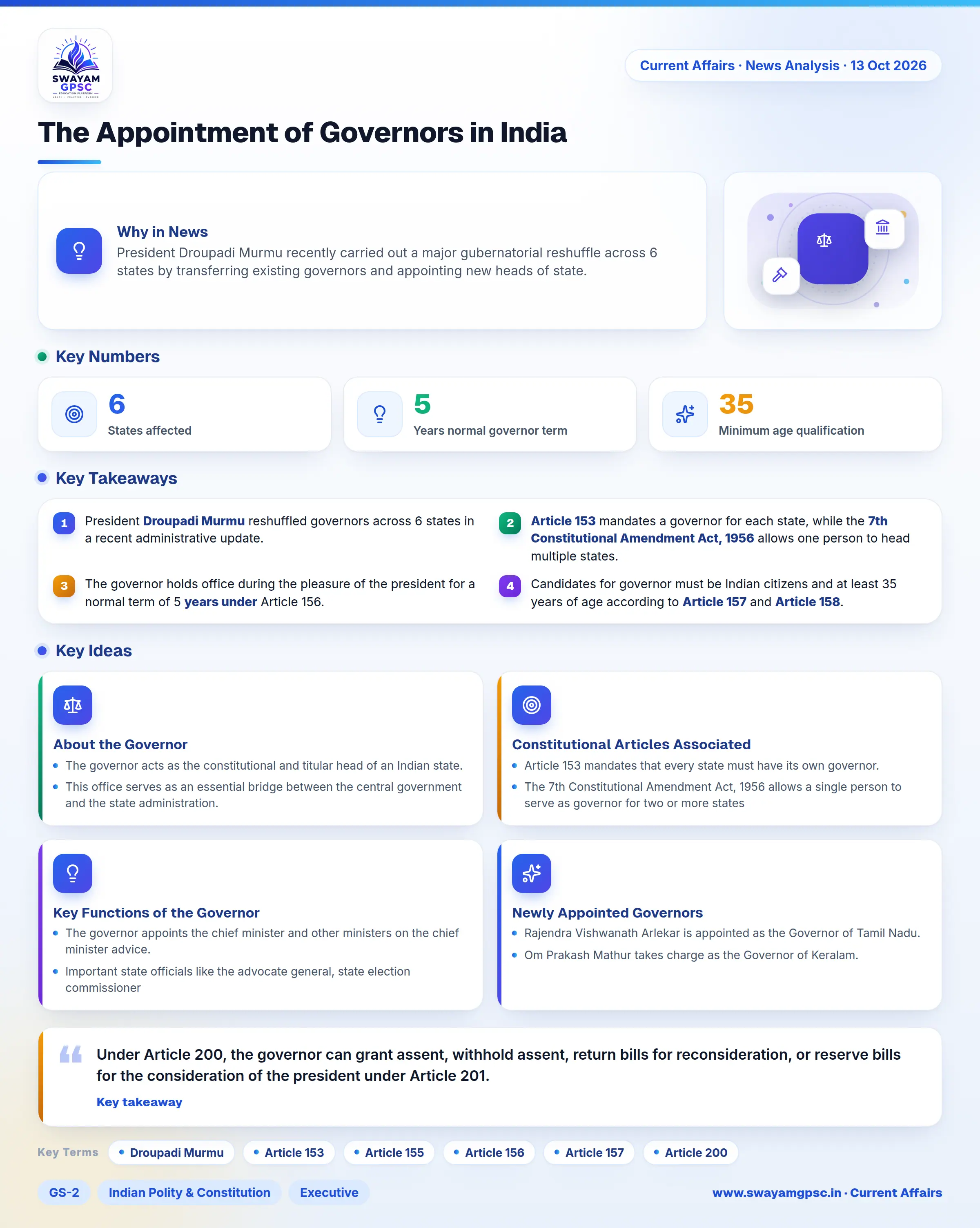
The Appointment of Governors in India
#GS-2 #Indian Polity & Constitution #Executive #Constitutional Bodies #National #Current Events #Polity
Key takeaways
- President Droupadi Murmu reshuffled governors across 6 states in a recent administrative update.
- Article 153 mandates a governor for each state, while the 7th Constitutional Amendment Act, 1956 allows one person to head multiple states.
- The governor holds office during the pleasure of the president for a normal term of 5 years under Article 156.
- Candidates for governor must be Indian citizens and at least 35 years of age according to Article 157 and Article 158.
Why in News
- President Droupadi Murmu recently carried out a major gubernatorial reshuffle across 6 states by transferring existing governors and appointing new heads of state.
About the Governor
- The governor acts as the constitutional and titular head of an Indian state.
- This office serves as an essential bridge between the central government and the state administration.
- The governor exercises executive authority based on the aid and advice of the state council of ministers.
Constitutional Articles Associated
- Article 153 mandates that every state must have its own governor.
- The 7th Constitutional Amendment Act, 1956 allows a single person to serve as governor for two or more states at the same time.
- Article 155 states that the president appoints the governor by a warrant under their hand and seal.
- Article 156 establishes that the governor holds office during the pleasure of the president, usually for a standard term of 5 years.
- Article 157 and Article 158 specify the basic qualifications, requiring the candidate to be an Indian citizen and at least 35 years of age.
Key Functions of the Governor
- The governor appoints the chief minister and other ministers on the chief minister advice.
- Important state officials like the advocate general, state election commissioner, and members of the state public service commission are also appointed by the governor.
- The governor summons, prorogues, and holds the constitutional power to dissolve the state legislative assembly.
- Under Article 200, the governor can grant assent, withhold assent, return bills for reconsideration, or reserve bills for the consideration of the president under Article 201.
- Article 213 empowers the governor to issue ordinances when the state legislature is not in session, which carry the same force as regular laws.
- The governor can recommend the imposition of President Rule under Article 356 if the constitutional machinery in the state breaks down.
- The governor exercises special discretionary powers during hung assemblies to choose a leader who can form the government.
Newly Appointed Governors
- Rajendra Vishwanath Arlekar is appointed as the Governor of Tamil Nadu.
- Om Prakash Mathur takes charge as the Governor of Keralam.
- Dushyant Gautam is assigned as the Governor of Sikkim.
- Braj Mohan Ram assumes office as the Governor of Odisha.
- Sudha Yadav is appointed as the Governor of Karnataka.
- Dhal Singh Bisen takes over as the Governor of Uttarakhand.