Analyzing India's High Space Launch Cost and Global Reliance
#GS-3 #Science & Technology #Space #India Space Launch Cost #ISRO #IN-SPACe #SpaceX
Key takeaways
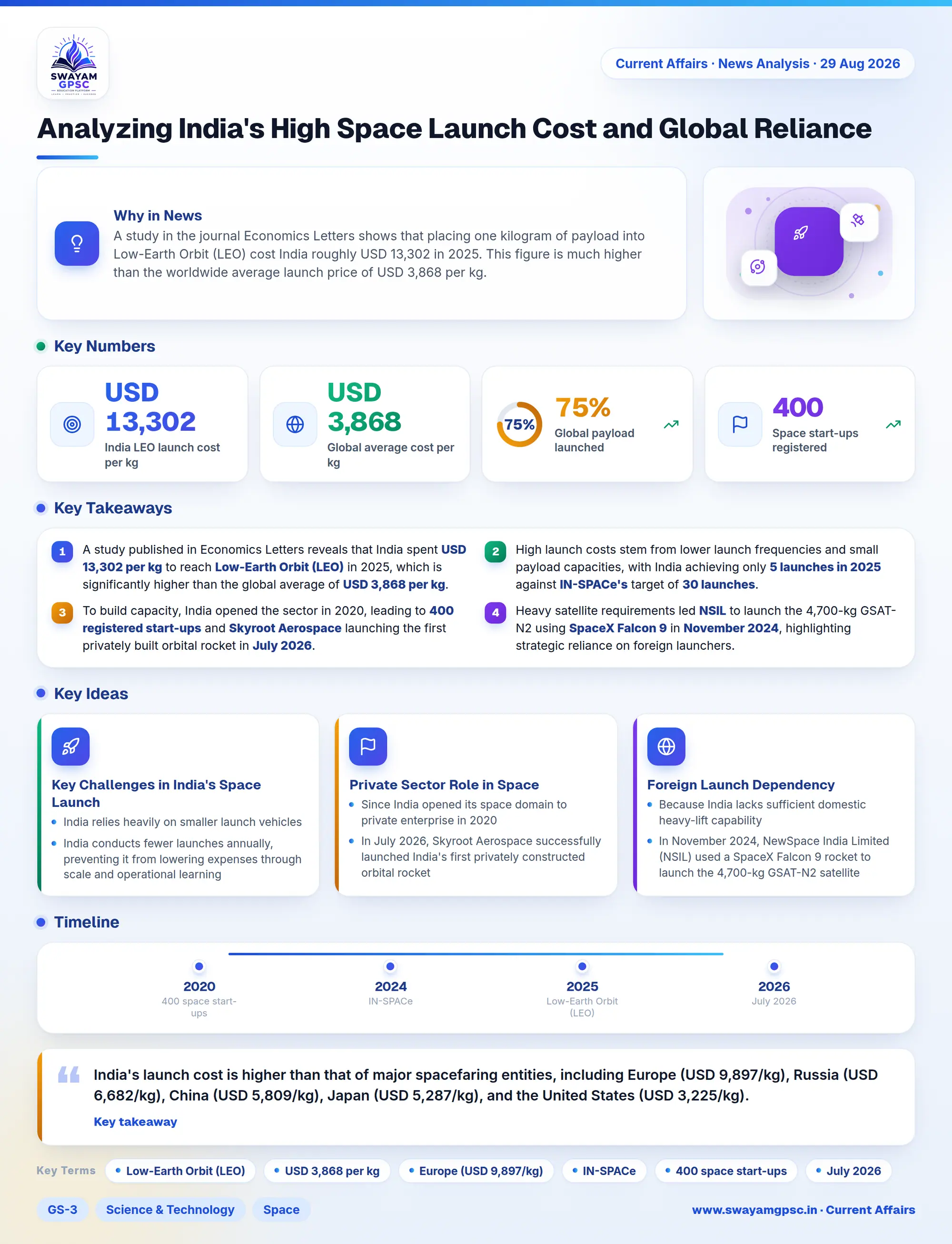
- A study published in Economics Letters reveals that India spent USD 13,302 per kg to reach Low-Earth Orbit (LEO) in 2025, which is significantly higher than the global average of USD 3,868 per kg.
- High launch costs stem from lower launch frequencies and small payload capacities, with India achieving only 5 launches in 2025 against IN-SPACe's target of 30 launches.
- To build capacity, India opened the sector in 2020, leading to 400 registered start-ups and Skyroot Aerospace launching the first privately built orbital rocket in July 2026.
- Heavy satellite requirements led NSIL to launch the 4,700-kg GSAT-N2 using SpaceX Falcon 9 in November 2024, highlighting strategic reliance on foreign launchers.
Why in News
- A study in the journal Economics Letters shows that placing one kilogram of payload into Low-Earth Orbit (LEO) cost India roughly USD 13,302 in 2025.
- This figure is much higher than the worldwide average launch price of USD 3,868 per kg.
Key Challenges in India's Space Launch Sector
- India's launch cost is higher than that of major spacefaring entities, including Europe (USD 9,897/kg), Russia (USD 6,682/kg), China (USD 5,809/kg), Japan (USD 5,287/kg), and the United States (USD 3,225/kg).
- India relies heavily on smaller launch vehicles, which spreads fixed operational expenses over lighter payloads and raises unit costs.
- India conducts fewer launches annually, preventing it from lowering expenses through scale and operational learning like the US and Europe have done since 2010.
- There is a wide gap between planning and execution, as IN-SPACe aimed for 30 launches between January 2024 and March 2025, but India recorded only 5 launches in 2025.
Private Sector Role in Space Operations
- Since India opened its space domain to private enterprise in 2020, around 400 space start-ups have registered with IN-SPACe to boost launch capacity.
- In July 2026, Skyroot Aerospace successfully launched India's first privately constructed orbital rocket, marking a major milestone for commercial spaceflights.
Foreign Launch Dependency and Strategic Risks
- Because India lacks sufficient domestic heavy-lift capability, local satellite operators frequently hire overseas launch providers like SpaceX.
- In November 2024, NewSpace India Limited (NSIL) used a SpaceX Falcon 9 rocket to launch the 4,700-kg GSAT-N2 satellite because it exceeded the weight limit of India's LVM-3 rocket.
- Private space firms such as Pixxel, Digantara, and GalaxEye have also booked launch spots on SpaceX missions to deploy their satellites.
- Depending on foreign rockets exposes India to strategic risks like diplomatic pressure, higher pricing, and geopolitical restrictions.
- Market concentration has increased significantly, with SpaceX launching nearly 75% of global orbital payload in 2025.