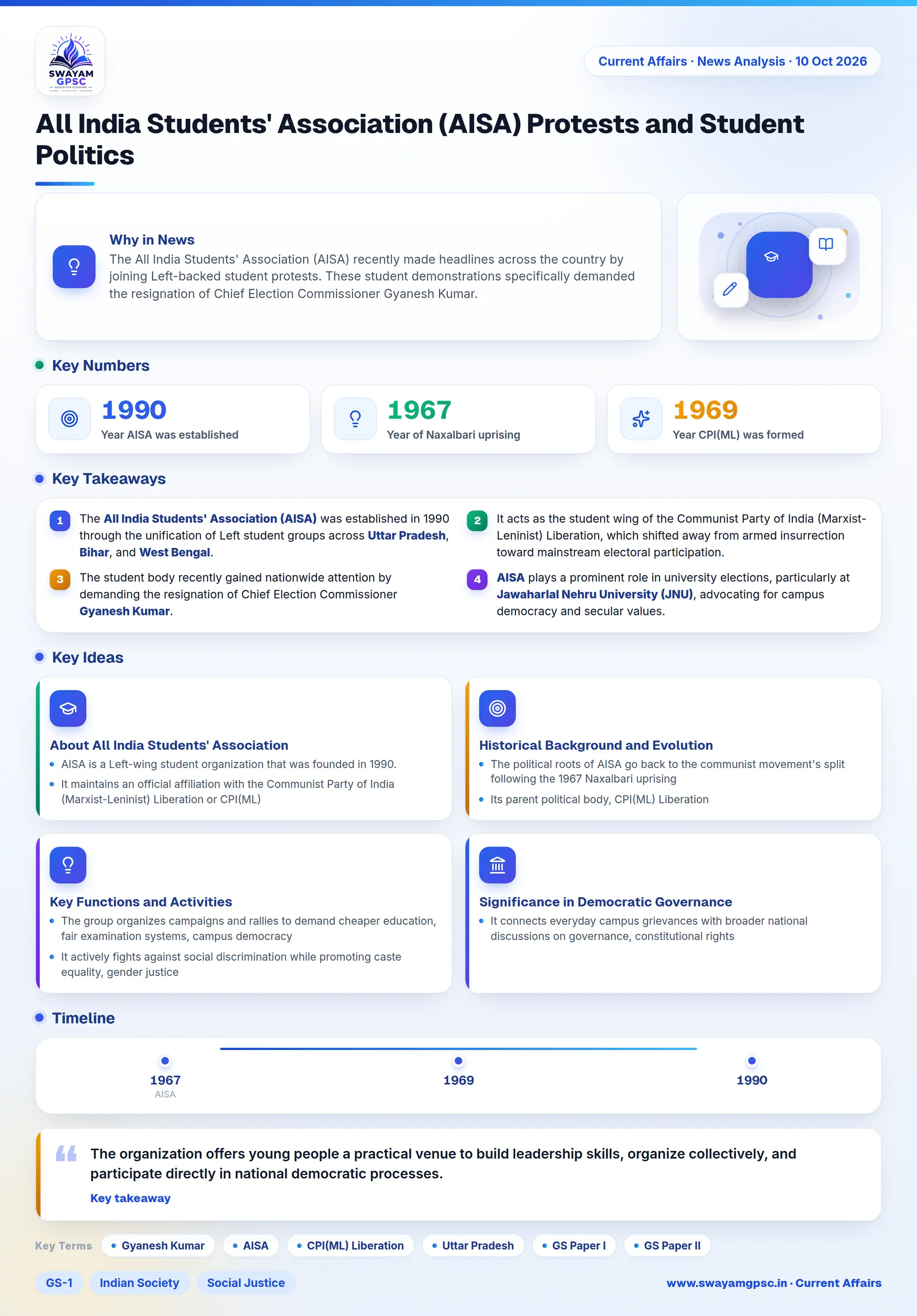
All India Students' Association (AISA) Protests and Student Politics
#GS-1 #Indian Society #Social Justice #GS-2 #Indian Polity & Constitution #Current Events #National #GS-4 #Ethics #Student Movements #Democracy
Key takeaways
- The All India Students' Association (AISA) was established in 1990 through the unification of Left student groups across Uttar Pradesh, Bihar, and West Bengal.
- It acts as the student wing of the Communist Party of India (Marxist-Leninist) Liberation, which shifted away from armed insurrection toward mainstream electoral participation.
- The student body recently gained nationwide attention by demanding the resignation of Chief Election Commissioner Gyanesh Kumar.
- AISA plays a prominent role in university elections, particularly at Jawaharlal Nehru University (JNU), advocating for campus democracy and secular values.
Why in News
- The All India Students' Association (AISA) recently made headlines across the country by joining Left-backed student protests.
- These student demonstrations specifically demanded the resignation of Chief Election Commissioner Gyanesh Kumar.
About All India Students' Association
- AISA is a Left-wing student organization that was founded in 1990.
- It maintains an official affiliation with the Communist Party of India (Marxist-Leninist) Liberation or CPI(ML) Liberation.
- The organization focuses on fighting for student rights, social justice, secular governance, and active democratic participation.
Historical Background and Evolution
- The political roots of AISA go back to the communist movement's split following the 1967 Naxalbari uprising and the founding of the original CPI(ML) in 1969.
- Its parent political body, CPI(ML) Liberation, shifted its core approach from armed struggle toward open electoral politics and mass public campaigns.
- In 1990, regional Left-wing student groups from states like Uttar Pradesh, Bihar, and West Bengal united to officially create AISA.
- During the early 1990s, the group grew rapidly because of intense national debates over reservations, caste equality, and anti-communal politics.
Key Functions and Activities
- The group organizes campaigns and rallies to demand cheaper education, fair examination systems, campus democracy, and institutional accountability.
- It actively fights against social discrimination while promoting caste equality, gender justice, and equal opportunity for marginalized communities in higher education.
- The organization protects constitutional liberties and secular values while standing against religion-based politics and restrictions on public freedoms.
- It fields candidates in university elections, most notably at Jawaharlal Nehru University (JNU), while holding public debates and policy conventions.
Significance in Democratic Governance
- The organization offers young people a practical venue to build leadership skills, organize collectively, and participate directly in national democratic processes.
- It connects everyday campus grievances with broader national discussions on governance, constitutional rights, and social policy.
Relevance to Civil Services Examination
- For GS Paper I, this topic connects to social movements, youth mobilization, post-independence political history, and social justice issues.
- For GS Paper II, it relates to democratic rights, civil society action, constitutional rights of association, and higher education policy.
- For GS Paper IV, it offers insights into democratic ethics, civic duty, political tolerance, and social equity.