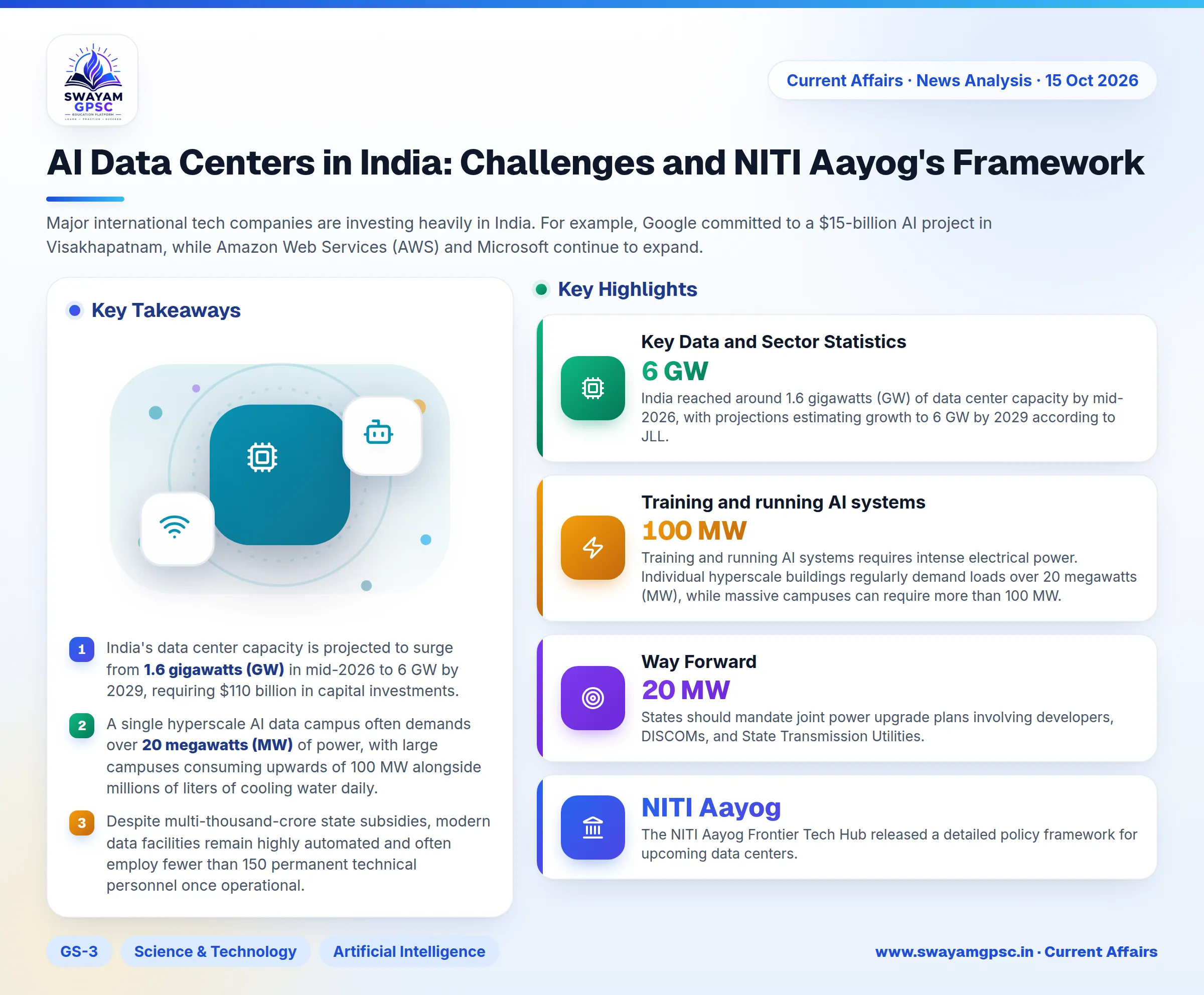
AI Data Centers in India: Challenges and NITI Aayog's Framework
#GS-3 #Science & Technology #Artificial Intelligence #Infrastructure #Economy #Environment #Sustainable Development #Energy
Key takeaways
- India's data center capacity is projected to surge from 1.6 gigawatts (GW) in mid-2026 to 6 GW by 2029, requiring $110 billion in capital investments.
- A single hyperscale AI data campus often demands over 20 megawatts (MW) of power, with large campuses consuming upwards of 100 MW alongside millions of liters of cooling water daily.
- Despite multi-thousand-crore state subsidies, modern data facilities remain highly automated and often employ fewer than 150 permanent technical personnel once operational.
- The NITI Aayog framework recommends mandatory 20- to 30-year hydrological impact assessments and calls on MeitY to audit Power Usage Effectiveness (PUE) and water consumption.
Why in News
- The NITI Aayog Frontier Tech Hub released a detailed policy framework for upcoming data centers.
- The framework advises state governments to require power grid readiness checks, long-term water impact assessments, and clear economic criteria before clearing new projects.
Understanding AI Data Centers
- A data center is a physical facility that houses central computing hardware, large storage systems, networking equipment, and related digital infrastructure to store and process digital data.
- Generative artificial intelligence is transforming traditional server rooms into massive hyperscale AI refineries. These centers operate tens of thousands of power-hungry Graphics Processing Units (GPUs) non-stop, requiring continuous power and advanced cooling systems.
Key Data and Sector Statistics
- India reached around 1.6 gigawatts (GW) of data center capacity by mid-2026, with projections estimating growth to 6 GW by 2029 according to JLL.
- Expanding India's AI and cloud facilities to hit the 6 GW target will need an estimated $110 billion in capital investments across equipment, construction, and power connections.
- Training and running AI systems requires intense electrical power. Individual hyperscale buildings regularly demand loads over 20 megawatts (MW), while massive campuses can require more than 100 MW.
- Major international tech companies are investing heavily in India. For example, Google committed to a $15-billion AI project in Visakhapatnam, while Amazon Web Services (AWS) and Microsoft continue to expand.
India as an Emerging AI Hub
- Rapid smartphone use and widespread 5G adoption drive massive data consumption across India, creating a strong need for local, low-latency processing systems.
- Everyday adoption of UPI, open digital systems, and video streaming requires domestic cloud storage and local edge processing facilities.
- Targeted public policies encourage domestic computing systems to protect national data security, such as the IndiaAI Mission funding over 10,000 public GPUs to build indigenous models on home servers.
- India's coastal geography offers excellent international connectivity through undersea fiber cables, with cities like Mumbai, Chennai, and Visakhapatnam acting as primary landing gateways connecting Europe, the Middle East, and Southeast Asia.
- The ready supply of large land parcels and expanding green energy regions attracts major global cloud operators to set up multi-tier facilities across industrial hubs like Navi Mumbai, Noida, and Hyderabad.
Challenges
- Heavy baseload power demand strains local power grids. This surge can overwhelm distribution transformers, force power distribution companies (DISCOMs) to buy expensive spot-market power, and raise electricity prices for local citizens.
- High-density cooling equipment consumes millions of liters of water each day through evaporative towers. This heavy usage in water-stressed areas competes directly with local drinking water supplies and farm irrigation.
- Data centers require enormous upfront capital investments but create very few permanent direct jobs. Many states grant tax holidays and cheap electricity to large campuses that end up employing fewer than 150 permanent technical staff.
- Continuous operations rely on large banks of diesel generators during grid interruptions. Periodic testing and outages cause local air pollution, while fast upgrade cycles create significant amounts of complex electronic waste.
Way Forward
- States should mandate joint power upgrade plans involving developers, DISCOMs, and State Transmission Utilities. Facilities exceeding 20 MW must link automated demand-response systems with State Load Dispatch Centres (SLDCs).
- Authorities must mandate hydrological evaluations spanning 20 to 30 years covering groundwater, rivers, and tap water supplies. Water-stressed locations should legally require treated wastewater and strict metering.
- State governments should tie fiscal subsidies directly to real economic returns such as local purchasing, research investments, renewable energy adoption, and jobs, rather than initial capital investment promises.
- Governments should establish clear data-center-ready zones supported by surplus renewable power while completely prohibiting construction in ecologically sensitive and water-stressed areas.
- The Ministry of Electronics and Information Technology (MeitY) should run central audits to periodically track water consumption, Power Usage Effectiveness (PUE), carbon footprints, and renewable energy adoption.
Conclusion
- India's growing role as an AI computing hub boosts the digital economy, but this growth must not exhaust electricity grids and freshwater reserves.
- The policy suggestions from NITI Aayog shift attention toward resource efficiency, local grid stability, and actual economic value addition rather than basic investment totals.
- Aligning rapid digital expansion with environmental sustainability will decide if India's data boom builds long-term digital independence or creates ecological stress.