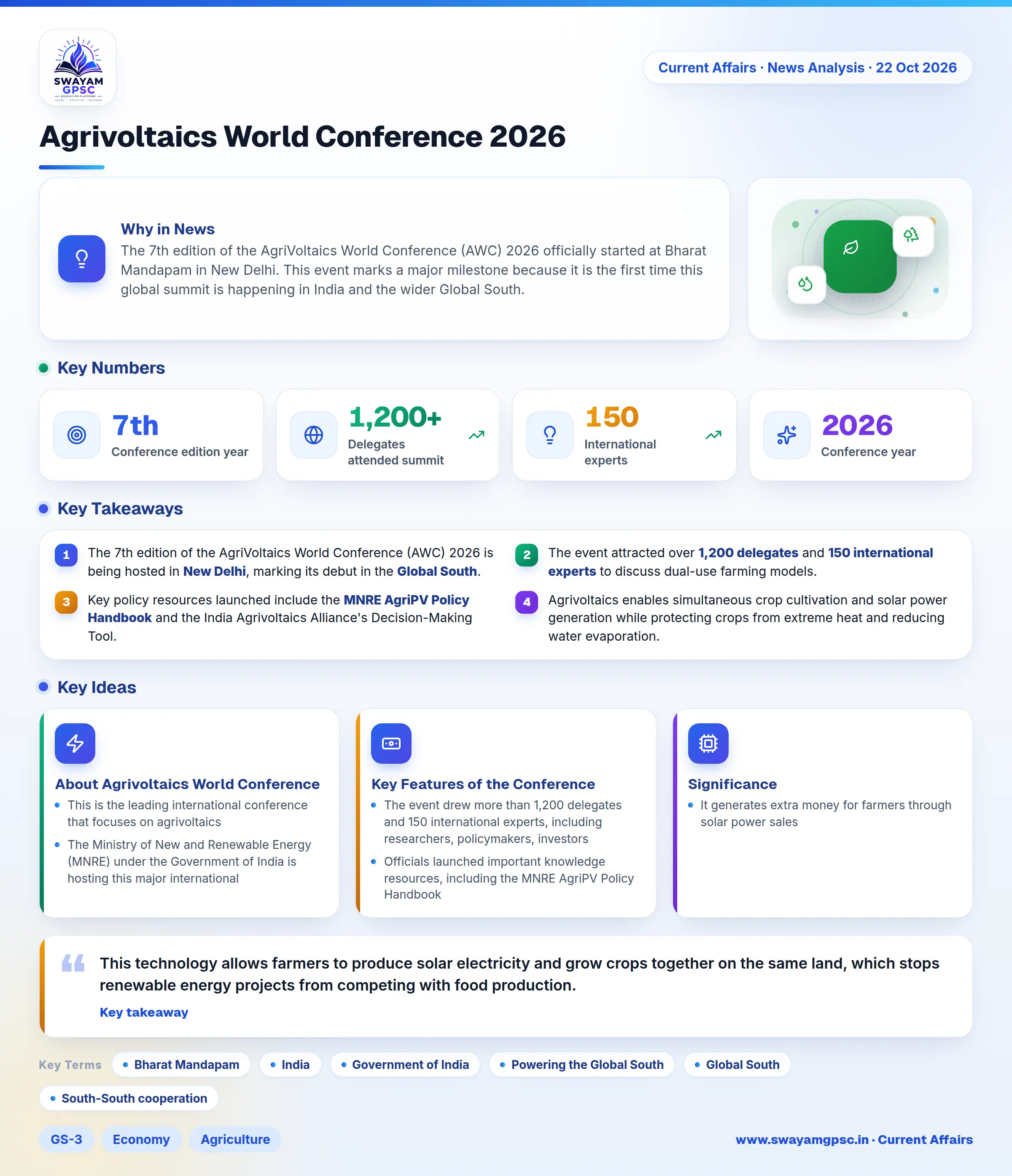
Agrivoltaics World Conference 2026
#GS-3 #Economy #Agriculture #Infrastructure #Science & Technology #Energy #Environment #Sustainable Development #Current Events #National
Key takeaways
- The 7th edition of the AgriVoltaics World Conference (AWC) 2026 is being hosted in New Delhi, marking its debut in the Global South.
- The event attracted over 1,200 delegates and 150 international experts to discuss dual-use farming models.
- Key policy resources launched include the MNRE AgriPV Policy Handbook and the India Agrivoltaics Alliance's Decision-Making Tool.
- Agrivoltaics enables simultaneous crop cultivation and solar power generation while protecting crops from extreme heat and reducing water evaporation.
Why in News
- The 7th edition of the AgriVoltaics World Conference (AWC) 2026 officially started at Bharat Mandapam in New Delhi.
- This event marks a major milestone because it is the first time this global summit is happening in India and the wider Global South.
About Agrivoltaics World Conference 2026
- This is the leading international conference that focuses on agrivoltaics, which means using the exact same piece of land for growing crops and generating solar power at the same time.
- The Ministry of New and Renewable Energy (MNRE) under the Government of India is hosting this major international event.
- The conference runs under the official theme of Powering the Global South.
- This global forum connects scientists, engineers, farming experts, and policy makers to advance the mixing of solar energy with farming.
- This 2026 meeting is the seventh annual gathering and the very first time it takes place in the Global South after previous meetings in Europe, North America, and East Asia.
- The main aim is to build South-South cooperation, support climate-friendly farming, and improve energy security through new dual-use farming models that boost farmers' incomes.
Key Features of the Conference
- The event drew more than 1,200 delegates and 150 international experts, including researchers, policymakers, investors, and industry leaders, for three days of talks.
- Officials launched important knowledge resources, including the MNRE AgriPV Policy Handbook, the India Agrivoltaics Alliance's Decision-Making Tool, and the International Water Management Institute's Book of Abstracts.
- The program included an India Focus Track alongside two international scientific tracks that covered crop growth, microclimates, funding models, and agrivoltaic policies.
- The Agrivoltaics Innovation Hub brought together agritech startups, clean-energy creators, and venture capital investors to build partnerships and fund solar farming projects.
- The exhibition highlighted smart irrigation, AI-based soil monitoring, solar tracking systems, and shade-loving crops to get the best results from both electricity generation and farming.
Significance
- This technology allows farmers to produce solar electricity and grow crops together on the same land, which stops renewable energy projects from competing with food production.
- It generates extra money for farmers through solar power sales, cuts down water evaporation because solar panels provide shade, and protects delicate crops from extreme heat and weather changes.