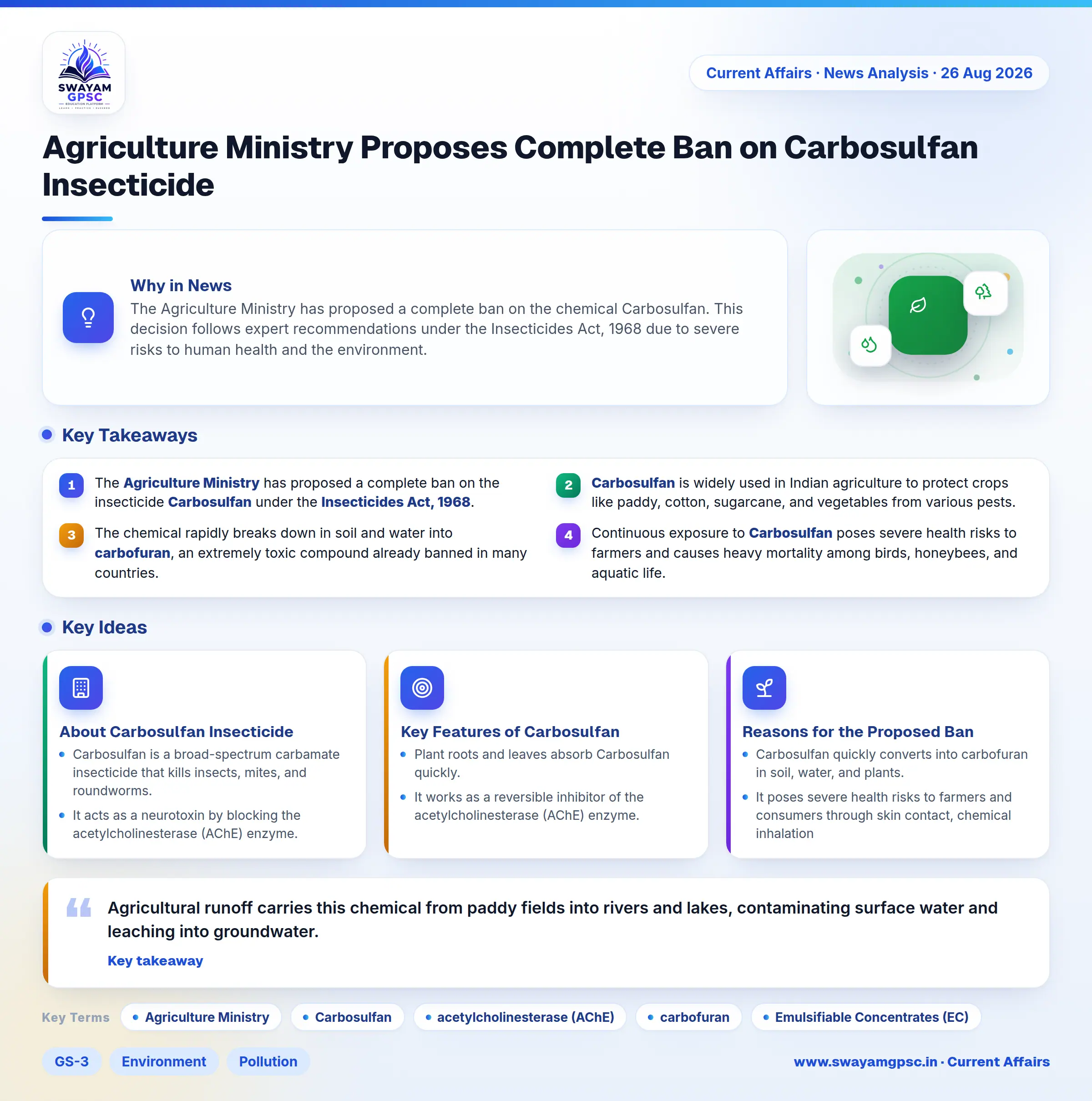
Agriculture Ministry Proposes Complete Ban on Carbosulfan Insecticide
#GS-3 #Environment #Pollution #Economy #Agriculture #GS-2 #Current Events #National #Carbosulfan #Insecticides Act, 1968
Key takeaways
- The Agriculture Ministry has proposed a complete ban on the insecticide Carbosulfan under the Insecticides Act, 1968.
- Carbosulfan is widely used in Indian agriculture to protect crops like paddy, cotton, sugarcane, and vegetables from various pests.
- The chemical rapidly breaks down in soil and water into carbofuran, an extremely toxic compound already banned in many countries.
- Continuous exposure to Carbosulfan poses severe health risks to farmers and causes heavy mortality among birds, honeybees, and aquatic life.
Why in News
- The Agriculture Ministry has proposed a complete ban on the chemical Carbosulfan. This decision follows expert recommendations under the Insecticides Act, 1968 due to severe risks to human health and the environment.
About Carbosulfan Insecticide
- Carbosulfan is a broad-spectrum carbamate insecticide that kills insects, mites, and roundworms.
- It acts as a neurotoxin by blocking the acetylcholinesterase (AChE) enzyme. This causes chemical buildup in pests, leading to nervous system collapse and fast paralysis.
- Farmers use it in paddy cultivation to control destructive pests like stem borers, gall midges, and green leafhoppers.
- In cotton farming, it protects plants from sucking pests like aphids, jassids, thrips, and whiteflies.
- For fruits, vegetables, sugarcane, and groundnuts, it protects the crops against both soil insects and leaf-eating pests.
Key Features of Carbosulfan
- Plant roots and leaves absorb Carbosulfan quickly. It spreads through the entire plant body to kill chewing and sucking insects.
- It works as a reversible inhibitor of the acetylcholinesterase (AChE) enzyme. This leads to continuous nervous system excitation in targeted pests.
- Chemically, it is a pro-pesticide derived from carbofuran. Once applied, it breaks down directly into carbofuran inside plants and soil.
- Manufacturers sell it mainly as Emulsifiable Concentrates (EC) and Granules (G) for direct soil application or leaf spraying.
Reasons for the Proposed Ban
- Carbosulfan quickly converts into carbofuran in soil, water, and plants. Carbofuran is an extremely hazardous chemical already banned in many nations.
- It poses severe health risks to farmers and consumers through skin contact, chemical inhalation, and toxic residues in harvested food crops.
- The chemical causes secondary poisoning and fast death in non-target species, especially birds, honeybees, and helpful soil organisms.
- Agricultural runoff carries this chemical from paddy fields into rivers and lakes, contaminating surface water and leaching into groundwater.