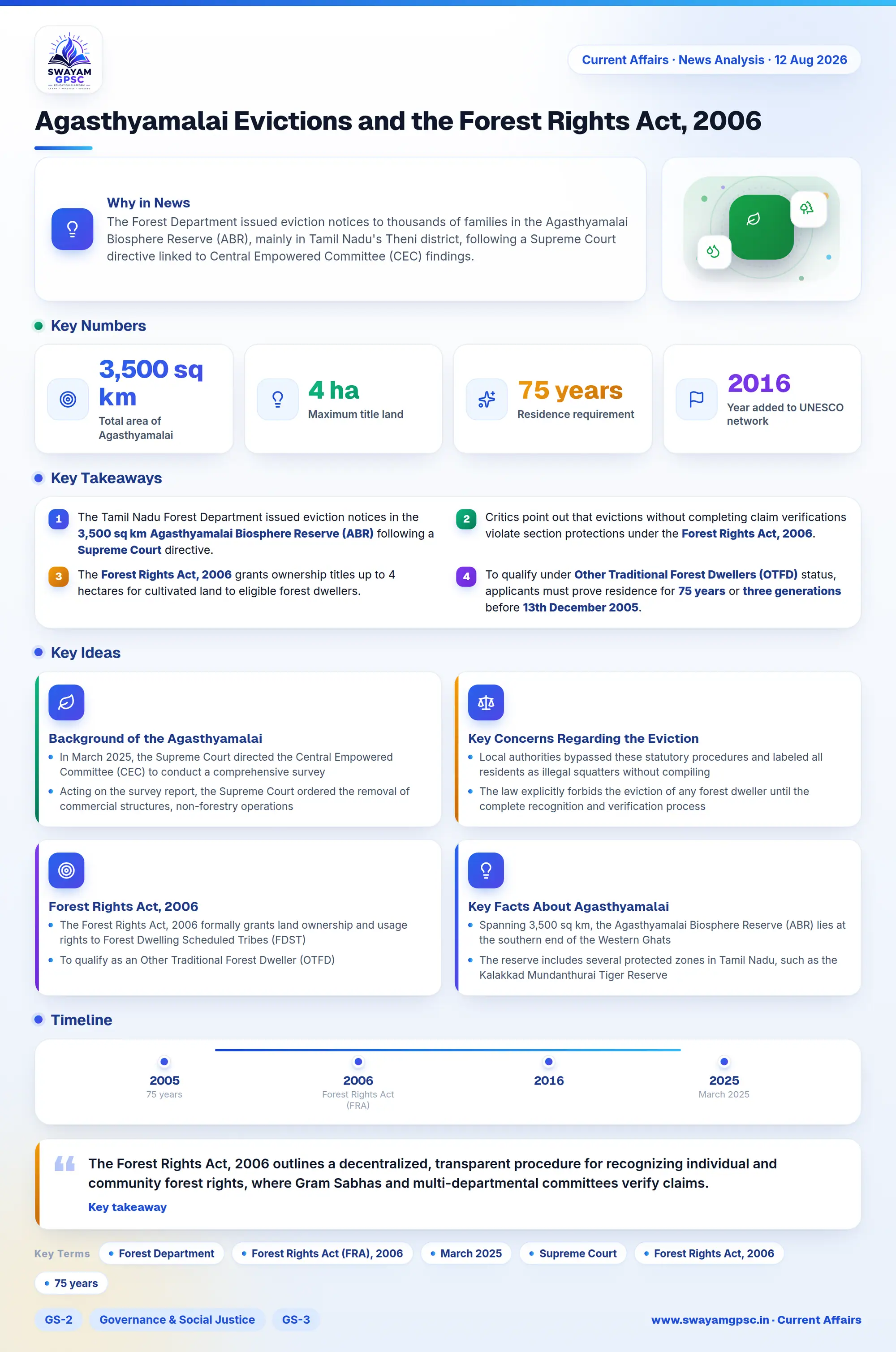
Agasthyamalai Evictions and the Forest Rights Act, 2006
#GS-2 #Governance & Social Justice #GS-3 #Environment #Conservation #Biodiversity #Forest Rights Act 2006 #Agasthyamalai Biosphere Reserve #Tribal Rights
Key takeaways
- The Tamil Nadu Forest Department issued eviction notices in the 3,500 sq km Agasthyamalai Biosphere Reserve (ABR) following a Supreme Court directive.
- Critics point out that evictions without completing claim verifications violate section protections under the Forest Rights Act, 2006.
- The Forest Rights Act, 2006 grants ownership titles up to 4 hectares for cultivated land to eligible forest dwellers.
- To qualify under Other Traditional Forest Dwellers (OTFD) status, applicants must prove residence for 75 years or three generations before 13th December 2005.
- The reserve was designated a UNESCO site in 2016 and houses indigenous communities such as the Kani tribe.
Why in News
- The Forest Department issued eviction notices to thousands of families in the Agasthyamalai Biosphere Reserve (ABR), mainly in Tamil Nadu's Theni district, following a Supreme Court directive linked to Central Empowered Committee (CEC) findings.
- This eviction action triggered controversy because critics argue it fails to protect forest rights granted under the Forest Rights Act (FRA), 2006.
Background of the Agasthyamalai Eviction Orders
- In March 2025, the Supreme Court directed the Central Empowered Committee (CEC) to conduct a comprehensive survey across the Agasthyamalai region to identify non-forestry activities violating the Forest Conservation Act, 1980 and the Wild Life (Protection) Act, 1972.
- Acting on the survey report, the Supreme Court ordered the removal of commercial structures, non-forestry operations, and unauthorized occupants from protected areas like the Kalakkad Mundanthurai Tiger Reserve and Srivilliputhur-Megamalai Tiger Reserve.
- The court instructed the Tamil Nadu state government to create and execute a structured, district-wise plan for removing encroachments, restoring ecosystems, and rehabilitating affected people where applicable.
- A major conflict emerged because legal experts and activists argue that this judicial drive ignores the mandatory statutory processes set out in the Forest Rights Act, 2006 to protect forest dwellers.
Key Concerns Regarding the Eviction Orders
- The Forest Rights Act, 2006 outlines a decentralized, transparent procedure for recognizing individual and community forest rights, where Gram Sabhas and multi-departmental committees verify claims.
- Local authorities bypassed these statutory procedures and labeled all residents as illegal squatters without compiling accurate data on who actually falls outside legal protection.
- The law explicitly forbids the eviction of any forest dweller until the complete recognition and verification process finishes.
- Unlawful eviction of Scheduled Caste or Scheduled Tribe members from their land can trigger criminal charges under the SC/ST (Prevention of Atrocities) Act, 1989.
- Administrative officials often misinterpret rules by demanding that Other Traditional Forest Dwellers (OTFDs) prove 75 years or three generations of continuous residence on the specific plot before 13th December 2005, which the statute does not require.
- Local officials restricted local livelihoods by claiming that commercial crop cultivation is illegal on forest lands.
- The Forest Rights Act, 2006 permits forest dwellers to sell surplus produce and graze animals to meet their legitimate livelihood needs.
- Tribal rights advocates criticized state tribal welfare departments for failing to intervene or defend forest dwellers during the eviction drive.
Forest Rights Act, 2006
- The Forest Rights Act, 2006 formally grants land ownership and usage rights to Forest Dwelling Scheduled Tribes (FDST) and Other Traditional Forest Dwellers (OTFD).
- To qualify as an Other Traditional Forest Dweller (OTFD), a community or individual must have resided primarily in forest land for at least three generations or 75 years prior to 13th December 2005.
- The legislation aims to strengthen environmental conservation while safeguarding the food security and basic livelihoods of forest-dependent communities.
- The local Gram Sabha serves as the primary authority to start evaluating and determining all Individual Forest Rights (IFR) and Community Forest Rights (CFR) claims.
- Under title rights, eligible families can receive land ownership up to a maximum limit of 4 hectares for plots they currently farm, with no grants allowed for new land.
- Use rights allow forest residents to collect non-timber forest produce, harvest Minor Forest Produce, and use traditional grazing areas.
- Relief and development rights ensure that displaced residents receive rehabilitation after illegal evictions, along with access to basic public infrastructure.
- Forest management rights empower local communities to protect, restore, and manage traditional forest areas for long-term sustainability.
Key Facts About Agasthyamalai Biosphere Reserve
- Spanning 3,500 sq km, the Agasthyamalai Biosphere Reserve (ABR) lies at the southern end of the Western Ghats across Tamil Nadu and Kerala.
- The reserve includes several protected zones in Tamil Nadu, such as the Kalakkad Mundanthurai Tiger Reserve, Srivilliputhur-Megamalai Tiger Reserve, Nellai Wildlife Sanctuary, and Kanyakumari Wildlife Sanctuary.
- The Kerala portion of the biosphere reserve contains the Periyar Tiger Reserve and the Shendurney Wildlife Sanctuary.
- Indigenous groups like the Kani tribe live within the reserve and depend directly on forest ecosystems for their cultural identity and daily livelihood.
- UNESCO recognized the region's rich ecological value by adding it to the UNESCO World Network of Biosphere Reserves in 2016.
- The area serves as a global biodiversity hotspot that protects endangered wildlife while preserving ancient tribal settlements.