Advancing Women's Employment and Economic Empowerment in India
#GS-1 #Indian Society #Women #GS-2 #Governance & Social Justice #Good Governance #GS-3 #Economy #Employment #Growth #Current Events #National
Key takeaways
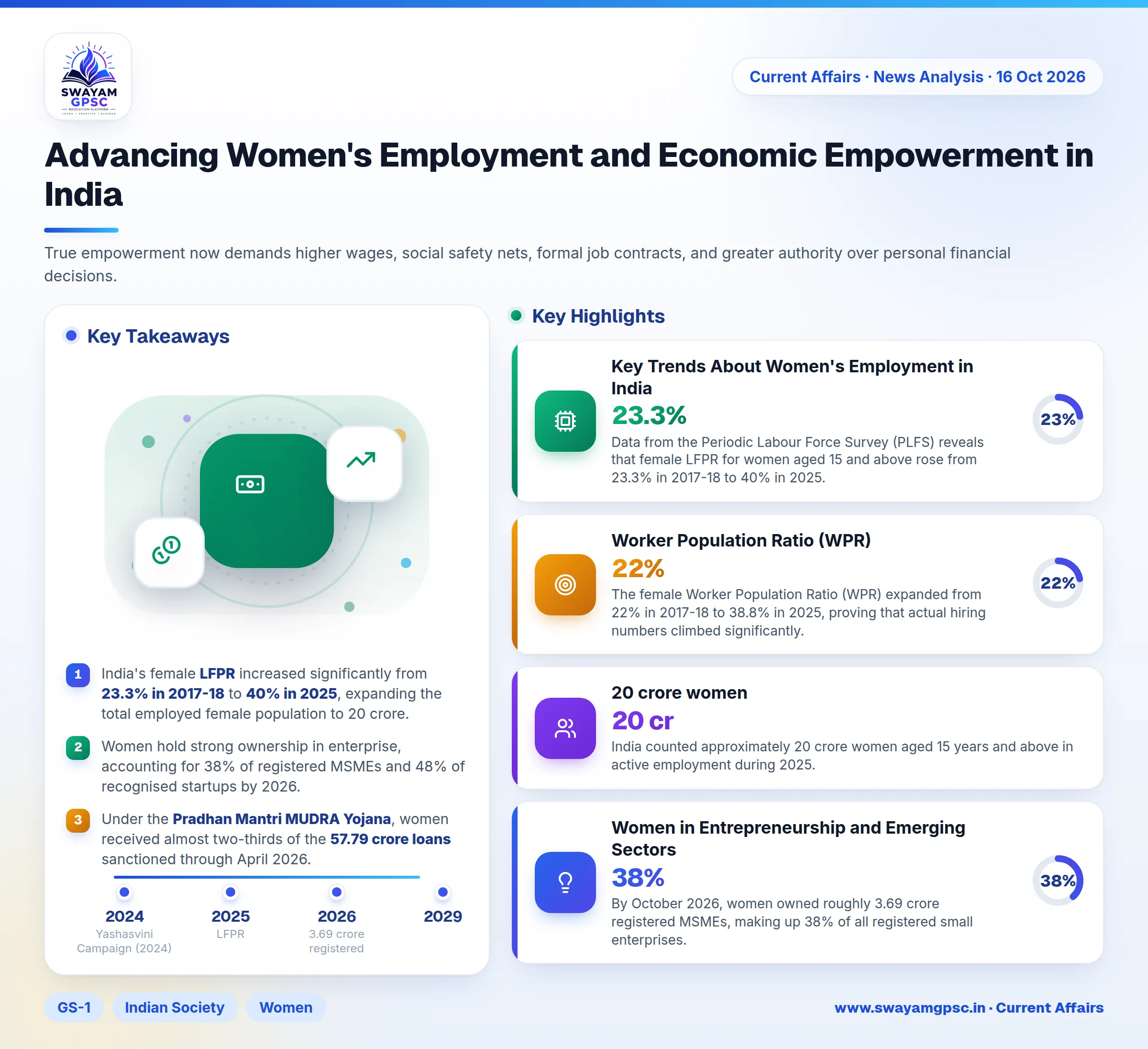
- India's female LFPR increased significantly from 23.3% in 2017-18 to 40% in 2025, expanding the total employed female population to 20 crore.
- Women hold strong ownership in enterprise, accounting for 38% of registered MSMEs and 48% of recognised startups by 2026.
- Under the Pradhan Mantri MUDRA Yojana, women received almost two-thirds of the 57.79 crore loans sanctioned through April 2026.
- Public procurement through GeM saw women-owned MSE orders reach 5.6%, surpassing the mandated target of 3%.
- Four consolidated Labour Codes took effect in November 2025, providing 26 weeks of paid maternity leave and permitting women to work night shifts safely.
Why in News
- More women are joining India's workforce today than ever before. Because of this jump, the policy focus has moved toward improving job security, workplace safety, and genuine economic freedom for women.
Key Trends About Women's Employment in India
- Data from the Periodic Labour Force Survey (PLFS) reveals that female LFPR for women aged 15 and above rose from 23.3% in 2017-18 to 40% in 2025.
- The LFPR tracks the share of the working-age population actively working or searching for jobs.
- The female Worker Population Ratio (WPR) expanded from 22% in 2017-18 to 38.8% in 2025, proving that actual hiring numbers climbed significantly.
- The WPR represents the exact proportion of working citizens within the entire population.
- India counted approximately 20 crore women aged 15 years and above in active employment during 2025.
- True empowerment now demands higher wages, social safety nets, formal job contracts, and greater authority over personal financial decisions.
Women in Entrepreneurship and Emerging Sectors
- More women are launching their own businesses, which builds personal wealth and opens up broader financial pathways.
- By October 2026, women owned roughly 3.69 crore registered MSMEs, making up 38% of all registered small enterprises.
- By March 2026, over 1.07 lakh recognised startups had at least one female founder or partner, representing 48% of the ecosystem.
- Women represented nearly 70% of direct factory workers in mobile phone manufacturing by July 2026, while securing 30% of total electronics manufacturing jobs over the last decade.
- The semiconductor sector employed about 25% women by March 2025, with female engineers filling one-fourth of chip design roles.
- In Indian civil aviation, women made up 15% of pilots by June 2025, alongside 15% of air traffic controllers, 11% of flight dispatchers, and 33% of Flight Operations Inspectors at the DGCA.
- The Research & Development Statistics 2025-26 reported that women in STEM research roles rose from 13% in 2000-01 to 18.6% in 2020-21, and reached 29% in 2023-24.
Supporting Women-Led Enterprises Through Formalisation
- The Swavalambini Scheme (2025) began as a pilot across six higher education institutions in five states, offering guidance, training, and 21 weeks of mentoring for young women founders.
- This pilot exceeded its targets by training 1,276 participants under the Entrepreneurship Awareness Programme and 602 participants under the Entrepreneurship Development Programme.
- The Yashasvini Campaign (2024) aims to close gender gaps on the Udyam Registration Portal and the Udyam Assist Platform by 2029.
- This campaign offers direct handholding to help women entrepreneurs secure their share of the mandatory 3% public procurement target.
- By July 2026, the campaign registered over 22 lakh women-owned MSMEs, pushing government procurement from women-owned enterprises to 3.8% in FY 2025-26.
Financial Support for Women-Led MSMEs
- Under the Pradhan Mantri MUDRA Yojana (PMMY), 2015, micro-enterprises can borrow up to ₹20 lakh without collateral for non-farm ventures.
- By April 2026, banks sanctioned more than 57.79 crore loans under PMMY, with women receiving nearly two-thirds of them.
- The Credit Guarantee Scheme for Micro and Small Enterprises (CGTMSE) gives women-led units 90% guarantee coverage and a 10% discount on fees.
- By February 2026, the scheme approved around 30.75 lakh guarantees worth ₹2.07 lakh crore for female-led small enterprises.
- The Prime Minister's Employment Generation Programme (PMEGP) provides special margin money subsidies of 25% in urban areas and 35% in rural areas for women.
- By May 2026, women ran nearly 40% of all assisted micro-units and secured 45% of the total disbursed subsidy funds.
Financial Support for Women-Led Startups
- The Fund of Funds for Startups (FFS), 2016 channels public funds through SEBI-registered Alternative Investment Funds (AIFs) to invest directly in innovative startups.
- Supported AIFs channelled around ₹2,995 crore into female-led startups from 2025 to January 2026.
- The Startup India Seed Fund Scheme (SISFS), 2021 distributes proof-of-concept and prototype capital via certified business incubators.
- Incubators under this scheme cleared nearly ₹294 crore for early-stage female entrepreneurs by January 2026.
- The Credit Guarantee Scheme for Startups (CGSS), 2023 encourages lenders to offer collateral-free loans backed by government guarantees.
- Lending institutions issued roughly ₹39 crore in guaranteed venture debt to women-founded startups by January 2026.
Expanding Market Access for Women Entrepreneurs
- The Womaniya Initiative on the Government e-Marketplace (GeM) links women-led small enterprises and self-help groups straight to government buyers.
- This platform helps female artisans sell goods like textiles, jute bags, coir products, and home decor items directly to ministries.
- Over 2.17 lakh women-owned MSEs joined GeM by July 2026, earning more than ₹28,000 crore with a 27.6% annual growth rate in FY 2025-26.
- Orders fulfilled by women-led MSEs captured 5.6% of total GeM procurement value, easily beating the official 3% mandate.
- The Procurement and Marketing Support (PMS) Scheme funds domestic exhibition stalls with a 100% space rent subsidy for women-led units.
- The MSME Trade Enablement and Marketing (TEAM) Initiative (2024-27) helps small firms sell digitally via the Open Network for Digital Commerce (ONDC).
- About 1,700 women-owned MSEs signed up on ONDC through the TEAM initiative by FY 2025-26.
- By bundling enterprise registration, credit access, and marketplace exposure together, these policies help female business owners grow sustainable enterprises.
Skill Development Initiatives for Emerging Sectors
- Under Pradhan Mantri Kaushal Vikas Yojana 4.0 (PMKVY 4.0), training programs focus heavily on future-ready technologies.
- From 2021-22 to 2025-26, PMKVY trained 20,393 women in artificial intelligence, 5,927 in semiconductors, and 76,671 in renewable power.
- The National Apprenticeship Promotion Scheme (NAPS) gives candidates paid practical experience across dynamic industries.
- Through NAPS, 1,534 women learned artificial intelligence and 19,899 women trained in green energy between 2021-22 and 2025-26.
- The Craftsman Training Scheme (CTS) provides technical diplomas across Industrial Training Institutes.
- Between 2021-22 and 2025-26, CTS enrolled 512 women in AI, 31 in semiconductors, and 5,753 in renewable energy.
- The NAVYA Initiative began in 2025 to equip 3,850 adolescent girls with skills for non-traditional and future jobs.
- The AI Careers for Women project established 30 Centres of Excellence and 150 spoke centres to skill 20,000 learners across regional towns.
- The WISE-KIRAN initiative supports female researchers in science through dedicated fellowships and project funding.
- In 2025-26, WISE-KIRAN funded 180 PhD scholars, 606 post-doctoral researchers, 26 senior scientists, and 29,443 schoolgirls.
Labour Reforms Promoting Safer Employment
- In November 2025, the government enforced four Labour Codes by merging 29 older labour acts into one unified framework.
- These laws cover wages, industrial disputes, social security benefits, and occupational workplace conditions.
Key Provisions for Women Workers
- Workplace Grievance Redressal Committees must include proportionate female representation to resolve disputes fairly.
- Eligible female workers receive up to 26 weeks of paid maternity leave, while adoptive and commissioning mothers get 12 weeks.
- Employers must pay a medical bonus of ₹3,500 if they do not provide free prenatal and postnatal medical care.
- Mothers are entitled to two daily nursing breaks until their child reaches 15 months of age.
- Offices with 50 or more employees must set up crèche amenities, granting mothers four daily visits.
- New mothers can work from home after maternity leave if the job duties allow and the employer agrees.
- Women are legally permitted to work across all shifts, including night duties, provided employers guarantee personal safety and transport.
- The Code on Wages, 2019 bans wage and hiring discrimination based on gender, cementing the rule of equal pay for equal work.
- Women must hold at least one-third of the seats on Central and State Advisory Boards dealing with minimum wages and labour policies.
- These new statutory mandates establish a safer, fairer, and more protective work environment for female employees nationwide.
Way Forward
- India must build upon rising workforce participation by safeguarding job quality, wage equality, and career longevity for women.
- Equipping women with modern technical skills, collateral-free capital, and institutional market access will anchor women-led development for Viksit Bharat 2047.