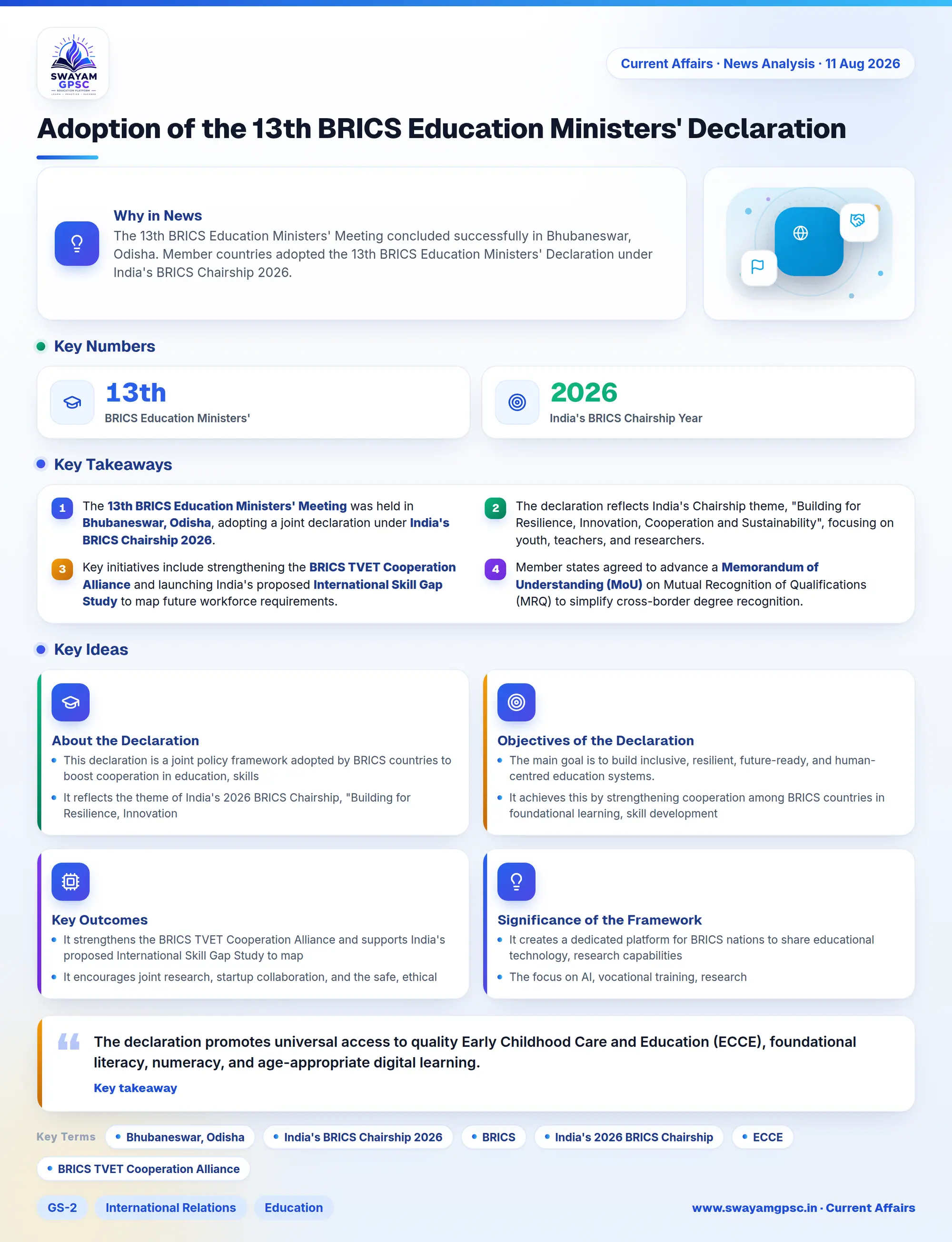
Adoption of the 13th BRICS Education Ministers' Declaration
#GS-2 #International Relations #Education #GS-3 #Employment #Artificial Intelligence #BRICS #Skill Development
Key takeaways
- The 13th BRICS Education Ministers' Meeting was held in Bhubaneswar, Odisha, adopting a joint declaration under India's BRICS Chairship 2026.
- The declaration reflects India's Chairship theme, "Building for Resilience, Innovation, Cooperation and Sustainability", focusing on youth, teachers, and researchers.
- Key initiatives include strengthening the BRICS TVET Cooperation Alliance and launching India's proposed International Skill Gap Study to map future workforce requirements.
- Member states agreed to advance a Memorandum of Understanding (MoU) on Mutual Recognition of Qualifications (MRQ) to simplify cross-border degree recognition.
Why in News
- The 13th BRICS Education Ministers' Meeting concluded successfully in Bhubaneswar, Odisha.
- Member countries adopted the 13th BRICS Education Ministers' Declaration under India's BRICS Chairship 2026.
About the Declaration
- This declaration is a joint policy framework adopted by BRICS countries to boost cooperation in education, skills, research, innovation, and student mobility.
- It reflects the theme of India's 2026 BRICS Chairship, "Building for Resilience, Innovation, Cooperation and Sustainability", keeping students, teachers, and researchers at the center.
Objectives of the Declaration
- The main goal is to build inclusive, resilient, future-ready, and human-centred education systems.
- It achieves this by strengthening cooperation among BRICS countries in foundational learning, skill development, research, and institutional capacity.
Key Outcomes
- The declaration promotes universal access to quality Early Childhood Care and Education (ECCE), foundational literacy, numeracy, and age-appropriate digital learning.
- It strengthens the BRICS TVET Cooperation Alliance and supports India's proposed International Skill Gap Study to map future workforce requirements.
- It encourages joint research, startup collaboration, and the safe, ethical, and human-centred use of Artificial Intelligence (AI) in education.
- It advances discussions on a Memorandum of Understanding (MoU) for Mutual Recognition of Qualifications (MRQ) to improve degree recognition across borders.
- It promotes the BRICS Rectors' Forum, faculty exchanges, STEM scholarships, and exploratory work toward a BRICS University Global Ranking and Evaluation System.
Significance of the Framework
- It creates a dedicated platform for BRICS nations to share educational technology, research capabilities, and best institutional practices.
- The focus on AI, vocational training, research, and skill-gap assessment will boost youth employability for emerging industries.
- It recognizes traditional and indigenous knowledge systems, blending ancient civilisational wisdom with modern scientific research.