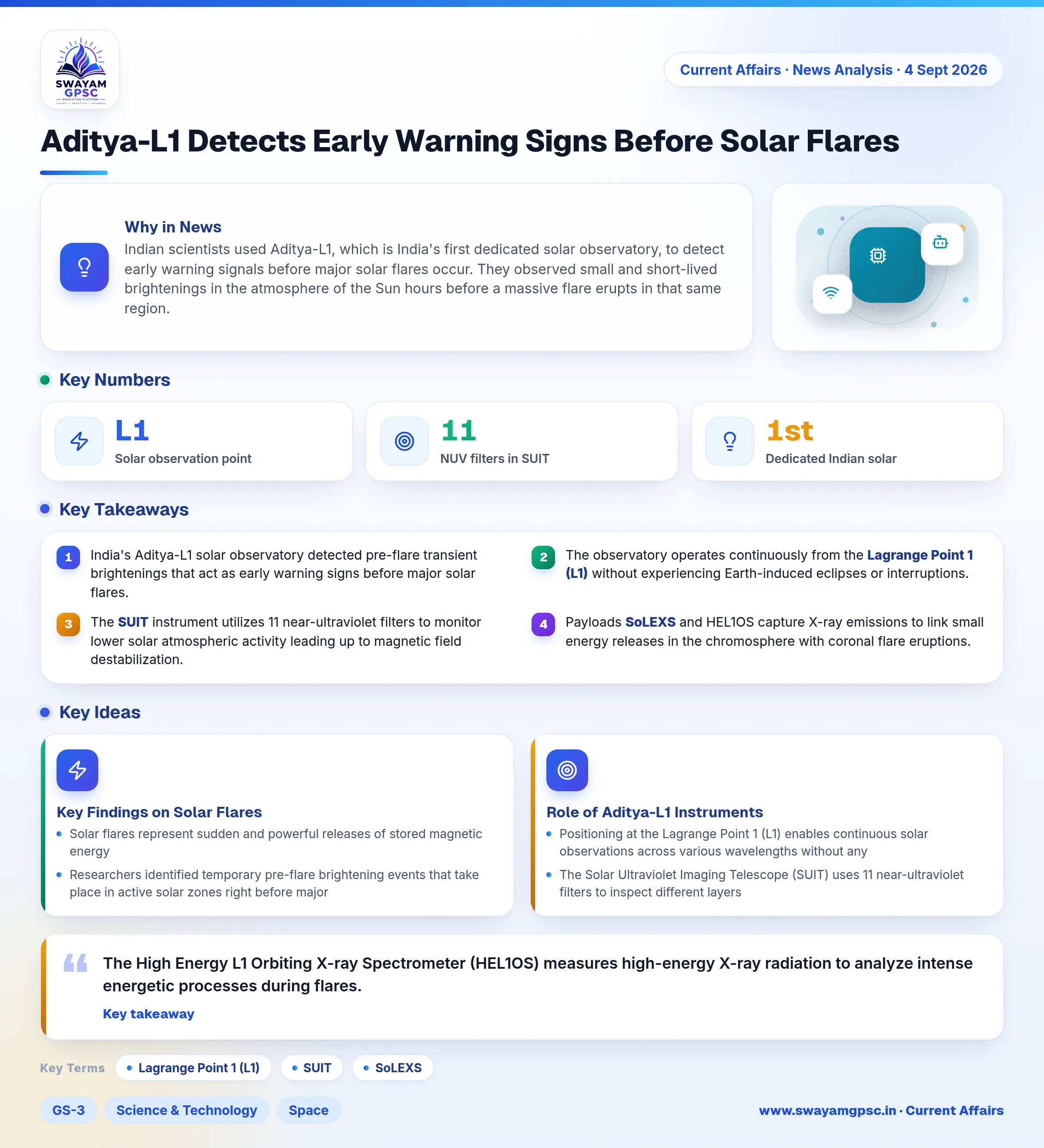
Aditya-L1 Detects Early Warning Signs Before Solar Flares
#GS-3 #Science & Technology #Space #Achievements of Indians in Science & Technology #Space Technology #Quick Facts For Prelims
Key takeaways
- India's Aditya-L1 solar observatory detected pre-flare transient brightenings that act as early warning signs before major solar flares.
- The observatory operates continuously from the Lagrange Point 1 (L1) without experiencing Earth-induced eclipses or interruptions.
- The SUIT instrument utilizes 11 near-ultraviolet filters to monitor lower solar atmospheric activity leading up to magnetic field destabilization.
- Payloads SoLEXS and HEL1OS capture X-ray emissions to link small energy releases in the chromosphere with coronal flare eruptions.
Why in News
- Indian scientists used Aditya-L1, which is India's first dedicated solar observatory, to detect early warning signals before major solar flares occur.
- They observed small and short-lived brightenings in the atmosphere of the Sun hours before a massive flare erupts in that same region.
Key Findings on Solar Flares
- Solar flares represent sudden and powerful releases of stored magnetic energy, which emit strong radiation that can damage satellites and disrupt communication networks.
- Researchers identified temporary pre-flare brightening events that take place in active solar zones right before major flares erupt.
- Many of these early brightenings showed X-ray signals, which confirms that small amounts of magnetic energy are being released beforehand.
- Repeated small energy releases slowly destabilize the local magnetic field, which ultimately triggers a huge solar flare explosion.
Role of Aditya-L1 Instruments
- Positioning at the Lagrange Point 1 (L1) enables continuous solar observations across various wavelengths without any blockage caused by Earth.
- The Solar Ultraviolet Imaging Telescope (SUIT) uses 11 near-ultraviolet filters to inspect different layers of the solar atmosphere like the photosphere and chromosphere.
- Observing ultraviolet rays from space is essential because the atmosphere of Earth absorbs most UV radiation before it reaches ground telescopes.
- The Solar Low Energy X-ray Spectrometer (SoLEXS) monitors low-energy X-rays to assess thermal plasma conditions in the solar corona.
- The High Energy L1 Orbiting X-ray Spectrometer (HEL1OS) measures high-energy X-ray radiation to analyze intense energetic processes during flares.
- Combining data from SUIT, SoLEXS, and HEL1OS helps scientists connect lower atmospheric activity with energy build-up in the solar corona.