9 Years of Goods and Services Tax (GST) in India
#GS-3 #Economy #Taxation #Growth #Mobilization of Resources #National
Why in News
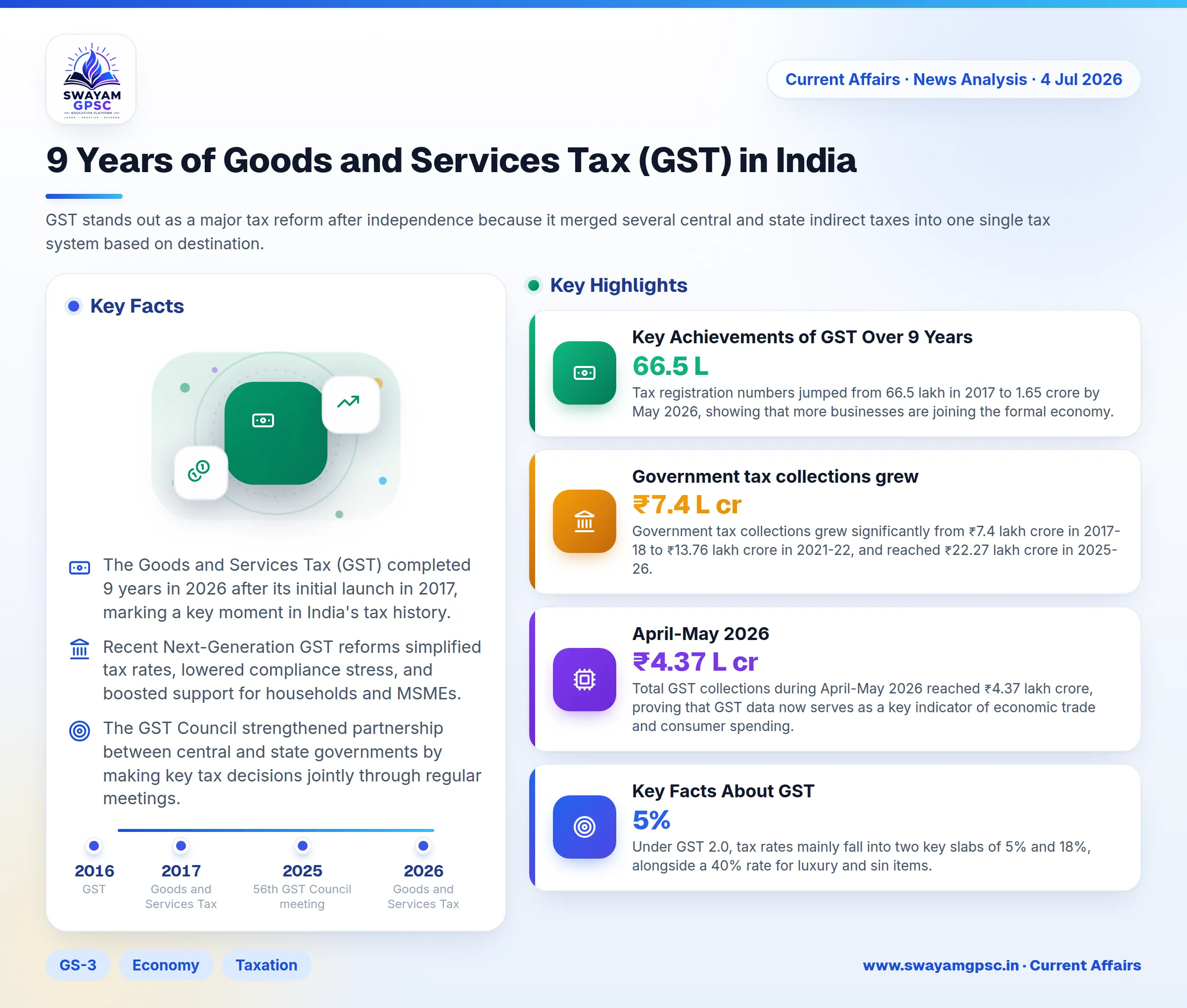
- The Goods and Services Tax (GST) completed 9 years in 2026 after its initial launch in 2017, marking a key moment in India's tax history.
- Recent Next-Generation GST reforms simplified tax rates, lowered compliance stress, and boosted support for households and MSMEs.
Summary
- GST stands out as a major tax reform after independence because it merged several central and state indirect taxes into one single tax system based on destination.
- Over the last 9 years, this system expanded the taxpayer list, raised revenue collection, brought Centre and States together in the GST Council, and modernized tax work using GSTN, automated tools, and AI.
Key Achievements of GST Over 9 Years
- The new framework created a single national market under the One Nation, One Tax goal by combining 17 separate taxes and 13 cesses, which eliminated cascading tax effects.
- Tax registration numbers jumped from 66.5 lakh in 2017 to 1.65 crore by May 2026, showing that more businesses are joining the formal economy.
- Government tax collections grew significantly from ₹7.4 lakh crore in 2017-18 to ₹13.76 lakh crore in 2021-22, and reached ₹22.27 lakh crore in 2025-26.
- Total GST collections during April-May 2026 reached ₹4.37 lakh crore, proving that GST data now serves as a key indicator of economic trade and consumer spending.
- The GST Council strengthened partnership between central and state governments by making key tax decisions jointly through regular meetings.
- The Goods and Services Tax Network (GSTN) built a digital setup that uses e-invoicing and real-time validation to make tax reporting accurate and transparent.
- Small businesses now enjoy simpler procedures like higher tax exemption limits, composition options, quarterly filings, and SMS facilities for filing NIL returns.
Key Facts About GST
- The 101st Constitutional Amendment Act, 2016 created India's unified indirect tax system by merging various central and state taxes.
- GST operates as a value-added tax applied directly to the supply of goods and services across the country.
- The new tax replaced central levies such as Excise Duty and Service Tax, as well as state levies like VAT and Luxury Tax.
- Tax liability under GST arises at the point of supply rather than during manufacturing or final sale alone.
- This system follows a destination-based consumption rule, shifting away from the older origin-based taxation concept.
- Under GST 2.0, tax rates mainly fall into two key slabs of 5% and 18%, alongside a 40% rate for luxury and sin items.
- The dual tax setup allows both the Centre through CGST and States through SGST to apply tax on the same transaction value.
- Imported goods and services count as inter-state supplies, attracting IGST along with regular customs duties.
- Governance relies on recommendations from the GST Council, while the digital infrastructure is run by the Goods and Services Tax Network (GSTN).
- Central and state governments fix specific CGST, SGST, and IGST rates based on inputs from the GST Council.
Key Features of Next-Generation GST Reforms
- The 56th GST Council meeting introduced the Next-Generation GST reforms (or GST 2.0) which took effect on 22nd September 2025.
- The updated structure consolidated most products into two primary slabs of 5% and 18% to make taxation predictable.
- A higher 40% tax rate applies to luxury and sin goods like tobacco, online gaming, aerated drinks, high-end vehicles, yachts, and private jets.
- Tax exemptions and reductions on essential medicines and health insurance reduced household expenses and provided financial relief to families.
- Lower rates on vital raw materials like cement and handicrafts reduced production costs for small manufacturers, artisans, and MSMEs.
- Correcting inverted duty structures helped domestic manufacturing, lowered market distortions, and made Indian exports more competitive.
- Procedural improvements simplified business registration, expedited refund processing, and cut administrative overheads for new startups.
- Advanced technology integration using GSTN, e-invoicing, pre-filled returns, and AI improved evasion detection and reduced human errors.
Challenges
- Essential items like human-consumption alcohol and 5 key petroleum products remain outside GST, causing tax cascading and blocking continuous input tax credit.
- Product classification disagreements persist despite rate consolidations, as interpreting exemptions and product categories creates legal confusion.
- Delays in fully setting up the GST Appellate Tribunal (GSTAT) and its regional benches prolong corporate tax litigation and heighten business uncertainty.
- Frequent rule modifications, complex reconciliation checks, and periodic tax filing continue to strain small MSME operations.
- Remaining inverted duty instances force manufacturers to pay higher tax on raw materials than finished goods, locking up cash reserves while awaiting refunds.
- Friction between the central government and states over tax distribution, compensation claims, and exemptions occasionally stalls broader policy consensus.
Way Forward
- Authorities can phase petroleum items into GST starting with natural gas and Aviation Turbine Fuel (ATF) while guaranteeing state revenue safeguards.
- Policy planners must resolve remaining classification conflicts and systematically review exemptions to build a cleaner tax framework.
- Accelerating tax refund timelines for exporters will restore liquidity and eliminate working capital strains caused by input-output tax mismatches.
- Speeding up judicial appointments will render all GST Appellate Tribunal benches operational, minimizing prolonged courtroom disputes.
- Government agencies should establish explicit tax guidelines for digital assets, carbon credits, and crypto transactions to mirror modern international standards.
Conclusion
- Over the last 9 years, GST reshaped India's fiscal landscape by building a unified market, enhancing tax transparency, and fostering cooperative federalism.
- Continued technological adoption, swift dispute resolution, and rationalized tax bases will empower GST to drive sustainable economic growth toward Viksit Bharat.