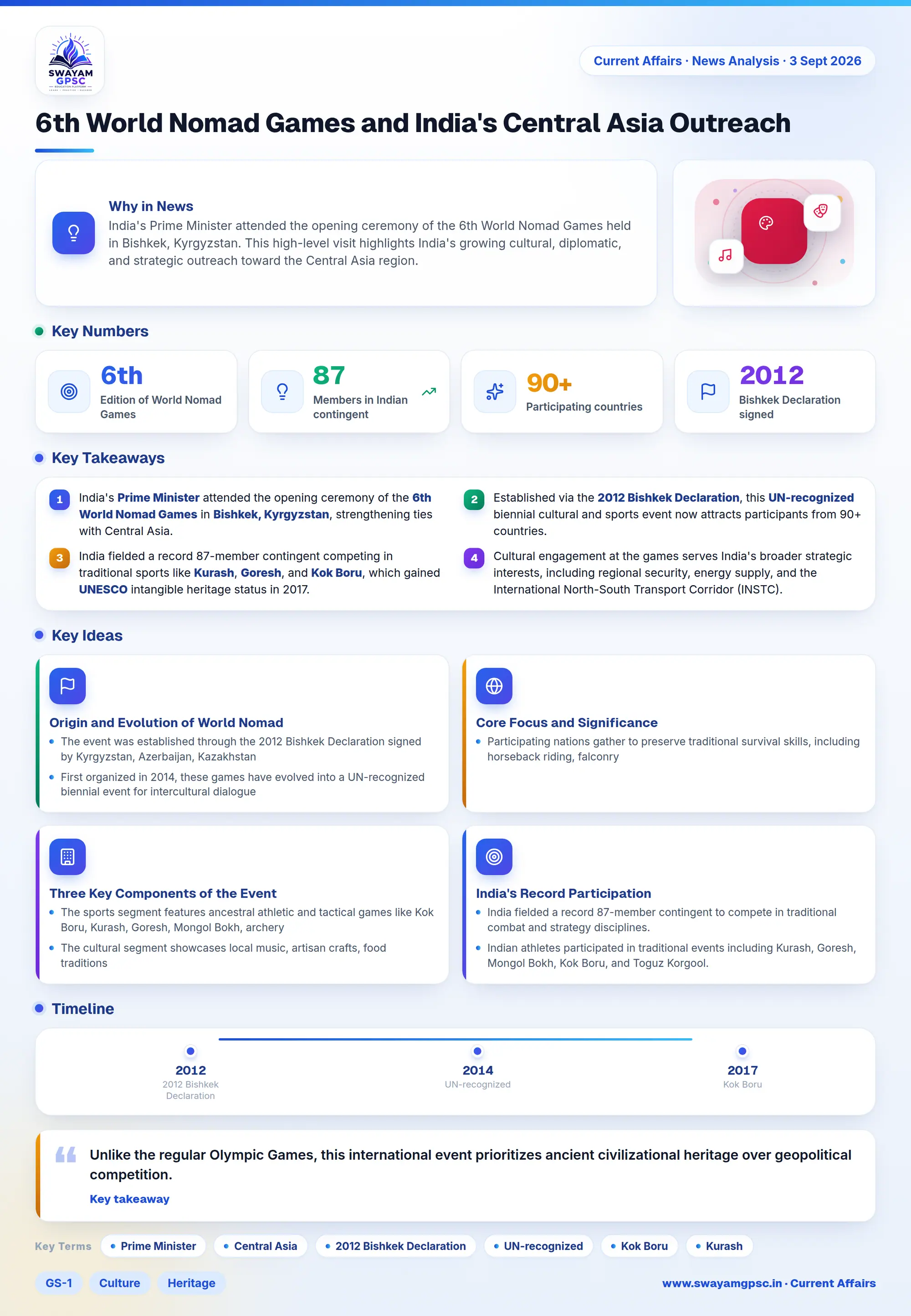
6th World Nomad Games and India's Central Asia Outreach
#GS-1 #Culture #Heritage #GS-2 #Current Events #International #Central Asia #World Nomad Games
Key takeaways
- India's Prime Minister attended the opening ceremony of the 6th World Nomad Games in Bishkek, Kyrgyzstan, strengthening ties with Central Asia.
- Established via the 2012 Bishkek Declaration, this UN-recognized biennial cultural and sports event now attracts participants from 90+ countries.
- India fielded a record 87-member contingent competing in traditional sports like Kurash, Goresh, and Kok Boru, which gained UNESCO intangible heritage status in 2017.
- Cultural engagement at the games serves India's broader strategic interests, including regional security, energy supply, and the International North-South Transport Corridor (INSTC).
Why in News
- India's Prime Minister attended the opening ceremony of the 6th World Nomad Games held in Bishkek, Kyrgyzstan.
- This high-level visit highlights India's growing cultural, diplomatic, and strategic outreach toward the Central Asia region.
Origin and Evolution of World Nomad Games
- The event was established through the 2012 Bishkek Declaration signed by Kyrgyzstan, Azerbaijan, Kazakhstan, and Turkey to safeguard nomadic heritage.
- First organized in 2014, these games have evolved into a UN-recognized biennial event for intercultural dialogue involving 90+ countries across Central Asia, Türkiye, and Kazakhstan.
Core Focus and Significance
- Unlike the regular Olympic Games, this international event prioritizes ancient civilizational heritage over geopolitical competition.
- Participating nations gather to preserve traditional survival skills, including horseback riding, falconry, and native styles of wrestling.
Three Key Components of the Event
- The sports segment features ancestral athletic and tactical games like Kok Boru, Kurash, Goresh, Mongol Bokh, archery, and Toguz Korgool.
- The cultural segment showcases local music, artisan crafts, food traditions, and festivals under a project inscribed on the UNESCO Register of Good Safeguarding Practices.
- The scientific segment focuses on academic research into nomadic history, preservation of traditional knowledge, and cross-cultural dialogue.
India's Record Participation
- India fielded a record 87-member contingent to compete in traditional combat and strategy disciplines.
- Indian athletes participated in traditional events including Kurash, Goresh, Mongol Bokh, Kok Boru, and Toguz Korgool.
- The traditional horseback sport Kok Boru resembles polo and was inscribed as a UNESCO Intangible Cultural Heritage of Humanity in 2017.
Geopolitical Strategic Importance for India
- Participating in these games acts as a soft power diplomacy tool to strengthen bilateral ties with Central Asian countries.
- It supports key security goals, including regional stability after the Taliban takeover of Afghanistan and counterbalancing China in the region.
- This strategic engagement helps secure long-term energy supplies and advances connectivity projects like the International North-South Transport Corridor (INSTC).