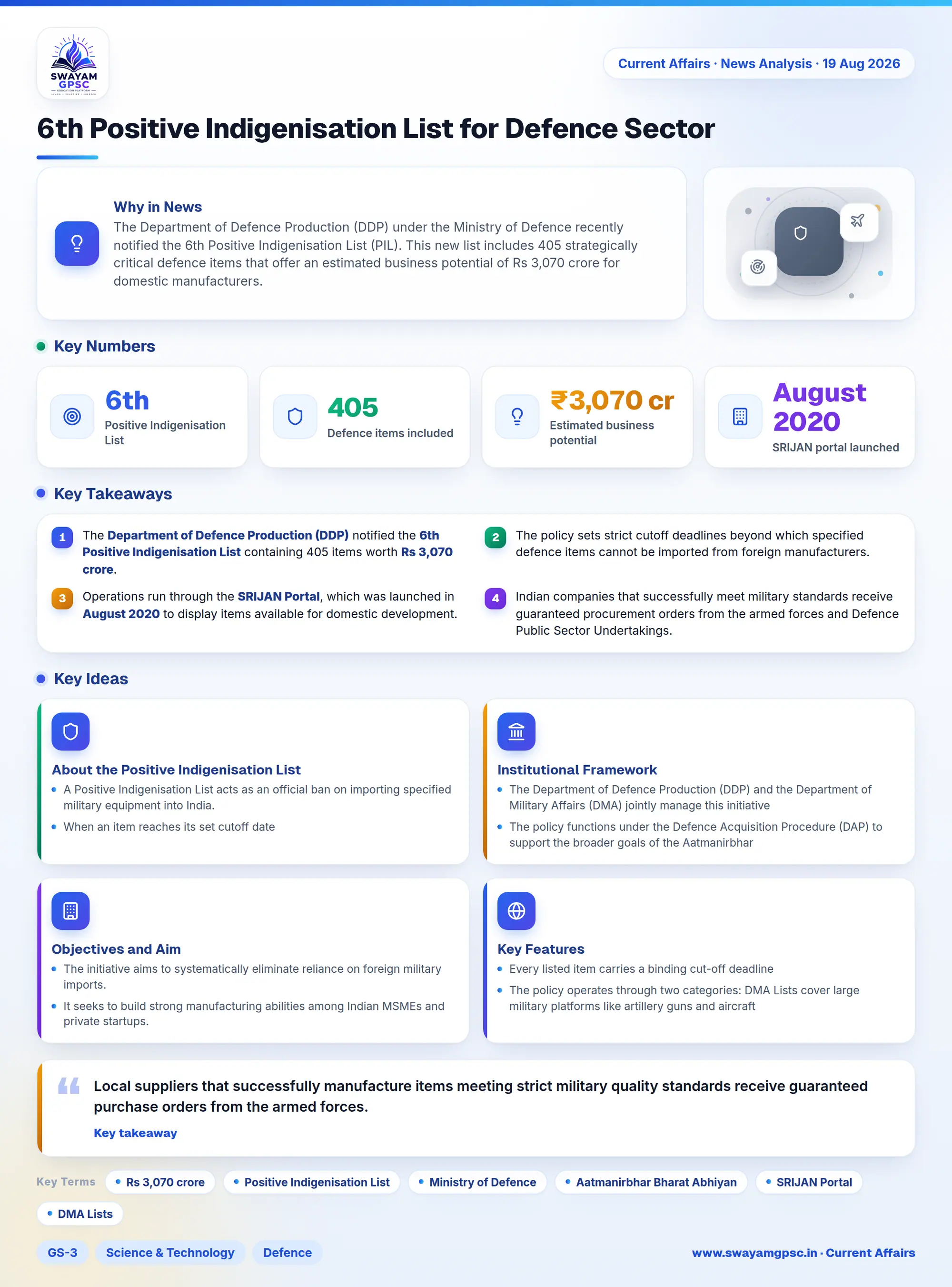
6th Positive Indigenisation List for Defence Sector
#GS-3 #Science & Technology #Defence #Economy #Infrastructure #Aatmanirbhar Bharat #Positive Indigenisation List #National
Key takeaways
- The Department of Defence Production (DDP) notified the 6th Positive Indigenisation List containing 405 items worth Rs 3,070 crore.
- The policy sets strict cutoff deadlines beyond which specified defence items cannot be imported from foreign manufacturers.
- Operations run through the SRIJAN Portal, which was launched in August 2020 to display items available for domestic development.
- Indian companies that successfully meet military standards receive guaranteed procurement orders from the armed forces and Defence Public Sector Undertakings.
Why in News
- The Department of Defence Production (DDP) under the Ministry of Defence recently notified the 6th Positive Indigenisation List (PIL).
- This new list includes 405 strategically critical defence items that offer an estimated business potential of Rs 3,070 crore for domestic manufacturers.
About the Positive Indigenisation List
- A Positive Indigenisation List acts as an official ban on importing specified military equipment into India.
- When an item reaches its set cutoff date, the Indian Armed Forces can no longer import it from foreign suppliers and must buy it locally.
Institutional Framework
- The Department of Defence Production (DDP) and the Department of Military Affairs (DMA) jointly manage this initiative under the Ministry of Defence.
- The policy functions under the Defence Acquisition Procedure (DAP) to support the broader goals of the Aatmanirbhar Bharat Abhiyan.
- The government uses the SRIJAN Portal, which started in August 2020, to display imported items that domestic companies can develop.
Objectives and Aim
- The initiative aims to systematically eliminate reliance on foreign military imports.
- It seeks to build strong manufacturing abilities among Indian MSMEs and private startups.
- The policy encourages local production of critical sub-systems and specialized raw materials.
- It aims to transform India into a global hub for defence manufacturing.
Key Features
- Every listed item carries a binding cut-off deadline, giving private firms sufficient time to build and test prototypes before foreign imports stop.
- The policy operates through two categories: DMA Lists cover large military platforms like artillery guns and aircraft, while DDP Lists focus on spare parts, sensors, and ammunition.
- Indigenisation takes place through mechanisms like Make-I, Make-II, and Make-III programs alongside internal defence public sector projects.
- Defence forces upload technical details and required quantities onto the SRIJAN Portal so that Indian vendors can submit development proposals.
- Local suppliers that successfully manufacture items meeting strict military quality standards receive guaranteed purchase orders from the armed forces.