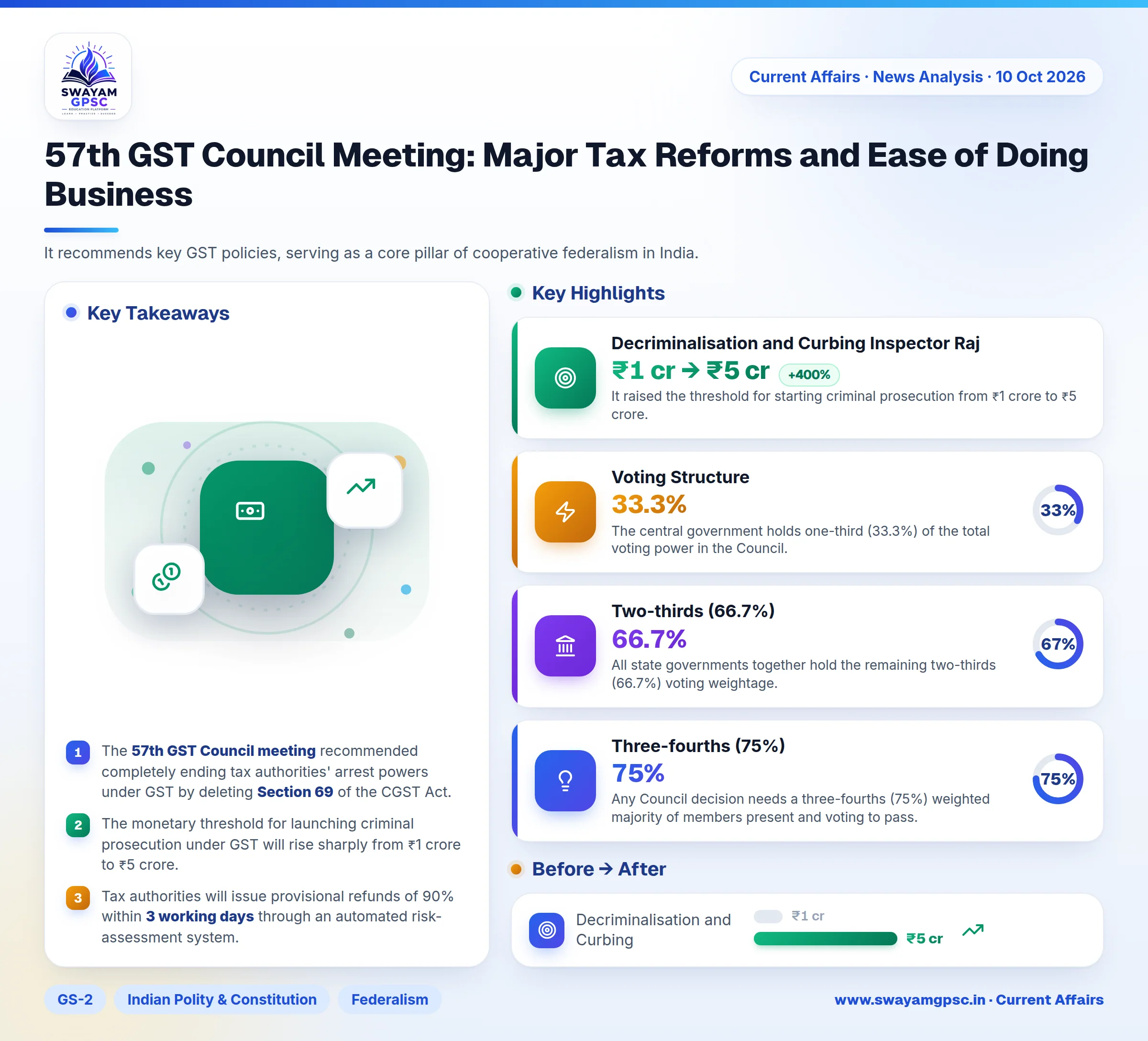
57th GST Council Meeting: Major Tax Reforms and Ease of Doing Business
#GS-2 #Indian Polity & Constitution #Federalism #Constitutional Bodies #GS-3 #Economy #Taxation #Goods and Services Tax #GST Council #Current Events #National #Prelims
Key takeaways
- The 57th GST Council meeting recommended completely ending tax authorities' arrest powers under GST by deleting Section 69 of the CGST Act.
- The monetary threshold for launching criminal prosecution under GST will rise sharply from ₹1 crore to ₹5 crore.
- Tax authorities will issue provisional refunds of 90% within 3 working days through an automated risk-assessment system.
- Under Article 279A, GST Council decisions require a 75% weighted majority, with the Centre holding a 33.3% vote share and states holding 66.7%.
- A minimum tax dispute threshold of ₹10,000 has been established, ending all pending notices and legal appeals below this value.
Why in News
- The Goods and Services Tax (GST) Council held its 57th meeting in New Delhi under the leadership of the Union Finance Minister.
- The Council announced major administrative and procedural reforms that will take effect from April 1, 2027.
About The GST Council
- The Council acts as a joint constitutional body representing both the Centre and the States.
- It recommends key GST policies, serving as a core pillar of cooperative federalism in India.
Constitutional Basis
- The 101st Constitutional Amendment Act, 2016 created the Council by inserting Article 279A into the Constitution.
- This amendment required the President of India to set up the Council within 60 days, leading to its notification on September 12, 2016.
Composition of the Council
- The Union Finance Minister heads the Council as its Chairperson.
- The Union Minister of State for Finance or Revenue serves as the central government member.
- Each state and union territory nominates its Finance Minister, Taxation Minister, or another designated minister as a member.
- The Revenue Secretary serves as the Ex-officio Secretary, while the CBIC Chairperson joins meetings as a permanent non-voting invitee.
Voting Structure
- The central government holds one-third (33.3%) of the total voting power in the Council.
- All state governments together hold the remaining two-thirds (66.7%) voting weightage.
- Any Council decision needs a three-fourths (75%) weighted majority of members present and voting to pass.
Key Functions of the GST Council
- The Council recommends tax rate slabs, cess rates, exempt items, turnover thresholds, and special disaster relief levies.
- It drafts model laws for CGST, SGST, and IGST, while harmonizing administrative rules for business registrations and tax filings.
- It establishes place of supply rules to decide whether a transaction counts as inter-state or intra-state trade.
- It creates dispute resolution mechanisms to settle disagreements between the Centre and states or among different states.
- It recommends special tax exemptions and procedural rules for 11 Special Category States in the North-East and Himalayan regions.
Decriminalisation and Curbing Inspector Raj
- The Council recommended removing arrest powers completely under GST by deleting Section 69 of the CGST Act.
- It raised the threshold for starting criminal prosecution from ₹1 crore to ₹5 crore.
- It cut the maximum general penalty under Section 125 from ₹25,000 down to ₹10,000.
Transit Check Protections
- The Council banned routine transit checks, allowing only officials from the dispatch or destination states to inspect goods.
- Officials now need written approval from an officer ranked Joint Commissioner or above based on actionable intelligence before stopping consignments.
Accelerated and Automated Refunds
- The Council reduced the refund acknowledgment window from 15 days down to 10 days, after which the system treats claims as acknowledged.
- An automated risk engine will release 90% of provisional refunds within 3 working days, while making excess cash ledger refunds completely automatic.
Expanded Input Tax Credit Coverage
- The Council removed restrictions under Section 17(5), allowing input tax credit on employee health and life insurance, telecom towers, pipelines, and destroyed stock.
- It set up an officers' committee that must submit a plan within 3 months to protect honest buyers when suppliers fail to file returns.
Streamlined Registration and Cancellation
- The Council introduced an automated system that approves low-risk business tax registrations within 3 days.
- It simplified registration for small e-commerce sellers by requiring registration only in their home state instead of every sales destination.
Litigation De-Minimis Threshold
- The Council set a minimum limit of ₹10,000 for issuing tax notices, dropping all pending notices and appeals below this amount.
Service Export Clarifications
- The Council granted export benefits to services delivered to foreign clients through offshore branch offices.
- It confirmed that testing, repair, or research services on foreign goods within India qualify as exports, even if the goods remain in India.